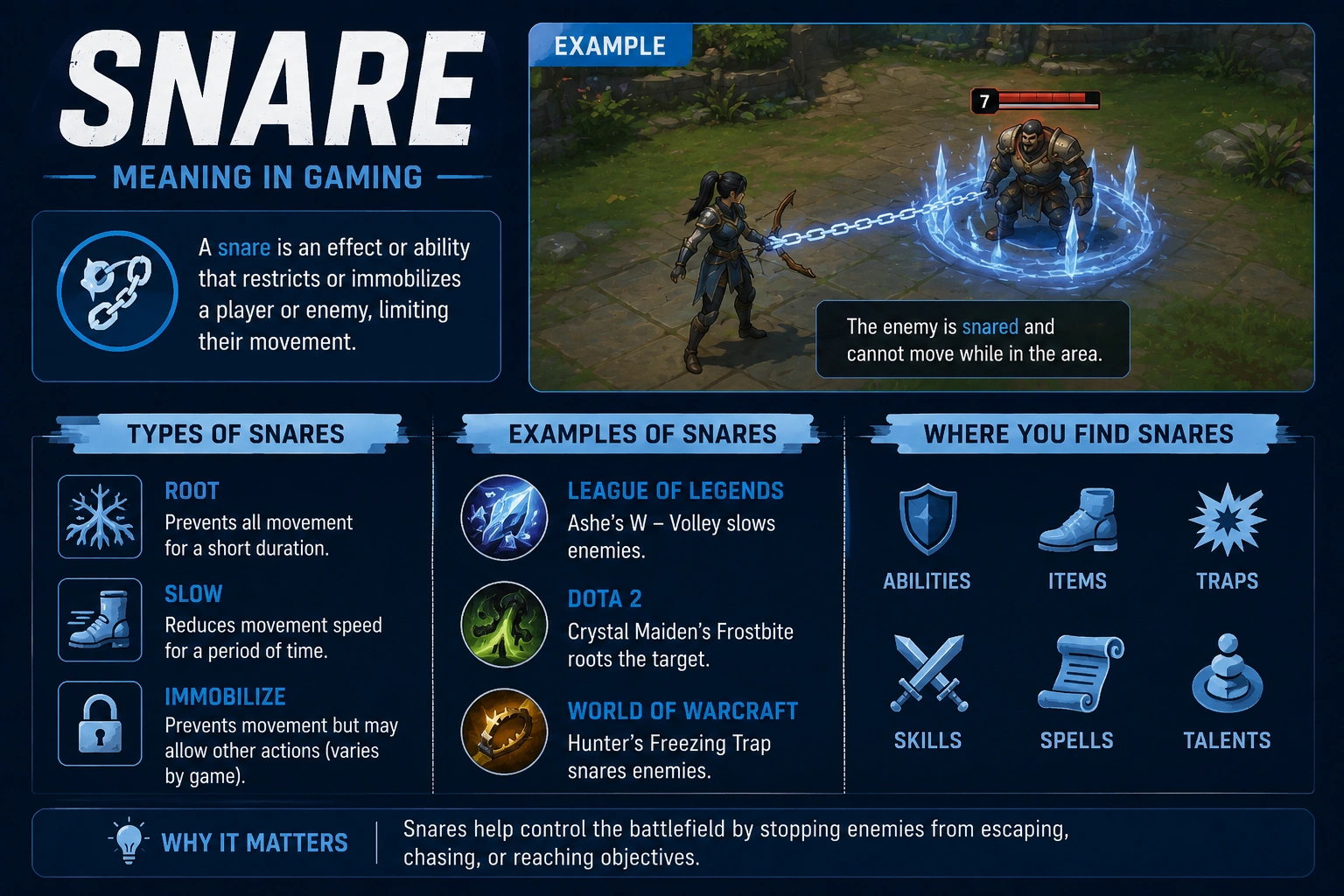
Snare Meaning: Movement Slowing Effects Explained
Snare effects are a cornerstone of crowd control in many game genres, designed to restrict movement and create tactical windows for players to engage or retreat. A snare typically reduces the target’s movement speed to a fraction of normal pace, sometimes stacking with other debuffs or environmental hazards. Understanding how snares work helps players predict enemy options, time ability usage, and coordinate team rotations. While the specifics vary by game, the core idea remains: a snare slows or traps to limit mobility and control the pace of fights. Mastery of snares involves recognizing timing, duration, and how counterplay changes your approach during skirmishes.
Definition and core mechanics
A snare is a movement-impairing effect that reduces a target’s mobility, typically by a significant percentage, and sometimes by immobilizing them entirely for a brief window. Mechanically, snares change how quickly a character can traverse terrain, often applying a speed multiplier (for example, 0.2x to 0.6x of normal speed) for a set duration. The exact numbers depend on the game, but the principle is consistent: the wearer moves more slowly, making pursuit, escape, and positioning more challenging.
Most snares include several common traits: a defined duration, a clear movement penalty, and a potential interaction with other abilities or terrain. Some games allow players to continue casting spells or attacking while snared, while others restrict both movement and actions. Many titles also provide counters such as cleansing, dashing, or sprinting to break the effect early, or they grant resistances that reduce the chance of being snared again shortly after breaking free.
Snare design often balances risk and reward: longer or harsher slows offer a stronger defensive tool, but they can be countered by counterplay options or by teammates cleansing or peeling for the snared player. In RPGs and MMOs, snares frequently appear as crowd control during boss phases or in open-world ganks, influencing cooldown management and resource use. In fast-paced games like MOBAs and shooters, snares tend to be shorter but highly tactical, enabling plays that hinge on catching opponents during their rotations or missteps.
Understanding when a snare will land, how long it lasts, and what actions are still allowed helps players read the battlefield, predict enemy behavior, and coordinate with teammates for effective kite and disengage plays.
How snares differ from other crowd control
To help you assess snares relative to other crowd-control options, the table below compares typical movement-affecting effects across genres. The goal is to illustrate how snares differ from stuns, roots, and slows in practical terms, including how much they slow, how long they last, and whether actions are possible during the effect.
| Crowd Control Type | Mobility Impact | Typical Duration | Actions Allowed |
|---|---|---|---|
| Snare | Substantial slow (often 60–80% reduction) but rarely immobilizes completely | 2–5 seconds | Often can cast or shoot, depending on game; melee and movement restricted |
| Stun | Movement disabled; cannot move | 1–3 seconds | Usually unable to act; some games allow basic actions after stun ends |
| Root | Movement stopped; cannot reposition | 2–6 seconds | Typically cannot move or cast while rooted, with rare exceptions |
| Slow | Moderate movement reduction; can still act | 3–8 seconds | Attacking or casting often allowed, depending on title |
Across titles, you’ll find snares designed to create chase lanes, break formations, and force enemies to reposition under pressure. Recognizing the differences helps you decide when to apply a snare, when to save it for a clutch moment, and how to combine it with other CC for optimal control.
Examples from popular games
Snare effects appear across the most popular game genres, each adapted to its pacing and objectives. Below are illustrative examples from three major genres to show how snare design translates into player experience, decision-making, and team dynamics.
MMORPGs (e.g., World of Warcraft)
World of Warcraft has a long history of movement-affecting snares that mix slow and root effects. Rogue crippling poisons reduce movement speed, creating escape routes for melee to close gaps or for ranged players to reposition. Chains of Ice from a Death Knight slows targets significantly and can transition into a root with follow-up spells or talents, depending on the build. Mages frequently rely on snares that combine with crowd-control to set up coordinated team plays during dungeon runs and battlegrounds. In PvP, players kite and peel using slows to control enemy advances, secure escapes, and maximize burst windows. In PvE, snares help manage boss mechanics that require players to stay within specific zones while continuing their standard rotation. Overall, WoW-style snares emphasize situational utility, timing, and resource management to maintain uptime on targets while preserving your own mobility.
MOBA (e.g., League of Legends)
In MOBAs, snares are central to lane trades, roams, and team fights. Champions can apply strong slows that dramatically reduce a target’s movement speed for short windows or land longer roots that keep an opponent in place for a follow-up combo. The duration of slows typically ranges from 1–4 seconds, with roots often lasting 1–2 seconds, though some abilities extend longer under specific conditions. Cleansing, tenacity items, or activatable immunities can remove or mitigate these effects, creating dynamic decisions about when to engage or retreat. Teams rely on well-timed snares to secure picks, protect carries during their farm, and force enemy mispositions into favorable angles for traps or burst damage. The mechanical feel in LoL-like games hinges on precision, timing, and synergy with other CC to deny escape routes and maximize damage windows.
Tactical shooters and hybrids (e.g., Overwatch)
In shooter hybrids, movement-impairing effects translate into zone control and pocket engagements. Melee-freezing or freezing-type effects immobilize targets temporarily, creating chokepoints and opportunities for teammates to finish off an injured opponent. Other abilities apply significant slows to hinder pursuit, retreat, or repositioning, contributing to tactical peels and crossfires. In arena modes, snares help teams weave in and out of danger, forcing enemies to reload, reposition behind cover, or abandon aggressive pushes. The key in these games is stacking CC with favorable terrain and team coordination, so that slowed enemies become easy targets for coordinated shots, throws, or ultimates. Overall, Overwatch-style snares emphasize utility, tempo control, and the ability to create space for teammates during high-stakes engagements.
Gameplay implications and strategy
Effective use of snares requires both awareness and coordination. The following strategies cover reaction, positioning, and team play.
- Anticipate enemy rotations and place snares to cut off chases, forcing opponents into unfavorable angles or into skill-shot lines.
- Coordinate with teammates to chain CC, ensuring a follow-up burst when the target is slowed or rooted.
- Mix sneaking slows with terrain advantages, such as narrow corridors or environmental hazards, to maximize uptime on the target.
- Preserve cleanse or sprint resources for high-priority targets or crucial moments, rather than using them on low-value targets.
- Adapt builds and lineups to counter enemy resistances, tenacity, or cleanse options, maintaining pressure while minimizing risk.
Adaptation is key, as opponents will adjust builds and rotations to mitigate snare impact. Practice helps players time disengage and re-engage moments with higher precision, improving decision-making under pressure.
Key Features and Benefits
Snare effects are a core mechanic in many battle systems, designed to restrict enemy mobility and create tactical openings during engagements. They are a form of movement slowing effects that can trap or significantly slow targets, forcing repositioning and careful planning. Understanding how snares work helps players anticipate pursuit, escapes, and counterplay, while giving developers reliable knobs to shape pacing. By examining typical attributes like duration and magnitude, you can assess how a snare impacts mobility, crowd control chains, and overall combat tempo. This section highlights key features and how both players and developers can leverage these effects to enrich gameplay.
Typical attributes of snare effects
Snare effects are a cornerstone of combat balance, providing a reliable method to limit enemy mobility and create tactical openings for your team. The following table outlines typical attributes that designers tune when implementing snares, helping players anticipate how long and how hard an enemy will be slowed.
| Attribute | Description | Typical Values / Notes |
|---|---|---|
| Duration | How long the target remains affected by the snare, measured in seconds. | 1.0–3.5s; extended durations on powerful abilities; refresh on reapplication |
| Magnitude | Percent reduction to base movement speed, typically excluding other speed modifiers. | 20–70% depending on rarity and power level |
| Stacking | Whether multiple snares can stack and how effects interact when reapplied. | No stacking in most cases; refresh mechanics may extend duration or reset timer |
| Application | How the snare is applied (on hit, on skill, or AoE). Some sources apply immunity windows. | Direct hit or area of effect; can grant brief post-release immunity |
| Area and Targeting | Scope of the snare: single target vs. area effect and which units are affected. | Single-target snares common; AoE snares present in teamfight tools |
Understanding these parameters helps players, streamers, and developers evaluate the impact of a snare on chase dynamics, escapes, and crowd control chains. Balancing these values requires careful consideration of game pace, risk vs reward, and the diversity of other crowd control options.
Benefits for players and developers
Snare mechanics offer tangible benefits that influence both gameplay depth and development workflows. They create a shared language around movement control and reward careful timing, positioning, and team coordination.
- Creates strategic depth by rewarding precise timing, team coordination, and careful decision making, enabling players to plan escapes or setups around enemy positioning and cooldown management.
- For developers, snare mechanics offer clear knobs to tune pacing, risk, and counterplay without overhauling core combat systems, supporting modular balance.
- They help define skill expression by distinguishing players who can time escapes and punish misreads with tangible, measurable effects in real combat.
- In multiplayer, snare diversity broadens teamfight options, encouraging varied team compositions and reinforcing roles such as initiators, peelers, and crowd-control specialists.
- From a UX perspective, predictable timing and clear visuals reduce confusion, helping players recognize why mobility shifts occur and how to respond.
By documenting these benefits, designers can justify balance changes and players can understand why a snare changes the tempo of a skirmish.
Balancing considerations
Balancing snare effects involves trade-offs between ensuring meaningful counterplay and maintaining game pace. Longer durations provide clear control but can frustrate players and stall fights, reducing action. Higher magnitudes increase impact but risk removing agency for nearly any escape or chase. Stacking rules, refresh timing, and immunity windows shape how snares interact with other crowd control tools, influencing team composition and strategic planning. Developers must consider accessibility, including new players who might find movement-impairing effects confusing, and design cues such as sound and visuals to communicate when and why a target is slowed. Finally, the environment and game mode matter: in fast-paced arenas, shorter, predictable snares support brisk skirmishes, while in more methodical RPGs, longer durations can be acceptable with proper counterplay. The goal is to preserve risk-reward, chase dynamics, and meaningful decision points without enabling unresponsive gameplay. Additionally, performance considerations and networking latency can influence how snare timing translates online, making consistent behavior essential.
Technical Specifications and Performance Metrics
Snare mechanics in games represent movement slowing effects that alter a character’s speed and traction, shaping how players approach fights and navigation. This Technical Specifications and Performance Metrics section outlines how timers, stacking rules, resistances, and state machines define when and how a snare can slow or trap targets. We discuss the impact of snare on mobility, the interpretation of slowed movements, and how deceleration interacts with movement inhibition in various engine loops. The goal is to give developers a clear model for performance costs, measurement, and tuning that preserve gameplay clarity and combat rhythm. By detailing timing granularity, feedback cues, and balance considerations, this guide connects movement restriction concepts to practical metrics.
Implementation details (timers, stacks, resistances)
Implementation details for snare effects hinge on careful timer design and robust state management. In most engines, a snare triggers a movement rate modifier at the moment of application and then decays over a defined duration. Choosing between a per-target timer and a global timer affects predictability and network load; per-target timers ensure accuracy for each agent but require more memory and update calls, while a shared timer can simplify synchronization but risks drift during long fights. The coding pattern should avoid tight polling and instead rely on event-driven updates tied to the game loop’s tick rate, typically aligning with physics or animation updates. This foundation helps ensure consistent behavior across client and server, reducing desynchronization risks in multiplayer scenarios.
Stacks and stacking order are central to movement restrictions. A snare may be classified as a root, slow, or hybrid effect, and the engine must decide whether multiple applications should refresh, extend, or override existing duration. Some designs use integer stacks with independent durations, while others employ a consolidated timer that resets on each new apply. The rule set should specify maximum concurrent snare instances per target and define priority when different movement impairments interact. Clear stacking semantics prevent surprising jumps in movement speed and help players understand why a target suddenly accelerates after receiving a new effect.
Resistances and duration modifiers shape how snare power scales with attributes or gear. Some games implement multiplicative reductions or flat decrements to duration, while others apply a soft cap to prevent snare from lasting too long in high-latency matches. It is crucial to distinguish between duration and magnitude: a longer snare duration may not translate to a stronger movement penalty if the speed multiplier is fixed. Documented rules for resistances to status effects, immunity frames, and partial or complete dampening ensure consistent outcomes across characters and classes.
State transitions and interaction with other crowd-control are an area where subtle bugs creep in. When a snare ends, the engine must restore the original movement multiplier without forcing a jitter or snap in velocity. Interactions with stun, knockback, or fear should be defined in a finite-state machine with explicit transition paths and priority ties. Edge cases like reapplication during cooldown, forced movement, or airborne states require careful sequencing to avoid misalignment between server state and client prediction.
On the network side, timers and state must be replicated reliably. A server-authoritative model typically calculates the actual duration and broadcasts the result to clients, while client prediction helps preserve smooth movement. Bandwidth concerns push developers toward compact delta messages and rate-limiting updates, especially in fast-paced games with many players. Logging a few representative traces during QA reveals how often snares trigger, how long they last, and how much drift appears under load, informing future tuning.
Performance costs and optimizations
Performance costs for snare effects arise from per-target state maintenance, periodic velocity adjustments, and the frequency of state checks during the game loop. A naïve approach that recalculates movement penalties every frame can waste CPU cycles and increase cache misses, especially in scenes with many actors. A tiered approach uses a fixed tick rate for movement modifiers and applies updates only when an actor is active or within range. Consolidating checks into spatial queries and batching updates for nearby characters reduces redundant work and improves cache locality.
Memory usage comes from per-target state and event queues. Implementing object pools for transient snare instances and reusing state objects lowers GC pressure and fragmentation. Avoiding allocations inside hot paths and using compact representations for duration, magnitude, and source data helps maintain stable frame rates in crowded battles. Profiling tools should track the allocation rate, peak memory, and the distribution of snare durations to identify hotspots and imbalance opportunities.
Network impact depends on how often snare state changes are replicated and how much data is needed to convey the effect. A server-authoritative model typically amortizes updates over several clients and uses delta compression to minimize bandwidth. Techniques like interest management, where clients subscribe only to nearby events, reduce unnecessary traffic. In latency-sensitive modes, prediction corrections and interpolation are essential so players perceive responsive movement, even when server updates lag slightly behind.
Cross-platform considerations matter for optimization. Mobile clients may require coarser tick rates and more aggressive clamping to conserve battery life, while PC and console versions can leverage higher bandwidth and faster CPUs for finer-grained timing. A/B testing different durations and magnitudes across maps and modes helps identify sweet spots that preserve fairness without dulling the experience. Finally, maintaining clear boundaries between gameplay logic and presentation reduces the risk of visual anomalies that can be misinterpreted as real delays.
Common optimization strategies include early-out checks when a target is out of range or immune, avoiding unnecessary stacking calculations in trivial scenarios, and caching derived values like final speed multipliers for repeated use within the same frame. Documented performance budgets per scene and per mode guide engineers in keeping snare calculation costs predictable and within acceptable limits.
Telemetry and metrics to track
Telemetry for snares should focus on impact, duration, and balance signals. The following metrics help quantify how movement slowing effects influence combat pacing and player perception.
- Average snare duration by source and target class, highlighting outliers and potential stacking exploits that alter movement penalties.
- Average movement speed while snared, across maps and modes, to compare actual deceleration against published multipliers and intention.
- Frequency of snare applications per match and per player, identifying overuse, underuse, or clustering in critical zones and moments.
- Latency between ability cast and observed speed reduction, including client-side prediction accuracy and perceived timing in high-l fidelity play.
- Resolution of snare end events, including drift between server-authoritative state and client display, to measure synchronization quality.
- Impact on player success metrics, such as chase outcomes, escapes, and assisted kills, to link movement restriction to broader balance decisions.
Collecting these metrics over multiple patches helps balance teams adjust durations, strengths, and stacking rules to maintain desired gameplay tempo. Dash timing, UI feedback, and consistency across platforms are also important signals to monitor.
Offers, Pricing, and How to Buy
Snare effects are a staple of movement control in many games, slowing or briefly trapping targets to shape battles. This section explores how offers, pricing, and purchase methods intersect with snare mechanics and why players encounter snares in the forms of purchasable content. When a weapon, artifact, or consumable can grant a snare, it changes decision making around builds, timing, and risk versus reward. The way developers monetize snares can affect balance, perceived fairness, and the long term health of a game’s competitive scene. Understanding these dynamics helps players distinguish between gameplay mechanics and monetization tactics, and guides developers toward responsible pricing strategies that respect player agency.
How snares appear in purchasable items and DLC
Purchasable snares appear in several forms across genres. In many RPGs and strategy titles, a snare is embedded in equipment players can buy from the in game store or through DLC bundles. Weapons may carry an intrinsic slow effect on hit, or a rare amulet may grant a chance to apply a snare on basic attacks. Traps and deployables sold in the shop provide tactical options in PvP arenas and cooperative modes, creating new choices for crowd control without requiring a separate ability slot. Consumables like potions or scrolls that temporarily reduce enemy movement speed are common as one time purchases, often designed to be used at key moments such as when defending objectives or initiating fights. There are also legendary items or limited edition bundles that promise a stronger snare, sometimes through activated abilities that players unlock after purchase. These items can change how teams coordinate engagements and which setups are considered optimal in mid to late game phases.
Mechanics vary by title, but the core idea is similar. Some snare items apply movement slow passively on hit, others trigger only when activated, and a few grant persistent auras that slow enemies within an area. The durability and duration can be tuned to emphasize tactical timing rather than raw DPS, encouraging players to think about when to employ a snare rather than simply owning it. Purchasable snares often incentivize players to experiment with builds that favor mobility control, trap placement, or zone denial, expanding the decision space beyond traditional damage focused options.
Balance considerations drive a lot of what you see in shops and DLC. If snares become too common or too powerful in paid content, new players may feel excluded from meaningful competition. Conversely, rare or expensive items can become highly coveted status symbols, creating friction for those who cannot spend as much time or money. To address this, developers frequently limit stacking, use cooldowns, or offer non paid routes to access similar effects through skill trees or seasonal challenges. Transparency matters here as well; players should understand how a purchase changes gameplay and whether the snare stacks with other slows or mitigates out of combat movement speeds in certain contexts. Clear labeling in storefronts and patch notes helps maintain trust and reduces confusion during busy combat moments.
Finally, many studios balance monetization with community feedback. Some titles separate cosmetic and functional content, ensuring that paid snares do not unbalance core gameplay, while others place functional snares behind optional challenges or time limited windows. When done responsibly, purchasable snares can expand strategic options without eroding a sense of fair play or competitive integrity for players who choose not to buy.
Pricing models for in-game items granting snares
Pricing models for in game items granting snares vary widely. Microtransactions often offer small, separate purchases such as a single snare trap or a temporary slow scroll. DLC packs might bundle snares with new story content, new zones, or new companions. Battle passes can unlock snares as part of a tiered progression that requires continued play. Each approach affects how players perceive value and how quickly they can access key crowd control options. From a design standpoint, the goal is to provide meaningful choices without creating barriers that block participation in core content. When snare items are introduced, developers must decide whether to tie them to gear slots, abilities, or consumables and how often players should see them in the shop. Additionally, the presence of snares in paid content can influence the game economy, value of in game currency, and the pacing of rewards across seasons.
Microtransactions often enable quick access to utility options, allowing players to tailor a build without waiting for a longer progression. However, overwhelming the shop with functional advantages can tilt balance toward players who spend more, so many teams set caps on how often a single player can purchase these items within a given period. DLC bundles can deliver larger, story driven experiences together with new purchasable snares, which can feel more substantial but may also require a larger upfront investment. Battle passes tie snare access to ongoing playtime, creating a rhythmic cadence of acquiring options alongside other rewards. This arrangement rewards regular players while offering non paying participants a path to earn similar effects through gameplay milestones. Regardless of model, transparent pricing and clear descriptions are essential to help players evaluate value and avoid misinterpretation of the snare’s impact on gameplay.
Microtransactions often enable quick access to utility options, allowing players to tailor a build without waiting for a longer progression. However, overwhelming the shop with functional advantages can tilt balance toward players who spend more, so many teams set caps on how often a single player can purchase these items within a given period. DLC bundles can deliver larger, story driven experiences together with new purchasable snares, which can feel more substantial but may also require a larger upfront investment. Battle passes tie snare access to ongoing playtime, creating a rhythmic cadence of acquiring options alongside other rewards. This arrangement rewards regular players while offering non paying participants a path to earn similar effects through gameplay milestones. Regardless of model, transparent pricing and clear descriptions are essential to help players evaluate value and avoid misinterpretation of the snare’s impact on gameplay.
Ethical and legal considerations
Ethical and legal considerations surrounding purchasable snares center on fairness, disclosure, and consumer protection. Pay to win concerns arise when paid items grant a competitive edge that cannot be matched through skill or time alone, potentially eroding trust in matchmaking and ranking systems. To mitigate this risk, developers should clearly distinguish between cosmetic and functional content and provide accessible, fair routes to similar gameplay benefits through non monetary means. Regulatory frameworks in some regions require explicit disclosures about what a purchase does, how long effects last, and whether randomness is involved, such as in loot style systems or gacha like bundles. Transparency in storefronts, patch notes, and user interfaces supports informed choices and reduces ambiguity at critical moments in play. Age appropriate protections and parental controls are important when a game targets younger audiences, especially for time limited or randomized offers. Finally, ongoing community feedback and independent audits can help ensure that monetization strategies respect player autonomy while still enabling sustainable development.