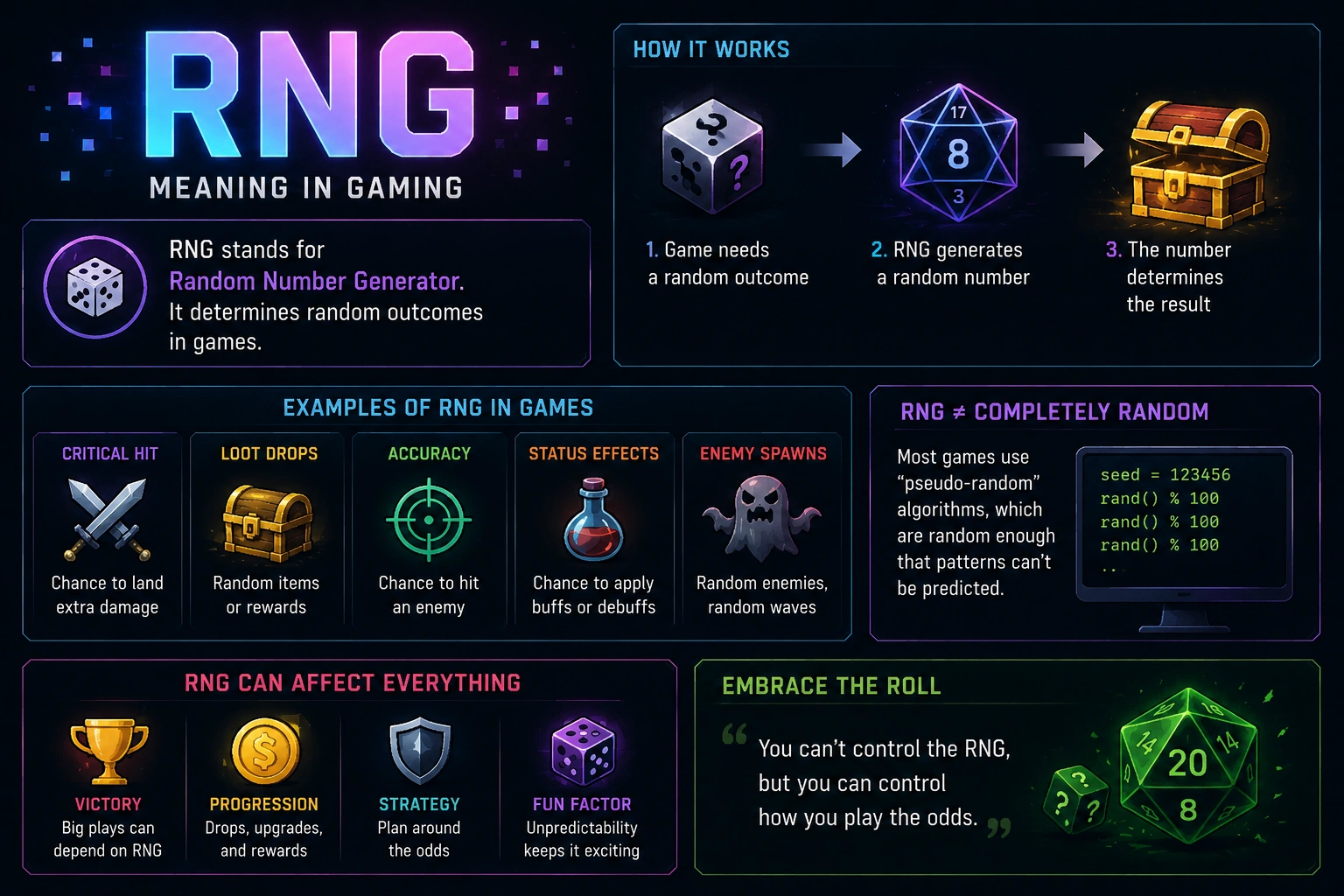
RNG Meaning: Core Concept and How It Works
RNG meaning in gaming refers to the system that generates random numbers which influence outcomes such as loot drops, critical hits, quest rewards, and encounter variety.
At its core, an RNG stands for Random Number Generator, a mechanism that outputs numbers designed to model chance while maintaining balance and predictability for testing and fairness.
Understanding RNG is essential for players, developers, testers, and regulators, because the reliability of random outcomes underpins game balance, monetization strategies, and trust in online ecosystems.
This section introduces the core concept, discusses common algorithms, and explains practical implications for different game genres, from single‑player adventures to competitive online titles.
By appreciating how RNG is designed, implemented, and audited, teams can evaluate fairness, detect bias, and communicate expectations clearly to players and stakeholders.
What RNG stands for and basic definition
RNG stands for Random Number Generator, a component that supplies numbers used to determine outcomes in games. In practice, an RNG is an algorithm or hardware mechanism that outputs a sequence of numbers that should be unpredictable and independent enough to model chance.
In most games, the RNG is invoked whenever something depends on luck: loot tables, spawn rates, critical hit checks, event timing, or randomized rewards. These decisions shape the moment-to-moment feel of play and can influence long-term balance.
Two core ideas underpin practical RNG use: determinism and reproducibility. A deterministic RNG will produce the same sequence if started from the same seed, which is essential for testing, debugging, and matching observed outcomes across different builds or platforms.
Quality RNG design also considers distribution properties, ensuring uniform outcomes where intended, or controlled bias to support game design goals. Designers may specify minimum and maximum probabilities, or tiered roll systems that reward sustained play with increasingly rare bonuses.
Finally, developers document seed values, reseeding events, and the mapping from generated numbers to game actions so operators can audit fairness and players can understand why specific results occur.
How RNG works in games (algorithms and processes)
In games RNG begins with a seed that initializes the internal state of the generator; from this seed the algorithm advances to produce a stream of pseudo-random numbers. This foundation ensures that results are repeatable under the same conditions, which is crucial for testing and balancing.
The generation step uses an algorithm such as a linear congruential generator, Mersenne Twister, PCG, or a hardware-based module; each has different period lengths and statistical characteristics. The normalization step converts numbers to a uniform 0 to 1 range, after which sampling methods determine whether a given outcome should occur.
Distributions may be uniform or biased as designed by the game, and sampling techniques like rejection sampling or inverse transform ensure that the chosen numbers produce the intended probabilities. The final mapping ties a numeric value to a specific in-game action, from loot tier to damage deviation to encounter difficulty.
To support testing and fairness, developers run simulations, compare observed frequencies to target probabilities, and document seeds and state transitions so behavior can be audited across patches and platforms.
Performance considerations are never far from design decisions; faster generators reduce latency, but developers must guard against predictability and exploit risks through proper seeding, entropy collection, and security-aware integration.
Types of RNG: pseudo-random vs true RNG
RNG types define how randomness is sourced and trusted in games, shaping both the gameplay experience and the integrity of competitive play. Understanding the nuances helps developers design fair systems, testers audit outcomes, and players grasp why certain results can feel unpredictable yet deterministic, enabling clearer communication about randomness, expectations, and the boundaries of chance within competitive play.
- Pseudo-random number generators (PRNGs) use deterministic algorithms with an initial seed to produce long sequences that appear random, offering speed, reproducibility, and predictable testing outcomes.
- True RNGs (TRNGs) rely on physical processes such as electronic noise or quantum phenomena to generate non-deterministic results, prioritizing unpredictability over speed.
- Seed management affects RNG behavior, where the seed determines the exact sequence; changing seeds changes outcomes while maintaining determinism for reproducibility in testing.
- Hardware-accelerated RNG modules exist in consoles and GPUs, providing faster generation and lower latency, typically integrated with cryptographic or security features.
- Hybrid approaches blend PRNGs with occasional TRNG inputs, improving fairness and resilience against prediction while preserving performance for real-time gameplay.
In practice, teams document RNG behavior, run statistical tests, and monitor for biases to ensure that outcomes align with declared probabilities across patches and platform configurations. They also incorporate fallback checks and audit trails to detect patterning or exploitation risks over extended play sessions, while maintaining performance parity with user expectations.
Common implementations: server-side, client-side, hybrid
Common implementations vary by where the RNG is executed and how results are delivered to the game engine.
| Implementation | Typical Latency | Security Considerations | Pros | Cons |
|---|---|---|---|---|
| Server-side RNG | Moderate, dependent on server performance | Centralized control allows auditing but can be a single point of failure | Consistent results across clients; easy seed management | Potential latency bottlenecks; scalable limits |
| Client-side RNG | Low latency; local computation | More prone to tampering; harder to audit | Fast responses; offline play possible | Verification challenges; inconsistent cross-session results |
| Hybrid RNG | Balanced latency and throughput | Best of both worlds with additional synchronization | Reduces single points of failure; improved fairness | Increased complexity; coordination overhead |
| Hardware RNG | Low to moderate latency; high entropy | Strong entropy sources; resistant to software predictability | High unpredictability; good seed material | Hardware availability and cost; integration complexity |
Choosing among these approaches depends on latency budgets, security considerations, and the need for consistent player experiences across platforms.
Engineers weigh scalability, reproducibility, and exposure to tampering when selecting an approach.
RNG Features and Benefits of Our Solution
RNG, or random number generation, underpins many core systems in modern games, from loot distribution to combat outcomes and event timing. It drives variability that keeps sessions fresh, balancing risk and reward across playstyles and challenge levels. When RNG is well designed, players perceive outcomes as fair and responsive, even as luck shifts within a session. For developers, RNG design translates complex balance goals into repeatable, testable mechanics that can scale across platforms, modes, and updates. This section explores how RNG features support engaging gameplay, and what to consider when implementing RNG in gaming projects.
Key gameplay features enabled by RNG
RNG influences more than luck in many games; it shapes risk assessment, reward pacing, and player choice across combat, exploration, and progression. By distributing probabilities across loot, encounters, and world generation, RNG creates dynamic experiences that reward adaptation and strategic planning while preserving surprise.
- Loot drops determine equipment quality, with probabilistic rarities that motivate gear upgrades, build diversity, and long-term progression across multiple playthroughs.
- Critical hits and damage dice add dramatic spikes to combat, creating moments of volatility that reward timing, skill, and adaptive tactics during fights.
- Procedural world events populate maps with randomized encounters, scavenger hunts, and dynamic challenges that force players to adapt strategies and explore alternatives.
- Enemy spawn logic and encounter tables decide where and when foes appear, shaping resource management, route planning, and risk versus reward decisions in every session.
- Variable quest rewards and milestones rely on RNG seeds to determine loot quality, unlocks, and timing, encouraging replayability and experimentation with different builds.
- Seed derivation and reseeding techniques influence future outcomes, adding depth to strategy while maintaining overall uncertainty.
- Balancing weights and soft caps adjust probability curves to prevent extreme outcomes, preserving fairness while keeping excitement across playthroughs.
In practice, designers blend these elements to avoid predictable cycles while keeping players engaged. Understanding the trade-offs helps players interpret outcomes and helps teams tune experience quality across releases.
Loot strategy and variability
Loot strategy and variability influence how players approach gear collection and build diversity. RNG shapes what drops players encounter from chests, bosses, and event rewards, integrating with rarity curves to determine if a new weapon or armor set feels meaningful. Designers tune weights to support both early-game progress and late-game mastery, ensuring that players can pursue multiple upgrade paths without stagnation. The system rewards exploration and risk-taking, since identifying high-value drops often depends on player choices and repeated engagements. Tradeoffs exist between frequent small upgrades and rare, impactful drops, requiring careful pacing to preserve excitement across sessions.
Combat randomness and timing
Combat randomness and timing shape how players perceive the skill curve and the pace of battles. When critical hits, miss chances, and damage fluctuations are well-balanced, fights feel dynamic without becoming entirely luck-based. Players learn to read cues, conserve resources, and adapt their strategies in response to probabilistic swings. For developers, timing outcomes influences animation frames, resource costs, and enemy AI responses, introducing depth without sacrificing responsiveness. Effective design uses bounded randomness, predictable average outcomes, and occasional spikes to create memorable moments while maintaining fairness across encounters.
Exploration rewards and route diversity
Exploration rewards and route diversity encourage players to experiment with different paths, territories, and playstyles. RNG determines waypoint rewards, hidden caches, and secret encounters, promoting curiosity and replayability. Visual cues, clue density, and map layouts balance RNG with discoverability to avoid dead-ends or overly punishing paths. When rewards are meaningful and contextually relevant, players feel that exploration yields tangible progression rather than mere chance. To sustain engagement, designers align RNG with pacing, ensuring that each new area presents fresh choices, promising loot, and potential strategic advantages for diverse builds.
Encounter pacing and resource management
Encounter pacing and resource management rely on RNG to adjust the rhythm of battles, ambushes, and safe zones. Probability determines when a tough encounter appears, how many foes join a skirmish, and how scarce resources feel across an expedition. Players learn to anticipate scarcity, ration ammo or mana, and decide when to retreat or press forward. For developers, these dynamics provide knobs to tune difficulty curves, spawn density, and recovery incentives without rewriting entire level layouts. The result is a responsive experience that rewards careful planning and adaptable tactics across different play sessions.
Event triggers and player choice
Event triggers and player choice hinge on RNG to deliver meaningful moments that still respect player agency. Randomized quest events, time-based flips, and world state changes create opportunities for experimentation, collaboration, and divergent endings. When used thoughtfully, RNG can highlight player decisions, making outcomes feel earned rather than arbitrary. However, designers must guard against opaque randomness by offering transparent indicators of probability and plausible ranges for event rewards. The best systems balance surprise with clarity, encouraging players to experiment while knowing the likely consequences of their choices.
Seed management and predictability
Seed management and predictability address the tension between reproducibility and surprises. Deterministic seeds allow testing, speedruns, and fair matches by reproducing identical conditions, while non-deterministic seeds preserve novelty in standard play. Operators may expose seed information to trusted players or auditors to validate fairness, provided that this transparency is managed securely. Effective seed handling involves recording seed lifecycles, versioned RNG configurations, and clear procedures for reseeding after updates or hotfixes. By tying seeds to specific builds, teams can reproduce issues, verify fixes, and maintain consistent experiences across platforms and regions.
Benefits for players and developers
Transparency and fairness support trust and a smoother player experience by making probabilistic outcomes more understandable. Players benefit from clearer expectations around loot, encounters, and rewards, reducing frustration when results deviate from what they expect. Developers gain the ability to calibrate systems using precise data, conduct reproducible tests, and communicate fairness standards to players and regulators alike. A well-designed RNG framework also enables cross-mode parity, streamlined QA, and scalable content generation that adapts to new features without breaking existing balance.
Beyond fairness, RNG-driven systems enable dynamic pacing, variability across modes, and broader creative freedom. When seeds, distributions, and testing are well-managed, teams can deploy updates with confidence that core experiences remain coherent. For players, this translates into familiar expectations paired with refreshing surprises, while for developers, it means more predictable performance and easier diagnosis when issues arise.
Transparency and fairness features (seed management, audits)
Transparency and fairness features hinge on rigorous seed management, auditable trails, and transparent testing. Seed lifecycle tracking documents the origin of each RNG sequence, its evolution through patches, and its relationship to game state. Audits—internal or external—verify that RNG outputs meet defined statistical criteria and that seeding methods resist exploitation. In practice, teams combine statistical tests for uniformity, independence, and lack of bias with reproducibility checks that ensure a given seed yields consistent results across platforms. Public reports may summarize methodology while preserving sensitive runtime data to protect gameplay balance.
To enable practical verification, many studios publish high-level results and code samples demonstrating how seeds are derived and used, without revealing sensitive entropy sources. Cryptographic approaches, such as verifiable random functions or hashed seeds, can provide strong guarantees while keeping runtime performance acceptable. The aim is to foster trust through traceable randomness rather than mystery or opacity.
Limitations and trade-offs
RNG brings excitement and variability, but it also introduces limitations that must be managed. Variance can lead to perceived unfairness when players experience long droughts or streaks, so many games incorporate distribution shaping or pity systems to smooth outcomes without eliminating luck entirely. Performance and complexity are additional concerns; cryptographic-grade guarantees or cross-platform parity demand careful algorithm choice, caching, and optimization to avoid latency or divergence across devices.
Security considerations are critical, since weak seeds or predictable sequences can undermine in-game economies or real-money systems. Developers should treat entropy sources, seed storage, and state transitions as security-sensitive components subject to regular testing and audits. Finally, testing demands substantial tooling, telemetry, and version control to detect bias or drift after patches, with clear communication to players about changes to RNG behavior and its impact on progression and balance.
RNG Specifications: Performance, Security, and Compliance
RNG specifications sit at the core of modern gaming infrastructure, shaping how players experience fairness, predictability, and responsiveness. In practice, RNG performance is a balance between latency, throughput, and the statistical quality of randomness, all of which influence loot drops, crits, and in-game events. Security considerations must protect the integrity of seeds, entropy sources, and the overall anti-tamper posture to prevent manipulation. Compliance considerations tie RNG implementation to standards and independent testing labs, ensuring that operators meet regulatory and industry expectations. This section provides an in-depth look at the key performance metrics, security controls, and certification pathways that guide RNG design and auditing in online gaming.
Performance metrics: latency, throughput, randomness quality
Performance metrics for RNG in gaming are not abstract numbers; they translate directly into player experience and system efficiency. Latency measures the round-trip time from a request for a random value to its delivery, and it matters most in fast-paced interactions such as real-time combat bonuses or loot determination during action moments. In practice, latency targets depend on platform capabilities, CPU affinity, and whether RNG calls run synchronously with the main game loop or asynchronously in worker threads. Latency budgets must account for worst-case paths, including queueing, contention, and OS scheduling variance, while also reflecting cross-language and platform timing jitter.
Throughput describes how many random values can be produced per second under load, and it becomes critical when RNG calls are frequent across multiple players or subsystems. High-throughput RNG must avoid bottlenecking the game loop, so designers often decouple RNG generation from gameplay logic, using precomputed streams or parallel streams with careful synchronization. Trade-offs between per-call overhead and batched generation should be analyzed, especially for MMOs with hundreds of events per second. Designers also consider cache locality, memory bandwidth, and the cost of regenerating seeds when pools are exhausted.
Randomness quality encompasses uniformity, independence, and unpredictability. This quality is validated with statistical test suites such as NIST SP 800-22 and Diehard tests, and it is expressed through metrics like min-entropy, bias, and correlation. A robust RNG design provides strong guarantees against predictability, including seed-state reconstruction or backtracking attacks, by ensuring the internal state is large enough and updated with fresh entropy each time. In gaming contexts, practical tests also examine the distribution of loot, crit chances, and timing randomness to prevent exploitable patterns. Regular calibration against historical data helps detect drift in distributions over time.
In practice, validation combines empirical testing with formal modeling. Engineers simulate edge cases, stress test entropy pools, and verify reproducibility across builds and environments. Documenting test vectors and expected distributions helps auditors reproduce results and compare them to reference implementations. The end goal is to maintain consistent performance while preserving cryptographic soundness and fairness across updates and platform variations.
Security measures: seed protection, entropy sources, anti-tamper
Seed protection and entropy sources are foundational to RNG security. Seeds should be unpredictable, derived from multiple entropy sources, and stored securely to prevent leakage or replay. A typical strategy is to combine hardware RNG output with system entropy and, when necessary, a cryptographic hash to derive a fresh seed for each session. Access to seed material should be tightly controlled, with least privilege, multi-factor authentication for operators, and explicit approval workflows for reseeding or seed rotation.
Entropy sources should be diverse and resilient. Hardware RNGs offer true randomness but can fail or produce outliers; OS-provided entropy pools add another layer, while software-based PRNGs can fill gaps with strong seeding and re-seeding policies. Continuous health checks, entropy testing, and automatic re-seeding when entropy quality metrics dip below thresholds help prevent predictability. Anti-prediction design includes state refreshers and periodic reseeding at safe intervals, while ensuring that no single seed alternative dominates the entire play session.
Anti-tamper measures and integrity checks guard RNG code. Code signing, runtime integrity verification, and memory protection reduce the risk of tampering with RNG pathways. Hardware-backed isolation or secure enclaves can further harden seeds and state. Monitoring for anomalies such as abnormal entropy consumption or reproducibility drift is essential. Incident response plans and rapid patching procedures ensure resilience against discovered weaknesses.
Recovery and resilience strategies include fallback RNG mechanisms and graceful degradation. If an entropy source becomes unreliable, the system should continue generating random values with a secure, less risky method while logging events for post-incident analysis. Regular audits of RNG state, plus cross-checks against independent randomness tests, help preserve fairness during transitions and updates.
Compliance and certification: standards, testing labs
Gambling and gaming operators face a landscape of standards and tests to demonstrate RNG fairness and security. While the exact requirements vary by jurisdiction, many regimes align on core practices rather than prescribing exact outputs. Core standards include ISO/IEC 27001 for information security management and, where relevant, FIPS 140-2/3 for cryptographic RNG modules. In the laboratory space, independent testing labs such as GLI, iTech Labs, and BMM provide certification services and apply randomness testing approaches inspired by NIST SP 800-22 as part of their evaluation regimes.
Statistics and test suites are used to validate randomness quality, including NIST SP 800-22, DIEHARDER, and Crush tests. The gaming industry often requires GLI or regulatory approvals to ensure auditability and reproducibility. Some jurisdictions require ongoing compliance audits such as annual or semi-annual reviews, with evidence including seed management policies, entropy source documentation, and build integrity verification.
Documentation should include test vectors, reproducibility artifacts, and detailed change logs that map RNG changes to outcomes in gameplay. Certification processes typically examine the entire lifecycle: from development and testing to deployment and monitoring. While formal cryptographic standards guide defense properties, the emphasis for online gaming remains on fairness, predictability bounds, and robust incident handling to protect players and operators alike.
Implementation checklist for audits
Auditors expect a structured, auditable trail across the RNG lifecycle. Use this practical checklist to prepare artifacts and demonstrate control effectiveness across development, testing, and production environments.
- Inventory of RNG sources, including software and hardware components, with traceable provenance, versioning, and status logs to confirm all inputs used in production are authorized.
- Document entropy collection methods and reseeding policies, specifying how often entropy pools are refreshed, minimum entropy thresholds, and recovery procedures after observed degradation.
- Seed protection and key management procedures, including storage, rotation schedules, access controls, cryptographic hygiene, and incident response measures to prevent leaks or misuse.
- Tamper-evident build and release controls, with code signing, reproducible builds, audit trails, and independent verification steps to ensure integrity across deployment environments.
- Comprehensive test vectors, including deterministic and non-deterministic scenarios, regression suites, and reproducibility checks to demonstrate consistent RNG behavior across updates.
Maintain living documentation and version-controlled artifacts to stay ahead of regulatory changes and vendor updates. Regular reviews ensure alignment with current standards and help streamline future audits.
Entropy source validation and continuous monitoring
Entropy source validation and continuous monitoring: The first line of defense against weak randomness is ensuring that entropy sources deliver genuine unpredictability. This includes validating hardware RNG outputs under varying temperatures and workloads, cross-checking with OS entropy pools, and maintaining a watchdog that flags repeated low-entropy states. Operational teams should implement routine health checks, collect statistics on entropy availability, and maintain redundancy between sources so that the failure of one source does not degrade the entire RNG pipeline. A robust monitoring framework uses dashboards, thresholds, and automated alerts to support rapid remediation and regulatory reporting.
Secure seed management and rotation policies
Secure seed management and rotation policies: Seed handling requires strict access controls, encryption at rest, and secure transmission. Seeds should be derived from multiple entropy sources, combined and hashed to obscure direct values, and rotated on a fixed schedule or in response to detected anomalies. Per-session seeds should not rely on a single global seed, and backup procedures must protect recovery keys. Logging and auditable trails should capture seed creation, rotation events, and access attempts, with time stamps and operator identifiers. This policy should be reviewed periodically and tested via simulated incident drills.
Audit trails and reproducible test vectors
Audit trails and reproducible test vectors: The RNG implementation must generate deterministic, testable outputs under controlled conditions. Audit trails should record configuration changes, version numbers, and build provenance. Reproducible test vectors enable auditors to reproduce outcomes from a given seed and state, ensuring verifiability of fairness claims. Systems should provide accessible references to test suites, sample outputs, and regression test results. Regularly archived logs should be preserved for the required retention periods and should be protected from tampering. Access to logs should be restricted and monitored.
Tamper-evident packaging and anti-tamper controls
Tamper-evident packaging and anti-tamper controls: The release process should provide tamper-evident packaging, cryptographic signing of binaries, and reproducible builds verified by independent checks. In-production RNG modules should run in isolated environments with memory protection, preventing exposure of internal state. Operational procedures include secure deployment pipelines, runtime integrity checks, and continuous monitoring for unexpected changes in behavior or entropy consumption patterns. Incident response playbooks describe steps to isolate compromised components and restore integrity with minimal disruption to players. Regular pen tests and supply chain assessments should be part of ongoing assurance.
Periodic RNG benchmarking and regression testing
Periodic RNG benchmarking and regression testing: Benchmarking ensures that performance remains within approved limits after updates, while regression tests confirm that randomness properties are preserved. Tests should cover latency, throughput, distribution of outputs, and reproducibility across platforms. Results must be compared against previously approved baselines, with deviations triggering reviews or rollbacks. Documentation should include test configurations, hardware profiles, and the exact seeds used to reproduce results, enabling auditors to verify stability and fairness over time. The process should be repeatable and auditable across releases.
Offers, Pricing, and Competitive Advantage
RNG meaning in gaming goes beyond a simple buzzword; it underpins fairness, unpredictability, and player trust across modern titles and platforms. This section explores how RNG services are priced, licensed, and positioned to deliver reliable randomness at scale. We will look at common pricing models for RNG services, licensing structures, and practical criteria to compare providers. By understanding the economics of RNG, developers and operators can align their budgets with performance guarantees, security, and compliance objectives. The goal is to outline how offers, pricing, and competitive advantage translate into better value for online games and related software.
Pricing models for RNG services
Pricing for Random Number Generator (RNG) services is rarely one-size-fits-all; it reflects how often randomness is consumed, how much reliability is required, and how much control a client needs over seeds and audits. Most providers blend several models to accommodate diverse game designs and deployment environments. Common structures include subscription plans with monthly allowances, consumption-based pricing per RNG request or per million outcomes, and tiered tiers that increase capacity as demand grows. Some vendors offer perpetual licenses for on-premise deployments paired with annual maintenance and support, while others price access as a cloud-based service with ongoing updates. A hybrid approach is also popular: a base subscription covers essential features and security compliance, while high-volume studios pay for excess throughput or specialized modules like tamper-evident seed management or real-time fairness verification. In practice, pricing often ties directly to throughput, seed rotation frequency, and the required level of randomness testing baked into the service. The concept of a seed value, entropy sources, and re-seeding strategies can influence cost, because higher entropy and more frequent reseeding require additional infrastructure and monitoring. When evaluating models, look for transparent metering, defined units of measure, and predictable renewal terms. Some providers disclose sample pricing bands based on requests per second (RPS), peak loads, or total daily RNG calls, while others use custom enterprise contracts. For gaming companies with variable demand—such as seasonal events with spike drops or promotional loot challenges—flexible ceiling caps and scalable auto-scaling are crucial. It is also important to assess whether pricing includes ancillary features like cryptographic strength RNG, audit logs, and compliance attestations, or if those are billed separately. Ultimately, the best model aligns with product velocity, quality guarantees, and risk tolerance, supporting predictable budgeting while enabling rapid iteration in game design and live operations. For buyers, negotiating credits for unused capacity, pilot testing, and transition assistance can improve ROI. Vendors who publish independent validation results and provide test vectors help quantify value. Ask about bundled services, such as seed management audits, reproducibility guarantees, and rollback options in case of suspected RNG anomalies. Finally, compare total cost of ownership over a 3- to 5-year horizon, including integration, training, monitoring, and security incident response. A transparent SLA with measurable penalties for downtime also strengthens value, making pricing decisions more deterministic in fast-paced development cycles.
Typical commercial offers and licensing
Typical commercial offers and licensing for RNG services span a spectrum from lightweight API access to full-stack, enterprise-ready arrangements. Most packages include core API access, seed management tools, reproducibility dashboards, and access to a library of validated randomness tests, with premium tiers adding advanced analytics and audit-ready logs. Licensing structures typically fall into perpetual on-prem licenses with optional annual maintenance, term-based cloud subscriptions, and white-label or OEM arrangements for publishers who want to embed RNG under their own branding. Some vendors price by seat or developer count, while others tier pricing by throughput, requests per second, or daily RNG events to align with game activity. Enterprise terms may bundle compliance attestations, security reviews, incident response support, and service-level guarantees around uptime and latency, sometimes with regional data residency options. Offers can also include add-ons like cryptographic strength RNG modules, seed rotation schedules, reproducibility reports, and automated audit trails, which are valuable for compliance-heavy platforms. In practice, introductory trials or sandbox environments are often offered to validate integration, followed by transition to paid tiers once performance targets are demonstrated. Negotiations typically address access scope, data ownership, redistribution rights, integration assistance, and customization allowances within the RNG pipeline. Buyers should check whether redistribution rights apply to titles or platforms they publish, whether cross-border data transfer is permitted, and how upgrades are handled. For regulated games, many providers supply independent test results, compliance documentation, and traceable seed provenance as part of the license, speeding regulatory approvals and certification. Clear licensing terms tied to product velocity and live-ops needs help reduce unexpected costs, while transparent renewal terms and predictable price escalators support long-term budgeting. Finally, compare total cost of ownership across the product lifecycle, including integration time, staff training, ongoing monitoring, security incident response, and the cost of potential downtime, to ensure a favorable return on investment over multiple product cycles.
How to evaluate vendors (comparison criteria)
Evaluation criteria for RNG vendors should be objective, comprehensive, and tied to business outcomes rather than vendor hype. Start with RNG quality and security: verify the source of entropy, the seeding process, reseeding frequency, and adherence to cryptographic strength where required; ask for evidence from standard statistical batteries and ongoing validation results. Assess throughput and latency guarantees, peak capacity planning, and how the service scales with user load across geographies. Reliability matters: examine uptime SLAs, disaster recovery plans, data residency options, and incident response timelines with clear escalation paths. Compliance and governance come next: confirm alignment with standards such as NIST SP 800-90A/B/C, ISO 27001, and industry-specific guidelines; request audit reports and third-party certifications. Integration readiness is critical: review API design, SDK availability, supported platforms, and ease of embedding RNG outcomes in games; request example calls, sample seed data, and sandbox environments for testing. Documentation and developer experience should include clear references, versioning, change logs, and a reproducible test suite; sign-off on reproducibility and determinism where needed for fair play. Commercial factors matter too: examine pricing transparency, unit definitions (per RNG call, per million outcomes, per second), renewal terms, and the availability of trial credits or pilot programs. Finally, vendor viability and support quality impact long-term success: look for a track record with peer clients in gaming, robust support channels, regular security updates, and a clear roadmap for product improvements. Ask for references, proof of successful integrations in similar-sized studios, and a demonstration of how RNG integrity is maintained under load.
Case studies and ROI examples
Case studies illustrate tangible value from RNG implementations in games and transactions. A mid-sized online casino migrated to a cryptographically secure RNG, reporting improved fairness scores, higher player trust, and a measurable rise in daily active users after launch events; the integration paid off within 12 months through reduced churn and increased in-app purchases driven by perceived fairness. A free-to-play title that tuned its loot drop RNG with a reliable seeding strategy reduced variance in rewards and stabilized revenue streams during seasonal events, yielding a return on investment within the first three quarters. In enterprise gaming platforms, RNG suppliers that offered managed services, audit-ready logs, and regulatory documentation helped operators pass compliance audits more quickly and avoid costly delays. In the broader domain of online transactions, robust RNG can support encryption and tokenization workflows, delivering stronger security postures at competitive cost. While results vary by project size and scope, buyers consistently report that predictable pricing, transparent testing, and strong support reduce risk, shorten go-to-market cycles, and free internal teams to iterate on gameplay design. For operators, the ROI equation often emphasizes uptime, fairness verification, and the ability to run live events without fear of biased outcomes, which translates into higher retention and longer customer lifetimes. Vendors that publish performance benchmarks and provide sandbox evaluation environments increase confidence in the partnership and shorten procurement cycles. Real-world ROI examples emphasize not just immediate revenue lift but long-term brand trust and regulatory readiness, both of which contribute to a more sustainable, scalable gaming infrastructure. When evaluating ROI, players should consider the cost of potential downtime, the revenue impact of unfair drops, and the savings from automated auditing and compliance reporting. In practice, a well-chosen RNG partner helps balance innovation with risk, delivering consistent, demonstrable value over multiple product cycles.