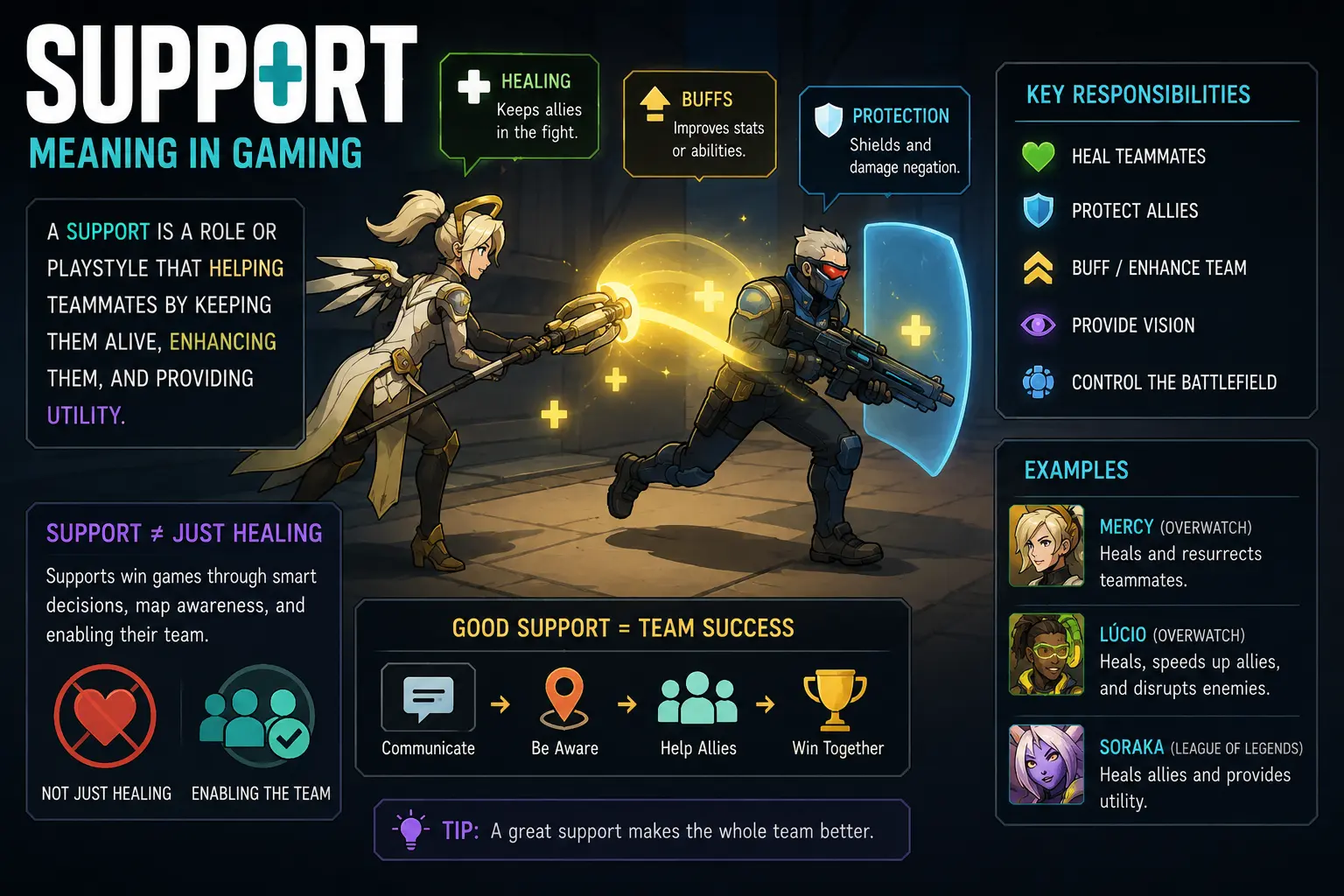
Support Meaning and Team Roles
Understanding what ‘support’ means in gaming helps players see beyond scores and raw damage. Supports are critical for sustaining teammates, controlling sightlines, and enabling plays through healing, shields, and utility. This overview explains how support roles contribute to team cohesion, communication, and strategic tempo. By clarifying responsibilities and expectations, teams can align around a shared meaning of support across genres and metas. The guide connects the concept of support to practical team dynamics, role clarity, and collaborative success.
What ‘Support’ Means in Multiplayer Games
In multiplayer games, ‘support’ refers to a role whose primary responsibility is enabling others rather than maximizing personal damage. A support’s core purpose is to keep teammates alive, create safer windows for attacks, and provide the tools that make team fights flow smoothly. This requires a blend of healing, shields, buffs, vision, and utility that coordinates with teammates to sustain pressure, respond to threats, and unlock opportunities that damage-focused players could not achieve alone.
Healing and sustain are foundational, but they are only part of the picture. In most team-based matches, staying power means more than raw HP; it also means managing cooldowns, allocating resources, and timing heals and shields to coincide with enemy cooldown windows. A strong support reads the flow of a skirmish, prioritizes targets who are most at risk, and communicates intentions clearly so teammates can act with confidence. The best supports anticipate danger before it happens, pre-emptively position themselves, and keep escape routes open for allies who get caught out of position.
Vision and information control are equally vital. Many teams rely on supports to gather intelligence about enemy rotations, ward or scan key areas, and communicate intel that allows others to trade efficiently or disengage when needed. Utilities such as cleanses, stuns, displacement, or defensive cooldowns givemates a flexible toolkit that adapts to evolving threats. This capacity to shape tempo—faster or slower depending on the moment—distinguishes successful supports from those who simply nail healing numbers.
Finally, the fit between a support and the rest of the team is built on trust, timing, and shared expectations. The support’s job is not to compete with damage dealers for glory but to create leverage, reduce risk, and convert fights into favorable outcomes. Across genres—from MOBAs to shooters to RPGs—the core idea remains: a well-timed heal, a timely shield, a crucial ward, or a well-placed buff can turn a 3v3 into a decisive push for objectives.
Common Responsibilities: Healing, Shields, Buffs, Vision, Utility
Supports perform a suite of core responsibilities that collectively enable a team to endure engagements and execute coordinated plays. Healing and sustain keep allies alive through sustained exchanges, preventing early knockouts and maintaining pressure during skirmishes. Shields and damage mitigation provide a frontline of safety, absorbing damage that would otherwise force risky retreats. Buffs and stat boosts enhance teammates’ capabilities, often turning a marginal advantage into a decisive moment. Vision and information gathering reduce risk by revealing enemy movements and rotations, enabling safer objectives and better timing. Utility and crowd control offer flexible tools to disrupt, control, or reposition enemies, shaping fights so allies can capitalize on favorable windows.
- Healing and sustain: Restoring health during battles to keep teammates in the fight, preventing early deaths and allowing coordinated pushes without placing the team at risk.
- Shields and damage mitigation: Providing shields or barriers to absorb hits, reducing incoming damage and enabling safer positioning during skirmishes and objective contests.
- Buffs and stat boosts: Administering temporary enhancements that increase speed, strength, or survivability, helping teammates execute combos, escape danger, or finish difficult engagements.
- Vision and information control: Placing wards, scouting, and providing intel to prevent ambushes, reveal enemy rotations, and coordinate team movements for safer engages.
- Utility and crowd control: Selective disables, cleanses, repositioning tools, and supportive ultimates that reshape fights and create opportunities for allies to capitalize.
Supports also coordinate with damage dealers to maximize impact, requiring precise timing and communication. The following tasks capture the core duties that appear in most team compositions. Together, these tasks keep a team functional under pressure and adaptable to changing threats.
Support vs Damage Roles: Key Differences
Support and damage roles diverge primarily in intent, resource priority, and risk management. Damage-focused players maximize output, often trading safety for aggression and advancement of kill counts or objective pressure. Supports prioritize team survival, tempo control, and successful execution of team plans, even when it means sacrificing personal glory. This fundamental distinction shapes positioning, target selection, and cooldown usage. Where damage roles chase openings to maximize DPS, supports chase openings to prevent deaths and secure safer paths to victory.
In practice, this means supports will often peek less aggressively, allocate resources to teammates who can convert fights into objectives, and prioritize warding, peeling, and disengagement tools over flashy plays. Communication becomes the bridge between roles, ensuring that damage dealers know when healing windows exist, when shields will land, and when crowd control will set up an all-in. The end result is a team that can absorb pressure, sustain longer fights, and execute complex combos that would be risky without reliable support presence.
Playstyle differences also appear in itemization and cooldown management. Supports choose items that extend their healing throughput, increase their utility, or improve survivability, while damage players invest in raw damage, crits, and mobility. The synergy between the two roles relies on mutual trust and clear role boundaries, so each player understands when to lead, when to follow, and how to adapt as the situation evolves.
Historical evolution of the support role in gaming
The concept of support has evolved with the history of gaming itself. In early cooperative and arcade titles, healing and protection were often limited to a single character with few utility options, focusing on immediate survival rather than sustained tempo. As genres diversified, dedicated support archetypes emerged in RPGs and MMOs, offering varied kits that included healing, shields, crowd control, and buffs. The rise of multiplayer online battle arenas (MOBAs) amplified the role, making vision control, map awareness, and micro-rotation crucial to success. Here, supports became the catalysts for team cohesion, with emphasis on protect-and-engage play and coordination with damage dealers to maximize objective control and team fights.
In first-person shooters and battle royales, supports shifted toward mobility, utility, and revives, emphasizing resilience and the ability to sustain teammates during continuous engagements. Over time, meta shifts and balancing patches have driven further specialization: some games reward aggressive sustain and playmaking, while others incentivize stricter peel, disengage, or protective zoning. Across genres, the core idea remains the same: a well-timed heal, shield, or buff can turn a lost fight into a recoverable one, enabling teams to execute advanced strategies and maintain momentum under pressure.
Today, support roles are valued for role clarity, adaptive thinking, and empathetic teamwork. The most effective supports anticipate threats, communicate intentions clearly, and tailor their toolkit to fit the team’s composition and strategy. As interoperability across platforms improves, modern supports often blend healing with damage mitigation, information gathering, and high-impact crowd control—an evolution that reflects broader shifts toward collaborative design and player empowerment in contemporary games.
Across future metas, the enduring lesson for players and teams remains: success comes from orchestrating reliable protections, timely information, and purposeful utilities that align with the team’s objectives, rather than chasing individual glory alone. This is the essence of why the support role is indispensable to any organized, resilient team.
Key Features and Technical Specifications
Effective team play hinges on clearly defined support roles. This section outlines the key features of support meaning in gaming and the technical underpinnings that drive successful team interactions. You will learn how healing, shielding, crowd control, buffs, and debuffs translate into practical in-game decisions and how these elements interact with vision, rotation, and itemization. We also cover the expected performance expectations, communication patterns, and how to measure impact in a way that guides continuous improvement. By understanding these features, players can align team expectations, reduce role ambiguity, and build cohesive strategies that prioritize collaboration over individual damage output.
Core Abilities: Healing, Crowd Control, Buffing, Debuffing
Core abilities define what a dedicated support contributes to each encounter, balancing direct care with strategic disruption. The table below contrasts Healing, Shielding, Crowd Control, Buffing, and Debuffing by their effects, ranges, and ideal timing in team fights.
| Ability | Primary Effect | Typical Range | Ideal Timing |
|---|---|---|---|
| Healing | Restores ally HP over time or instantly, supporting sustain through poke and prolonged skirmishes. | 4–9 units | Early skirmishes and sustained lane pressure; cooldowns coordinated with damage taken |
| Shielding/Absorption | Creates a temporary shield that absorbs damage and buffers against burst damage. | 6–10 units | After a heavy enemy engage or to preserve carries during all-ins |
| Crowd Control | Stuns, roots, slows, or purges to disrupt enemy actions and purchases openings. | 6–12 units | At the start of fights or to interrupt enemy ultimates and channeling |
| Buffing | Improves ally stats such as movement speed, attack speed, or ability power for short windows. | 8–14 units | Pre-engagement or during rotations to maximize objective control |
| Debuffing | Reduces enemy defenses or applies hindrances, lowering their combat effectiveness. | 6–12 units | During counter-engages or when the enemy frontline groups up |
Healing and utility synergy is maximized when players coordinate with vision and objective spawns.
Itemization and Build Paths for Support
Itemization and Build Paths for Support. Selecting the right items requires balancing vision, sustain, defense, and timing to adapt to the evolving game state. Below is a practical outline of typical builds and where to pivot for specific matchups. The following items are presented as core categories; use them as anchors while adjusting to the enemy composition and your team’s needs.
- Vision and map control tools that provide early awareness and secure safe rotations, including warding items, sweepers, and trinket upgrades that reveal enemy movements.
- Healing efficiency and mana sustain items that extend a support’s presence in lane and fights by reducing cooldowns, increasing resource regeneration, and enabling longer skirmishes with less backtracking.
- Defensive auras and shield enablers that absorb damage, mitigate heavy bursts, and keep backline carries safer during dives, engages, and objective contests, with appropriate timing.
- Mobility and repositioning tools that help a support reach flank engages, escape unfavorable ganks, and rejoin teammates quickly, reinforcing coordinated rotations and safer capture of neutral objectives.
- Situational items that provide cleansing effects, additional CC control, or friendlier waveclear against certain opponents, enabling tailored responses to crowd control-heavy or poke-heavy lineups.
Core values include map presence, survivability, and utility timing.
Communication and Macro Techniques
Effective communication and macro play are as important as mechanics for supports. Shotcalling shapes when to engage, disengage, and rotate for objectives. Clear callouts like back in 5, ward placed, or no vision keep the team informed without overloading chat. Vision control is a discipline: regular ward placement, de-warding critical areas, and sharing ward timings so the team can plan around enemy sightlines. Rotations require precise timing and space creation: one member may push a side lane to draw attention while others collapse on a neutral objective. Macro play also includes cooldown management, target prioritization, and insurance plays to protect carries when fights break out. Consistency matters: agree on a standard shotcalling pattern, use concise terminology, and avoid blaming teammates for mistakes. You should practice routines for early pathing, lane swaps, and objective trades that adapt to the game state. The most successful supports blend proactive vision with reactive adjustments, using pings, chat, and pre-defined sequences to keep the team synchronized during both calm phases and chaotic skirmishes. Practical tips include establishing a primary caller for each phase of the game, such as early game, mid game, and late game. A dedicated shotcaller tracks timers, while another player handles vision and micro-communication. Use go-to callouts for common scenarios and train with your team to internalize these phrases for faster, calmer decision-making during pressure.
Performance Metrics and KPIs for Supports
Performance metrics for supports extend beyond raw damage numbers to capture how well a player enhances team survival, consistency, and objective control. Core KPIs include vision score, which combines wards placed, wards cleared, and map control, and is reinforced by metrics around objective timing. Wards per minute and time spent with teammates to protect carries quantify map presence and team safety. Healing per minute and shielding per minute measure your direct care output, but should be contextualized against the damage you prevent and the lives saved during critical fights. Assist participation, not just final blows, reflects your contribution to team fights; higher involvement during objective fights indicates better peel and support uptime. Objective involvement tracks dragons, Barons, turrets secured or defended, and successful trades that preserve map control. Moreover, cooldown efficiency shows how often you align ultimates and shields with team initiations, preserving or turning engagements. Another valuable KPI is carry uptime: the percentage of time your main damage dealers remain alive and able to output DPS during pushes and defense. Finally, the quality of callouts and communication can be assessed via peer reviews, focusing on timeliness, conciseness, and accuracy of information shared during matches. Use these metrics to identify gaps, set incremental goals—such as increasing vision uptime by 15 percent or improving assist contribution in the early game—and tailor practice drills to reinforce better macro decisions and greater team cohesion.
Benefits, Use Cases, and Competitive Differentiation
Support meaning in gaming is about how dedicated non damage roles shape the outcome of a match. This section explores why having a clear support function matters for team cohesion, information flow, and sustained frontline presence. It also covers how supportive play translates into tangible advantages across casual play, ranked ladders, and professional scenes. By examining use cases, shiftable roles, and potential meta impacts, readers will gain a practical understanding of what constitutes effective support. The discussion also highlights how teams differentiate themselves through well defined support structures and proactive communication.
Why Teams Need Dedicated Supports
Dedicated supports bring a set of tactical tools that complement carries and junglers while shaping the game’s broader tempo. The first advantage is sustain and survivability: healing, shielding, and mitigation extend team fights and allow damage dealers to reach their power spikes. This directly increases win probability in longer skirmishes where raw damage cannot decide the outcome quickly. In addition to direct healing, supports enable safer engages and disengages through crowd control, peel, and zone denial, reducing the risk that a single misstep snowballs into a lost fight. A strong vision game is another strategic asset: consistent warding, de-warding, and map control improve information flow, guiding roams, objective timings, and counterplays. When teams share reliable information, they rotate more efficiently, contest important choices like dragons and towers, and punish opponents for overextensions with timely engages or disengages. Macro control is the third pillar: supports help manage the team’s resource economy by timing ultimates, shields, and utility item actives so that the damage dealers hit critical power windows. By aligning cooldown usage and objective sequencing, teams maximize DPS during pivotal moments rather than wasting resources on low value trades. The synergy between supports and carries is a force multiplier; a timely shield on a key ally can unlock a damage window that would be inaccessible otherwise. Communication and role clarity are essential: a well defined support tracks enemy engages, calls out opportunities, and respects pacing to keep the team synchronized. Finally, adaptive play matters. Support players monitor patch notes, item changes, and objective timers, testing new approaches in practice and guiding the team to adjust their playbook as the meta evolves. In short, the tactical and strategic advantages of dedicated supports lie in stabilizing the frontline, shaping information flow, and coordinating the team around disciplined, objective driven plays.
Use Cases: Casual Play, Ranked, Esports, Co-op PvE
Across different play contexts, the core responsibilities of a dedicated support shift to emphasize the specific tempo, risk, and learning curve of the environment. In casual matches, the role becomes a catalyst for participation and learning. Supports provide reliable sustain, consistent vision, and low risk setups that let less experienced teammates experiment while staying protected. The result is less friction and more opportunities to practice fundamentals without heavy penalties. In ranked games, emphasis moves toward reliability and efficiency. Supports manage resources, time roams to maximize objective pressure, and maintain deep information flow to help carries land skill expressions. They work on stabilizing the map, rotating to contests, and coordinating safe engages that yield wins without exposing teammates to needless risk. Vision control becomes a currency: ward timing, map reads, and denial of enemy information. The goal is to create deterministic outcomes in uncertain situations, preserving the team’s tempo when the lead feels fragile. In Esports and Pro Play, supports execute with higher precision and strict formation. They practice standardized engage sequences, peel patterns, and shot calling that keeps team members in sync during fast high stake fights. Communication is concise, timers are shared, and players rely on champion specific synergies. They test new combos in scrims, adjust to patch notes, and constantly refine macro decisions that influence vision, rotation, and objective fights. In Co op PvE and Raids, the value of support is measured by how it sustains multiple players through mechanic heavy boss encounters. They coordinate cooldown windows, share alerts about mechanics, and shield teammates during risky phases. Their role is to balance DPS windows with survivability, ensuring that groups can endure long encounters while learning patterns and strategies. Across all contexts, successful support play depends on clear expectations, disciplined positioning, and proactive communication. Teams that align on these patterns can convert small advantages into meaningful, game changing outcomes.
Casual Play
In casual play, supports amplify the fun by maintaining lane safety, providing reliable heals and shields, and guiding teammates through simple macro plays that reduce frustration and promote consistent participation.
Ranked Play
In ranked contexts, supports optimize resource economy, coordinate roams, and maintain vision pressure, creating safer engages and reliable shot calling that helps teammates convert outplays into steady ladder progress.
Esports and Pro Play
In Esports and Pro Play, supports specialize in synergy with junglers, execute precise engage or peel routines, stabilize comms, and practice standardized rotations that compress error margins under high pressure.
Co-op PvE and Raids
For co op PvE and raids, supports sustain teams through Boss phases, share mechanic alerts, shield teammates, and coordinate crowd control to maximize DPS windows and minimize wipe risk.
How Support Can Shift Competitive Balance
Across the competitive landscape, support play influences both micro interactions and macro outcomes. Effective supports extend the lifespan of carries, allowing them to remain threats during chaotic team fights. They also alter the perceived threat level of engages, forcing enemies to respect peel and kite patterns rather than commit freely. The table below highlights the key levers by which supports influence meta balance, along with typical impact ranges and practical implications. By mastering these levers, teams can craft draft strategies that exploit gaps in enemy setups and sustain pressure through critical objective windows. As patches adjust item power, timers, and cooldowns, adaptable supports keep team compositions viable by recalibrating focus toward safer engages, stronger vision networks, and better cooldown synchronization. In practice, the most successful teams treat support as a central hub for information, tempo control, and risk management, rather than a secondary utility layer. This mindset helps teams convert small advantages into meaningful, game changing outcomes and makes support a truly pivotal role in modern play.
Examples of Support-Driven Win Conditions
Support driven win conditions emerge when vision, peel and utility create opportunities that others cannot exploit alone. In the early game, a well timed ward line and a safe poke trade can set up a favorable lane phase for your carry to scale into mid game. By preserving summoner spell timing and ensuring safe recalls, a support can keep teammates prepared for dragon or objective fights. In mid game, a coordinated engage sequence that begins with a tank frontline and ends with a multi carry meltdown can swing a team fight even when the gold graph is even. During late game scenarios, reliable peel and disruption are often worth more than raw damage, letting your carries land the decisive abilities. A key win condition is maintaining objective pressure while minimizing the enemy’s ability to contest. Finally, good communication around cooldowns and threat, a willingness to sacrifice for the team’s macro goals, and precise execution in clumped team fights frequently decide matches that might otherwise slip away. The most reliable supports continually read the battlefield, adapt their decisions to the enemy’s patterns, and align with the jungler and mid laner to force advantageous engagements. When these conditions align, the team can convert small tactical edges into decisive victories.
Pricing, Plans, and Limited-Time Offers
This section examines how pricing strategies, subscription plans, and limited-time promotions shape the meaning of ‘support’ in gaming. Monetization decisions influence which tools, abilities, or cosmetics are accessible to players serving supportive roles. We explore how free-to-play and paid experiences alter the availability of healing, shields, vision, and utility features. We also consider how seasonal offers, battle passes, and store items redefine how teams collaborate and rely on supportive play. Understanding the pricing dynamics helps players evaluate what support means in different game economies and how players communicate expectations within teams.
Free-to-play vs Paid Content Impacting Support Playstyles
Free-to-play titles often restrict advanced support tools behind a free access baseline or a grind to earn premium currency. Players typically start with a core set of healing, shielding, and utility options, while more potent or flexible tools require purchases or earned progress. The difference is not just cosmetic; it changes how teams coordinate, with non-paying players often relying on limited cooldowns, shorter buff durations, or weaker vision instruments. Developers frequently design the baseline to feel useful enough to attract newcomers, but they layer on monetized upgrades to widen tactical options for those who invest, creating a spectrum of playstyles within the same game. This division can subtly shift decisions in the draft phase and in mid-game rotations, as the presence or absence of premium tools nudges players toward different supportive approaches.
Paid content expands the toolbox: unlocks longer-lasting shields, faster healing, instant status clears, or support-oriented augments that alter movement, line-of-sight, or cooldown management. When these tools are accessible primarily through purchases, teams may lean on players who have invested to provide reliability in critical moments, changing how a roster prioritizes sustain versus burst protection. The upshot is a shift in the traditional definition of support—from a stable, teamwork-first role to a hybrid one where personal investment unlocks extra utility. Even when the game remains balanced overall, the perceived value of different support builds can diverge between payers and non-payers, influencing practice habits and coaching discussions.
However, publishers counterbalance this effect to avoid pay-to-win dynamics. They often cap the gameplay impact of paid tools, preserve a robust baseline for all players, and separate cosmetics from power. They may also use rotating access models, time-bound unlocks, or optional microtransactions that reward experimentation without guaranteeing victory. In practice, this means that a well-coordinated squad can operate effectively with the free toolkit, while paying players gain optional enhancements that feel empowering but not decisive. The result is a spectrum of support playstyles that rewards strategy and teamwork as much as spending, rather than letting price dictate outcomes.
Monetization Effects: Skins, Items that Change Support Visibility
Cosmetics and visibility shapes how players perceive support in a match. Skins, voice lines, emotes, and aura effects can signal a healer’s readiness or a tank’s protective posture, which helps teammates time shields and heals more confidently. Even subtle color shifts or glow timing can cue an ally to expect a defensive pulse, creating clearer team communication without explicit chat. In free-to-play economies, cosmetic items are typically the primary monetization stream, so designers often experiment with signals that feel meaningful but do not alter core power. This dynamic keeps the social contract of support intact while offering a vanity lane for monetization.
Beyond cosmetics, some items may temporarily alter how support visibility behaves in the UI. For example, icons that pulse when healing is active or shields are refreshing can help teammates track remaining protection, particularly in chaotic teamfights. Although these features are cosmetic or informational, they directly affect decision-making and can improve coordination. Developers must ensure that such tools do not reveal hidden mechanics or provide unintended advantages, preserving a fair environment for all players. The balance hinges on keeping the perception of utility high without turning it into a power shift that can be bought.
In practice, the best-performing supports in monetized games are those who maximize teamwork using the tools everyone can access. Creators encourage experimentation with skins and signals while gating any gameplay-affecting advantages behind responsible progression, ensuring that a good plan, timing, and communication remain decisive factors. By maintaining clear, visible cues that help teammates read the moment, developers reinforce the social aspects of support and keep the role central to game flow, irrespective of cosmetic purchases.
Season Passes and Their Effect on Support Meta
Season passes and seasonal rewards can reshape the support meta by guiding players toward certain build paths and playstyles. Passes often include quests that reward careful healing rotations, timely shielding, or vision control, nudging players to experiment with supportive synergies you might not try in a freeform ladder. The unlocked cosmetics and XP boosters create a sense of progression that encourages players to invest time in mastering those tools, contributing to a more cohesive team approach during the season. Because rewards rotate, teams may discover new lineups that emphasize sustain, poke, or crowd-control utilities as the meta evolves between patches.
Seasonal objectives can also modify practice habits. Players who chase season-specific tasks are more likely to explore underused support kits, test alternate aura timings, and coordinate trinket placements with map objectives. This exploration helps broaden the pool of viable support configurations and reduces stagnation in team drafts. On the flip side, meta shifts introduced by season passes can put pressure on players to adapt quickly to new rewards, potentially sidelining traditional support playstyles that do not align with the current season’s theme.
Developers balance this by ensuring season rewards amplify rather than override core gameplay. They typically detach power from cosmetic rewards and assign functional benefits in a way that remains accessible across player skill levels—so a new season’s queue remains fair for all teams. They also publish notes that explain how season mechanics affect roles like support, helping players calibrate their expectations and adjust their communication and rotation plans accordingly. The outcome is a more dynamic but still grounded support landscape that shifts with the season without erasing established teamwork norms.
How Developers Balance Support Without Pay-to-Win
Balancing support without pay-to-win requires clear design guidelines. The core power of healing, shielding, vision, and utility should remain available to all players through base progression and skill-based play, independent of purchases. Monetization should focus on cosmetics, optional conveniences, or time-limited boosts that do not grant immediate, game-changing advantages in a skirmish or long-form fight. When a game offers premium content, developers often separate it from the core power curve and ensure that competitive modes use the same balance across storefronts. This separation preserves trust and keeps match outcomes determined by player skill and teamwork rather than wallet size.
Practical approaches include gated access to premium tools behind non-time-limited progression tracks, difficulty-based unlocks, or cosmetic-adjacent signals that do not alter damage, healing amounts, or shield strength. Some titles also rely on rotating storefront items that are available to all players over time, so no one is permanently advantaged. Transparent communication about what is paid versus what is earned through gameplay helps players gauge their own ambitions and reduces resentment in the community. The result is a healthier ecosystem where support meaning rests on collaboration, not monetization leverage.
Additionally, developers commonly employ balance tests, telemetry, and community feedback to refine support mechanics. They monitor win rates, pick rates, and cooldown dynamics across modes to ensure that paid options do not disproportionately impact outcomes. They may implement fallback adjustments during patches to prevent any paid tool from becoming a must-have for victory. The overarching objective is to keep support meaningful as a team function, not as an insurmountable gap between paying and non-paying players.