Lore Meaning: Storytelling in Video Games Overview
Lore meaning in gaming extends beyond lore as mere background texture; it is the backbone of worldbuilding and character motivation. It shapes why factions exist, why conflicts erupt, and why players care about outcomes. Through crafted histories, myths, and rule systems, lore anchors gameplay to a believable universe. Good lore supports coherent narrative design while inviting player exploration, fan theories, and emotional investment. In modern titles, immersive storytelling often balances ambient details with explicit explanations, guiding players through meaningful discoveries without slowing interactivity.
What is lore in gaming?
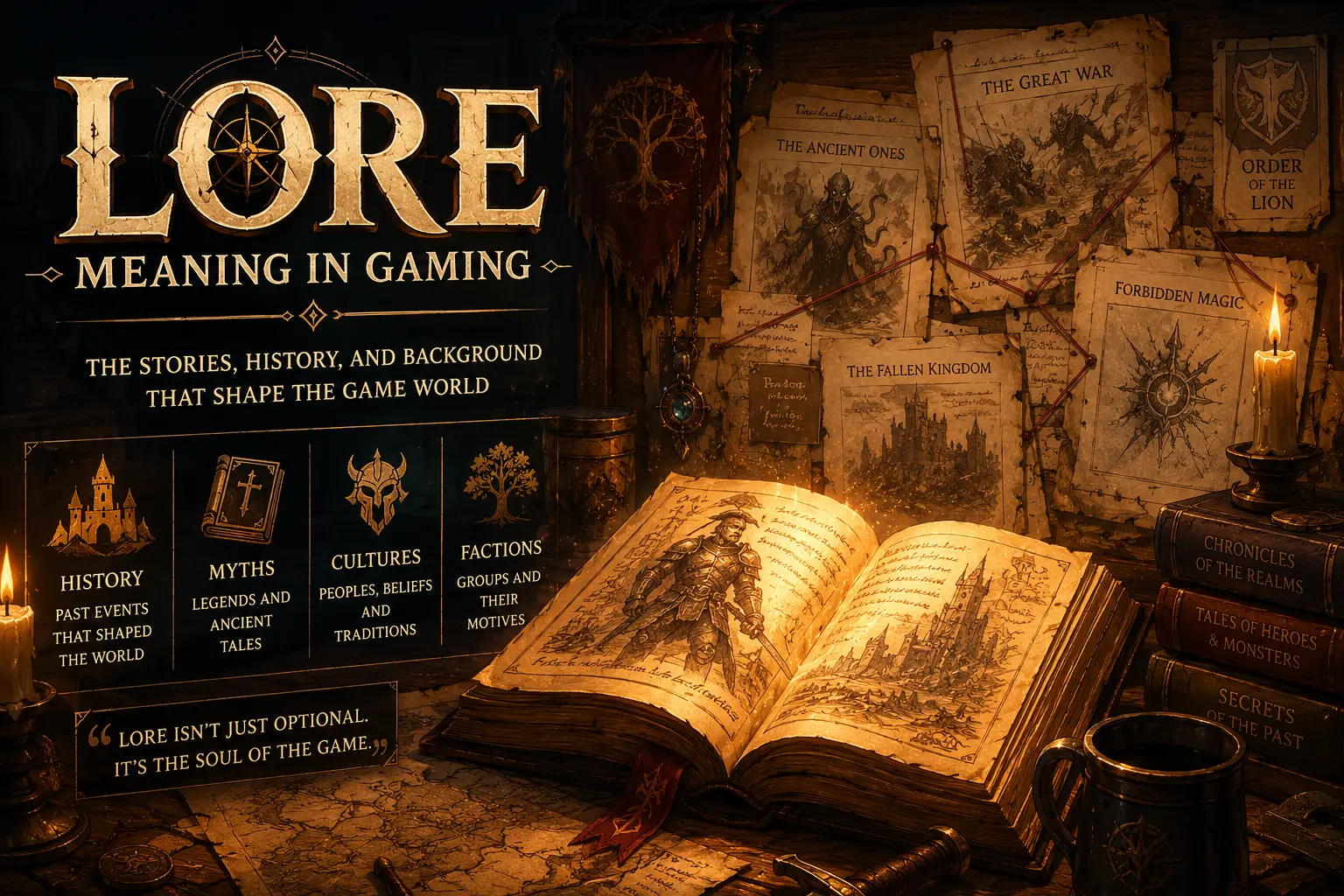
Lore in gaming refers to the collective background knowledge that gives a game world its depth: histories, myths, factions, and the causal rules that govern how things work.
It goes beyond what is shown on screen, existing as a map of connections players can discover, debate, and piece together.
Good lore serves as both scaffolding for the story and fuel for curiosity, inviting players to read codices, parse dialogue, and track timelines.
It provides motive for characters and constraints for events, ensuring choices matter within a coherent universe.
In practice, lore acts as a bridge between narrative design and world design, ensuring that storytelling informs gameplay and that gameplay reinforces world consistency.
Explicit lore communicates facts directly, while implicit lore rewards observation and inference, creating a dynamic dialogue between what the game says and what the player deduces.
A robust lore framework supports character development by giving protagonists and antagonists clear histories, believable motives, and evolving relationships that unfold as players explore, fight, and negotiate alliances.
Lore also defines the rules of the world, such as how magic works, what limits exist on technology, and why certain events change the course of civilizations.
As new entries, sequels, or expansions arrive, designers must decide how much is revealed, what is revised, and how continuity is preserved across different platforms and media.
Ultimately, lore is not just exposition; it is a tool that shapes atmosphere, motivates exploration, and deepens emotional resonance through a well-tuned mix of explicit information and suggestive detail.
For readers and players, the meaning of lore in gaming is a promise: a living, narratively coherent world that invites ongoing engagement and interpretation.
Types of lore: explicit vs implicit
Understanding explicit and implicit lore helps players gauge what matters in a world already dense with symbols, symbols that often carry more weight than spoken lines. When designers layer documents, dialogue, and world cues, they invite ongoing interpretation rather than prescribing a single reading.
These forms coexist across many titles, informing how players understand worldbuilding and narrative coherence.
- Explicit lore is openly stated through codices, dialogue, cutscenes, and official manuals, providing clear facts, timelines, and relationships that anchor the game’s world.
- Implicit lore hides connections in environmental storytelling, subtle dialogue, and scattered details that players assemble into a cohesive history using inference and pattern recognition.
- Mythic lore draws on legends, prophecies, and recurring motifs to evoke a living mythos that evolves as players uncover more secrets.
- Environmental lore arises from art direction, flora and fauna, architectural debris, and architecture that imply history without stating it outright.
- Player-driven lore emerges when communities theorize, map connections, and preserve lore through mods, wikis, and fan-made timelines that enrich canonical understanding.
These forms influence how players engage with quests, environments, and character arcs, and they shape a shared sense of what is possible within a game’s world.
How lore supports narrative and immersion
Lore supports narrative and immersion by providing a stable framework for the plot and the world to feel coherent.
When designers establish rules for magic, technology, and politics, players experience consistency across quests, dialogues, and environmental cues.
Foreshadowing and payoff emerge naturally when earlier lore hints align with later events; players feel rewarded for memory and attention.
Immersive storytelling thrives on subtle cues: a mural speaks of a defeated empire; a rumor explains a treaty that shapes a current conflict.
Character development benefits from lore by deepening backstories, providing motivations, and clarifying how relationships evolve under pressure.
Narrative design in gaming relies on pacing — revealing layers gradually, allowing player agency to steer when to pursue certain threads, and letting outcomes hinge on informed choices.
Dynamic or evolving lore can respond to player actions in some titles, preserving immersion while acknowledging player influence on the world.
The emotional impact of a well-timed reveal can redefine a player’s connection to a character, a faction, or a place, turning curiosity into empathy.
Balancing lore and gameplay is a core challenge: exposition must not overwhelm action, and mechanics must reinforce story rather than obstruct it.
Ultimately, robust lore underpins the fan experience and long-term engagement, guiding community discourse and sustaining interest across expansions.
When lore aligns with audio design, music, sound cues, and visual language, players receive multi-sensory signals that crystallize the mood of a scene.
Developers may also use codices and optional dialogue to let curious players dive deeper, ensuring access for newcomers while rewarding veterans who remember minute details.
Consistency across platforms and media—game, comics, and companion apps—helps preserve immersion and supports a credible, enduring universe.
In cooperative play, shared lore becomes a bonding mechanism, as teams reason about outcomes, coordinate strategies, and negotiate interpretations of ambiguous events.
In short, lore meaning in gaming is about enabling narrative depth that respects player intellect, invites exploration, and fosters emotional resonance through a well-tuned mix of explicit information and suggestive detail.
For developers, the goal is not to provide every answer but to cultivate a sense of mystery that gradually unfolds into a satisfying and memorable arc.
As games evolve through patches and sequels, maintaining a core mythos while allowing flexible interpretation helps preserve trust and anticipation.
Common lore delivery methods (quests, codex, environmental storytelling)
Quests serve as vehicles for lore by embedding backstory in objectives, choices, and consequences that players experience firsthand.
A codex or in-game journal collects lore in a structured, searchable format, letting players track dates, factions, and key events at their own pace.
Environmental storytelling communicates history through space: ruined temples, signage, artifacts, and terrain design imply a timeline without explicit narration.
Dialogue and cutscenes provide direct exposition or character perspective, while player agency allows reactions that shape perception of the lore.
Audio cues, visual motifs, and recurring symbols reinforce themes and help players feel a connected world across scenes.
Balancing these methods requires clarity and restraint; overloading players with lore during action scenes can break immersion, while too little detail invites speculation that may destabilize coherence.
Developers often layer methods, starting with core, obvious lore and layering hints and optional deep-dives that reward curious players later.
Localization and accessibility should preserve meaning in every method, ensuring that lore remains legible to players across languages and cultural contexts.
Examples across genres show that well-delivered lore enhances player satisfaction, turning a simple quest into a memorable journey when the world feels discoverable and consequential.
Even micro-interactions, like a recurring insignia or a prophecy that reappears in different areas, can bind disparate moments into a coherent arc.
Ultimately, effective lore delivery respects pacing, offers clear anchors for newcomers, and invites long-term fans to dive deeper without breaking the flow of gameplay.
Core Features and Benefits
Lore in gaming goes beyond backstory, shaping why characters act, how factions collide, and why players care about the worlds they explore. A strong lore framework anchors immersive storytelling, balancing narrative depth with gameplay mechanics. From ancient prophecies to hidden diaries, lore provides context for player choices and world events. Designers weave worldbuilding, character arcs, and environmental storytelling to create a living, breathing universe. This section explores core features and benefits of lore in video games and how narrative design enhances player engagement.
Character and faction development
Lore deepens character and faction development by providing motivations, histories, and contradictions that fuel drama. When players understand a character’s past and the pressures of their faction, every decision gains weight and every relationship becomes more nuanced. Lore explains why allies trust or betray one another, how rivalries originate, and how loyalties shift under stress. This depth allows writers to craft arcs that respond to player actions, producing meaningful consequences rather than static archetypes. Worldbuilding and history become living tools for character growth, as individuals react to revelations that reframe their goals and alliances. Players form stronger connections with groups and leaders who feel as real as the protagonists. The most memorable factions have coherent backstories, rival agendas, and evolving dynamics that react to the player’s evolving role in the world. When lore is intertwined with progression systems, character development becomes an engine for both storytelling and gameplay, encouraging investment and long term commitment. The goal is to create characters who carry the weight of a shared world, whose choices ripple across political landscapes and alter the course of events, inviting players to see themselves as agents within a larger narrative. Factions gain texture through relics, codes, and culture that players can discover, interpret, and contest. Their leaders emerge from histories that players gradually piece together, creating a sense of mystery and anticipation. In sum, strong lore gives characters both motive power and moral ambiguity, enabling players to build relationships that reflect a living, shifting world. This dynamic alignment between backstory and player action is what makes group dynamics feel authentic and memorable. Developers can seed conflicts through competing factions with overlapping claims, allowing players to negotiate, ally, or oppose based on the stories they uncover. By tying character fates to faction outcomes, game design ensures that narrative stakes scale with the player’s influence. New factions can emerge from past events, reshaping alliances and offering fresh entry points for veterans and newcomers alike. Character arcs can hinge on secrets uncovered during exploration, forcing players to reevaluate loyalties. The result is a chorus of voices within the world that responds to time, choice, and consequence.
Worldbuilding and setting depth
Worldbuilding and setting depth transform simple gameplay into a believable, living universe. The best games balance explicit lore with environmental storytelling, allowing players to discover the world at their own pace.
| Technique | Description | Example |
|---|---|---|
| Codex and diaries | In-game books and notes convey history, factions, and magic rules through artifacts placed in the world. | The Witcher series uses in-world tomes and letters to reveal political tensions. |
| Environmental storytelling | Architecture, props, and spatial layout tell stories without dialogue, hinting at past events and power structures. | Dark Souls style architecture implies tragedy and ancient covenants. |
| Dialogue and revelations | Key conversations reveal lore gradually, creating suspense as players unlock backstories. | Mass Effect reveals galactic history through character arcs and mission briefings. |
| Faction politics and timeline weaving | Lore tracks factions and events across regions, showing cause and effect for player decisions. | The Elder Scrolls guilds and prophecies shape the world state over time. |
Worldbuilding depth is reinforced by recurring myths, artifacts, and map landmarks that fans reference when discussing theories.
Player engagement and replayability
Lore can boost replayability by inviting players to approach the world from multiple angles. Each discovered thread offers a new path through quests, dialogues, and hidden memories.
- Lore-driven side quests invite players to uncover hidden histories through letters, journals, and environmental clues, encouraging careful exploration and deduction beyond main objectives.
- Branching lore conversations unlock alternate perspectives on characters and factions, creating multiple dialogue paths that reward replay with new insights and choices.
- Hidden lore entries can alter world states or unlock powerful rewards on subsequent playthroughs, increasing curiosity and the value of revisiting familiar maps.
- Fan theories and community discoveries fuel ongoing engagement, as players compare notes, test hypotheses, and create shared meaning that outlives a single play session.
- Seasonal events and narrative events shaped by lore encourage anticipation, as players look forward to new chapters and the revelation of long-held secrets.
Designers can maximize this by making secrets accessible through skill checks, map exploration, and choice-driven outcomes that compound across playthroughs. This creates a loop of curiosity that encourages repeated attempts to see every possibility.
Supporting player agency and emergent narratives
Player agency in narrative driven games hinges on a lore framework that makes choices feel consequential. When the world remembers actions, reputations shift, and alliances realign, players sense that their decisions carry weight beyond the immediate moment. Lore provides cause and effect that ties quests together, so a decision in act one can influence NPC attitudes, available tools, and even access to future chapters. This continuity encourages players to plan, test alternatives, and accept responsibility for outcomes rather than treating the game as isolated puzzles. A well designed lore backbone also supports emergent narratives by letting procedural or player driven events interact with established history in believable ways. Leaders, factions, and locales respond to player conduct with evolving diplomacy, sanctions, or rewards, creating a living map of value and risk. The result is a narrative that accommodates different playstyles, from cautious exploration to bold, decisive action, while preserving coherence across moments of discovery. By providing clear motifs, recurring symbols, and shared myths, lore helps players interpret new events through familiar lenses, making each playthrough feel like a fresh chapter in a larger saga. Designers should balance stable world rules with flexible outcomes, ensuring players can influence outcomes without breaking the world’s consistency. In practice this means scripting key decision points that trigger visible changes, while leaving room for unexpected twists driven by player curiosity. Finally, strong lore invites communities to speculate, test theories, and celebrate moments when a long shot choice rewrites a beloved narrative arc. This approach also helps accessibility by providing a consistent framework that players can learn and reference, reducing confusion while preserving mystery. When lore threads converge during climactic moments, players feel a sense of agency and ownership that transcends individual play sessions. By anchoring choices to meaningful lore, developers can design flexible winding paths that accommodate experimentation, ensuring that curiosity remains the primary driver of progression. This combination keeps players returning for fresh discoveries time and again across seasons. Ultimately lore serves as the map and compass.
Competitive Position, Specifications, and Use Cases
Lore meaning in gaming extends beyond a backstory. It informs character motivations, world conflict, and player choices that ripple through missions and updates. A strong lore frame helps players remember why factions exist, why events matter, and how their actions reshape the world. In this section we explore how lore shapes competitive positioning, guides narrative design, and drives player engagement. We also examine practical specs for building lore systems that scale with both live service projects and indie development. The goal is to link storytelling depth with measurable outcomes in reach and emotional resonance.
How lore differentiates games in the market
Lore differentiation in a crowded market hinges on how players encounter backstory, how accessible it remains while offering depth, and how it evolves across expansions, seasons, and DLC to make a living world feel responsive rather than static.
Concrete differentiation comes from proven patterns like environmental storytelling, codex systems that reward curiosity, character driven arcs that align with player choices, and worldbuilding that scales with post launch content, turning lore into a driver of gameplay rather than a garnish.
- Environmental storytelling through artefacts and codex entries in the Witcher series rewards players for exploration, turning side quests into world building that deepens lore without stalling action.
- Masterful worldbuilding in open worlds like The Legend of Zelda Breath of the Wild connects landscapes, lore fragments, and recurring motifs to create a cohesive mythos.
- Storytelling through evolving narratives in live service games such as Destiny uses seasons to expand lore, aligning character arcs with shifting factions and new planetary histories.
- Character driven narratives in Mass Effect invite player choices to ripple across the galaxy, shaping alliances, memories, and future events while preserving a central mythic arc.
- Evolving lore in FromSoftware titles like Dark Souls relies on atmosphere, item descriptions, and ambiguous lore to spark fan theories that sustain engagement beyond gameplay.
When these approaches are combined with a clear governance model and a shared glossary, players encounter a coherent canon across campaigns, spin offs, and media, making the world feel expansive yet navigable.
That connection translates into stronger brand loyalty, longer play sessions, and richer fan engagement as players share theories and revisit moments to uncover new implications and shifting loyalties.
Technical and design requirements for robust lore integration
Robust lore integration starts with architecture that treats lore as data first. A central glossary and linked ontologies capture characters factions places events terms and relics in a way that all teams can reference quickly. A modular data model supports cross game continuity, enabling re use of lore snippets across campaigns and platforms while keeping localization consistent. Clear ownership lines ensure that narrative designers writers and engineers stay aligned on naming conventions data schemas and version control so that updates to lore do not drift from gameplay intent.
Design patterns for lore systems emphasize discoverability and re playability. Tagging subplots with metadata helps create dynamic quest lines and easter eggs that dialogue systems and quest editors can reuse. Content pipelines should support branching transcripts and alternate timelines without fragmenting the canon. Tools such as content management dashboards wire into QA check lists and automated tests that verify references between characters events and factions remain coherent after patches or balance changes. Localization teams must have access to glossaries and dialogue trees to preserve meaning in multiple languages.
World building must scale with post launch content. Developers should plan a long term narrative spine with pivot points that guides new chapters while preserving fan expectations. Ambient lore such as item descriptions environmental cues and non player character dialogue should reinforce core themes rather than repeating exposition. The best practice is to separate canonical facts from speculative elements so fans can discuss theories while the game remains internally consistent. Continuous feedback loops let players feel heard and help shape future lore through surveys and in game polls.
Testing and governance are essential to prevent lore fragmentation. Regular cross discipline reviews align marketing localization narrative design and gameplay teams on the shared canon. A governance model should document changes track decisions and archive older lore for reference. A robust pipeline includes version control for lore assets with rollback options and automated checks that flag contradictions between quest lines faction histories and character arcs.
Use cases: single-player, multiplayer, live-service, indie
Single player experiences balance a tightly authored arc with optional lore that rewards exploration. A central mission should matter, while codex entries and environmental hints offer context that players uncover at their own pace. This approach keeps pacing intact while still delivering depth for devoted fans.
Multiplayer and co op titles rely on a shared mythos that players carry into every session. Faction histories and recurring rituals create social ties and strategic choices, while lore must be accessible enough for new players to join without feeling lost. The design goal is a common frame that supports cooperation and competition alike.
Live service games extend lore through seasons and events that unfold over time. This cadence sustains interest, invites experimentation with character arcs, and motivates participation in community driven discussions. Indie games often lean on sparse but potent worldbuilding where players assemble the larger story from small clues, delivering strong emotional payoff through implication rather than explicit exposition.
Measuring lore impact: KPIs and player feedback
KPIs for lore strength include engagement with lore assets such as codex reads per session and time spent in dialogue trees, as well as the frequency of lore related discoveries across play sessions. Instrumented quests that reference past events provide measurable signals of memory retention and narrative coherence. Dashboards can track glossary hits and cross references to verify consistency with canonical timelines.
Qualitative feedback channels matter as much as numbers. Surveys and in game polls invite players to rate clarity, emotional impact, and perceived relevance of lore to gameplay. Community forums and short interviews reveal fan theories and expectations, guiding future content design. Regular lore audits across teams help maintain a stable canon while allowing creative growth through new chapters and seasons.
In addition, metrics on player retention after lore heavy milestones and sentiment analysis of fan discussions provide a holistic view of lore effectiveness. A transparent process that shows how feedback informs updates strengthens trust and long term engagement.
Pricing, Plans, and Special Offers
Pricing, plans, and special offers are not just about price points; they shape how players access lore-rich experiences and engage with storytelling over time.
In lore-heavy games, transparent pricing helps communities understand value, while flexible plans can accommodate both casual players and dedicated fans.
This section explores monetization models, licensing dynamics, and community incentives that support immersive storytelling without compromising player trust.
By combining thoughtful pricing with meaningful narrative content, developers can sustain long-term storytelling and deepen worldbuilding.
The goal is to balance accessibility, fairness, and the emotional connection players have with the characters, factions, and histories that drive the game.
Monetization tied to lore: expansions, DLC, and cosmetics
Monetization tied to lore does not merely add price tags to an evolving world; it provides a framework for ongoing storytelling that respects player time, curiosity, and emotional investment.
By anchoring expansions, cosmetics, and season-based content to in-game history and character arcs, developers invite players to participate in a living narrative rather than simply acquire digital goods.
- Story-driven expansions unlock a new arc that reveals ancient factions, guiding players through hidden histories while offering fresh quests, characters, and gear that feel earned through lore momentum and continuity.
- Cosmetics tied to legendary events create identity, letting fans display allegiance to factions or characters whose stories evolve with narrative seasons, culminating in gear that signals their place in myth.
- Season passes that unlock lore chapters offer a dependable cadence for storytelling, rewarding participation with lore-rich cutscenes, journal entries, archival maps, and new dialogue options that deepen immersion and exploration.
- Narrative-driven cosmetic bundles and microtransactions emphasize meaningful rewards rather than random chance, reinforcing character arcs and worldbuilding while maintaining fair value for players across all platforms and over multiple seasons.
- Lore-forward DLCs encourage collaboration with community creators, offering scripts, voice lines, or art packs that enrich shared mythologies and extend longevity for players worldwide to discover and discuss together online.
When lore drives value, purchases feel like entries in a personal diary of discoveries rather than deceptive hooks.
This alignment between narrative design and monetization creates a durable relationship with the audience, supporting future storytelling and sustainable growth.
Licensing, adaptations, and transmedia opportunities
Licensing, adaptations, and transmedia opportunities extend a game’s lore beyond its initial platform, offering benefits to players and creators when managed with care. Clear licensing frameworks enable partnerships with comic publishers, animation studios, and other media that share a unified canon while respecting intellectual property boundaries. When adaptations stay faithful to core lore, they reinforce worldbuilding and invite fans into new experiences rather than fragment the mythos. Thoughtful governance of IP rights reduces risk and ensures that new media amplifies rather than dilutes the original storytelling.
Establishing a transmedia strategy requires documenting lore hierarchies, establishing canonical checkpoints, and coordinating with partners to preserve tone, voice, and visual language across formats. Licensing decisions should balance creative freedom with protection against conflicting interpretations that could confuse players. Fan content can be channeled through guidelines and recognition programs that reward quality contributions while safeguarding brand integrity. Collaborations with external creators can yield fresh perspectives on characters, factions, and events that enrich the universe without rewriting established canon.
Across media, a cohesive spine links the game to comics, series, novels, and capstone events, ensuring that each project contributes to a larger, more immersive myth while remaining accessible to newcomers. This requires ongoing dialogue with players about new projects, budget implications, and release timelines so audiences can anticipate and engage with the expanded world. Localization, licensing, and distribution plans must adapt to different markets without sacrificing core lore. A well-managed portfolio of licenses and adaptations ultimately stretches the life of the universe and strengthens player connection to the narratives they love.
Budgeting and production considerations for lore-heavy games
Lore-heavy games demand careful budgeting and structured production pipelines to align narrative ambition with technical feasibility. Writing staff should be integrated early with design leads to ensure that worldbuilding informs gameplay mechanics, quest design, and progression systems. Reserve funds for lore documentation, continuity checks, and localization, since translating lore-heavy content expands the scope of a project and its timeline.
Staffing needs include dedicated narrative designers, lore writers, and worldbuilders who collaborate across departments to maintain a consistent tone and history. A robust editorial process with style guides, lore bibles, and archival systems helps prevent contradictions as new chapters are added. Planning for multiple seasons or expansions requires a staged roadmap, release cadences, and budget buffers that account for potential delays while preserving creative momentum.
Localization, QA, and accessibility add further cost layers; allocate resources for subtitle scripting, voice direction, testing in multiple languages, and ensuring that lore remains clear for players with varying familiarity. Contingency plans for shifting market conditions, licensing negotiations, and partner changes can reduce risk and keep production on track. Metrics tracking that connects narrative milestones to engagement and monetization guides future investments in worldbuilding and story-driven content.
Special offers and community incentives (betas, lore drops, events)
Special offers and community incentives can reward lore engagement while encouraging broader participation. Public betas, early access to lore drops, and behind the scenes insights create anticipation and a sense of belonging within the game’s world. These incentives should provide real value, such as early access to a new chapter, in-game items with clear lore significance, or exclusive cosmetics tied to narrative milestones.
Community events that celebrate lore milestones—season finales, lore drops, or faction anniversaries—generate social momentum and content sharing across platforms. Transparent communication about what is included, how rewards are earned, and how long offers last helps maintain trust. Design incentives to promote positive player interactions, such as collaborative community quests, storytelling challenges, or fan art competitions with meaningful in-game recognition. Finally, measure sentiment and participation to optimize future campaigns and ensure incentives reinforce worldbuilding rather than merely boosting short-term sales.