Buff Meaning: Character Enhancements Explained
Buff meaning in gaming centers on temporary or situational enhancements that improve how a character performs in a game. Buffs can originate from abilities, gear, consumables, or environmental events, and they typically boost stats, skills, or survivability for a limited window. Recognizing how buffs function helps players optimize rotations, tempo, and team coordination to seize tactical advantages. While not every buff is world changing, effective management of uptime and stacking often defines success in both PvE and PvP contexts.
What is a buff?
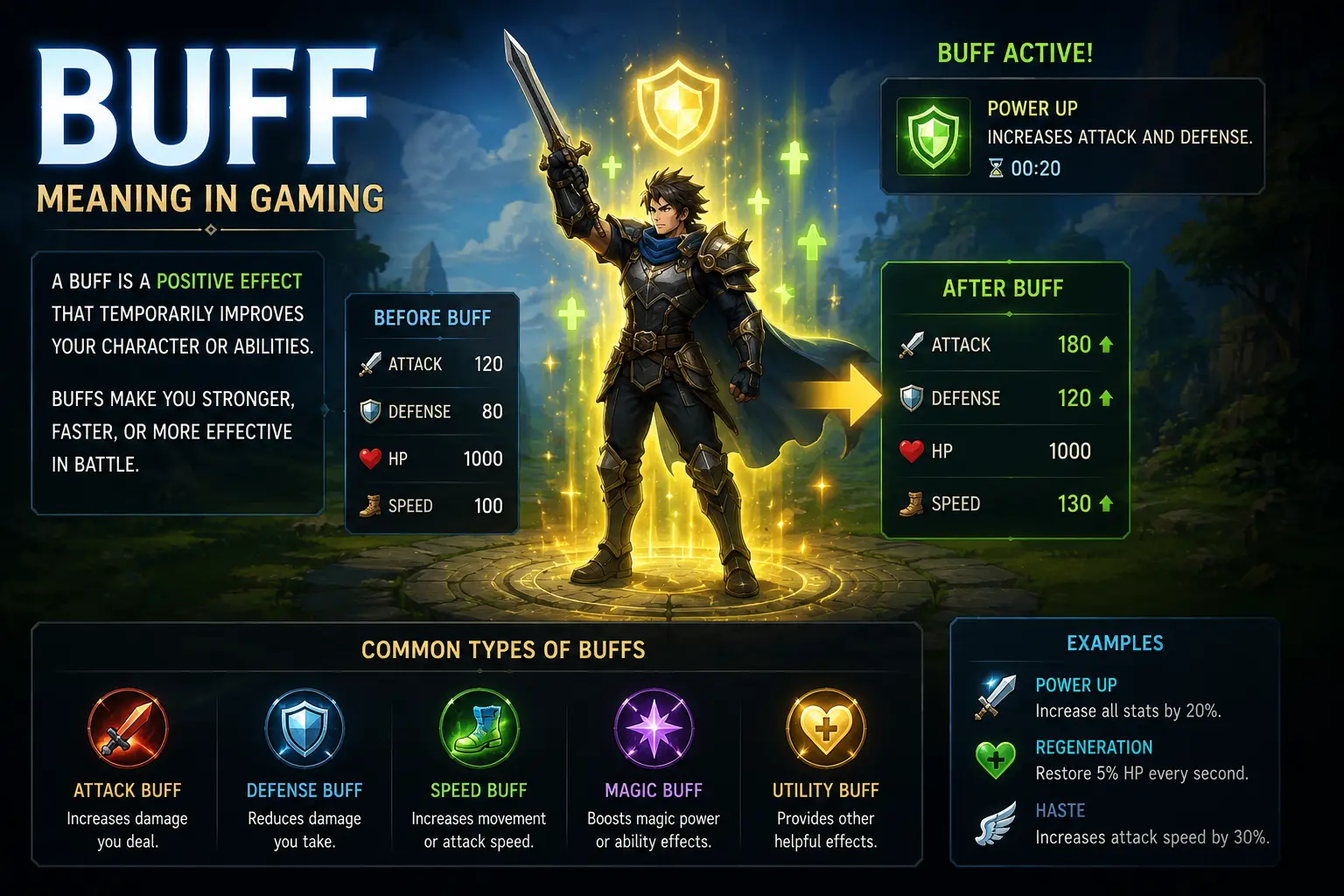
A buff is a temporary or conditional enhancement that improves how a character performs in combat or exploration.
These effects may come from abilities, gear, or in game events and they modify stats, skills, or survivability for a limited time.
- In RPGs, a buff increases max health, armor, or offense for a limited duration, giving characters a clear temporary edge in combat or exploration.
- Buffs can stack, cap out, or share durations, influencing decisions about when to engage, retreat, or coordinate with teammates for peak effectiveness.
- Some buffs come from equipment or consumables, while others arise from skill trees, party support, or temporary spell effects granted by the game.
- Understanding buff mechanics—like duration, cooldowns, and scaling—helps players plan rotations, exploit favorable windows, and maximize overall efficiency in encounters today.
- While buffs boost strength, game designers balance them with debuffs or diminishing returns to prevent a single strategy from dominating.
The precise rules governing buffs vary by game, but the patterns described here apply broadly.
Types of buffs
Buffs come in several broad categories that affect different aspects of performance. The table below outlines common buff types, what they do, and typical durations, helping players recognize patterns across games.
| Type | Effect | Typical Duration | Example |
|---|---|---|---|
| Stat Boost | Increases a key attribute such as Strength or Intelligence to raise damage, spell power, or capacity. | 15–60 seconds | Might buffs in action RPGs |
| Damage Multiplier | Increases damage output by a percentage, amplifying offense during key windows. | 20–90 seconds | Power up aura in fantasy RPGs |
| Defensive Buff | Raises armor, resistances, or evasion, reducing damage taken. | 25–80 seconds | Shield aura during team fights |
| Utility Buff | Improves non combat perks such as cooldown reduction, resource regen, or speed. | 10–40 seconds | Haste or focus boosts in strategy games |
These patterns, while broad, recur across many genres and help players anticipate how buffs shape encounters.
How buffs work in mechanics
Buffs operate under a core set of mechanics that determine when they apply, how long they last, and how they interact with other effects within a game world. Understanding these rules helps players predict outcomes rather than rely on chance. Buff sources include character abilities, gear enchantments, consumables, ally skills, and environmental events that temporarily reshape combat dynamics. Each source may bring prerequisites, cooldowns, or unique interactions with other statuses.
Application and timing: most buffs apply instantly after activation or when a triggering action completes. Some require a successful attack, a precise cast, or the completion of a specific objective. Timers run in real time or in game time, with some buffs delivering additional effects at fixed intervals while others persist until expiration.
Duration and scaling: durations can be fixed or scale with level, gear quality, or encounter difficulty. Buffs may refresh on reapplication, or be capped by soft or hard limits. Stacking rules vary: additive stacking sums bonuses, multiplicative stacking compounds effects, and some buffs overwrite weaker versions.
Refresh and expiration: once a buff expires, its effects revert to baseline unless overlapped by another active buff. Many systems support refreshing buffs by reusing the source or maintaining uptime through specific actions. Debuffs and enemy buffs can interact with player buffs by amplifying, diminishing, or canceling effects, creating strategic counters.
Cooldowns and resource costs: buffs are often tied to cooldowns or resource costs, preventing perpetual uptime and forcing tradeoffs between options. Some buffs require you to conserve resources or wait for a cooldown to finish before reactivating. Teams coordinate to maximize combined uptime, with wide aura buffs and targeted boosts timed for key moments.
Strategy and patterns: successful buff management relies on identifying the most impactful buffs for each encounter, maintaining uptime during critical phases, and adapting to phase changes. Players track buffs that boost damage, survivability, or resource generation and prioritize those that enable core team strategies.
Edge cases: some titles reveal only rough values or use hidden scaling, which can complicate planning. Clear UI timers, color cues, and audible alerts help players keep track of uptime and align actions with buff windows.
Core Features and Benefits
Buffs in gaming are deliberate enhancements applied to characters, weapons, or abilities that raise power, precision, or reliability during play.
They can originate from patches, equipment, or temporary spell effects and are designed to influence decisions about timing, positioning, and resource use.
Understanding how buffs work helps players optimize progression and maximize value from every encounter, whether in PvE, PvP, or cooperative play.
A well balanced buff system creates meaningful momentum shifts while preserving risk, counterplay, and strategic diversity across classes and roles.
This section covers core features and benefits, including how stat scaling works, how duration and permanence influence design, and how buffs interact to enable tactical synergies.
Stat boosts and scaling
Stat boosts fundamentally shape a buff’s value by tying numerical gains to progression curves and game design goals.
Understanding these patterns helps players plan rotations, prioritize targets, and adapt to enemy defenses as the match evolves.
- Attack power increments: buffs raise base damage by a percentage, add flat values, or multiply effectiveness of critical hits, affecting every attack across combat and scaling with level or tier.
- Defensive stats: increased armor, shield effectiveness, evasion, or health regeneration raise survivability, reduce burst damage, and prolong skirmishes, encouraging careful timing and resource management in team fights.
- Resource flow: mana or energy generation and cooldown reduction improve rotation consistency, enabling more ability casts per encounter while keeping resource budgets in balance across longer engagements.
- Accuracy and crit synergy: buffs can raise hit chance, crit rate, and armor penetration, increasing reliable damage against diverse enemies and making rotation windows more forgiving.
- Mobility and timing: movement speed buffs paired with shorter cast times enable better positioning and faster access to crowd control or finishers.
These patterns illustrate how a single buff can scale with your build, maintaining relevance as power levels rise and enabling flexible, on the fly optimization.
Attack power increase
Attack power increases are a central mechanism in many buff systems, functioning as a bridge between character growth and combat impact. designers typically implement a mix of percentage-based boosts, flat dice or weapon damage additions, and multipliers tied to weapon or skill modifiers. Percentage-based buffs respond dynamically to the character’s overall power, making them meaningful from early levels through late game, while flat boosts provide predictable spikes that players can time for specific encounters. The balance challenge lies in preventing any single buff from eclipsing the entire mechanic set; soft caps, diminishing returns, or caps that scale with level are common tools to maintain challenge and counterplay. In practice, attack power buffs interact with critical chance, armor, and enemy resistances, so players must consider the entire damage pipeline rather than focusing on raw numbers alone. When paired with appropriate weapons and synergy buffs, attack power increases can unlock explosive burst windows or extend sustained damage during prolonged engagements, reinforcing the value of well-timed play and team coordination.
Defense and resilience
Defense and resilience buffs center on reducing incoming damage and increasing survivability. This category often includes armor or shield bonuses, damage reduction percentages, health regeneration, evasion, or damage absorption mechanics. Properly balanced, defensive buffs create meaningful frontline sustain without making tanks invincible; designers typically combine flat guard values with scaling percentages so resonance remains across levels. Timing is crucial: defensive buffs that trigger before or during high-damage phases can dramatically shift outcomes of skirmishes, especially in team-based objectives. Interaction with debuffs, crowd control, and healing buffs further shapes overall durability, forcing players to coordinate so that protection lines up with ally damage windows. In many games, defensive buffs are designed to degrade under sustained pressure or after a threshold, preventing perpetual invincibility and preserving strategic tension in fights.
Resource generation and cooldowns
Resource generation and cooldown management buffs alter the cadence of combat by increasing resource flow and reducing ability downtime. Buffs that grant mana, energy, or stamina generation help sustain longer rotations and reduce the need to pause for regeneration. Similarly, cooldown reductions shorten the time between powerful abilities, enabling more dynamic and reactive playstyles. Designers balance these buffs with resource caps and diminishing returns to prevent runaway DPS and to maintain decision points. The practical effect is a smoother, more consistent cycle of action, allowing players to weave combos, interrupts, and interrupts more fluidly. In team contexts, resource buffs often align with pacing strategies—for example, enabling a critical sequence during a boss phase or a late-game crescendo—thereby reinforcing strategic planning and coordination.
Health and stamina
Health and stamina buffs focus on sustaining presence in combat and extending the window for meaningful decisions. Health increases extend survivability, while stamina or energy buffs improve the ability to sustain continuous actions, enabling longer combos or more frequent defensive maneuvers. The challenge for designers is to ensure these buffs scale with difficulty without removing tension from encounters; soft caps, gradually scaling regen rates, and synergy with healing sources help maintain balance. In multi-hero scenarios, health and stamina buffs can create durable frontline pressure or empower splashes of aggression across teammates. When combined with other enhancements, they enable diverse builds—from aggressive dive compositions to stubborn, sustain-focused play—without eliminating the need for tactical choices and timing.
Temporary vs permanent buffs
Temporary buffs provide short lived, high impact enhancements that compel players to seize opportunities at specific moments. They are valuable for major roasts, boss phases, or swing moments where a spike in power can decide outcomes, but their limited duration requires precise timing and risk assessment. Designers often pair temporary buffs with cooldowns, ensuring players plan rotations that maximize uptime during favorable windows while avoiding waste when the buff expires. Permanent buffs, in contrast, remain active across encounters and contribute to long term progression. They are typically earned through level ups, achievements, gear upgrades, or quest lines, shaping a player’s build trajectory over time. The distinction between temporary and permanent buffs helps preserve pacing, providing satisfying milestones and ongoing incentives without erasing the skill element. Both types must remain balanced with resource costs, counterplay options, and the variability of encounters to maintain engaging gameplay.
From a design perspective, developers frequently test the interaction of temporary and permanent buffs to ensure a smooth power curve. This includes monitoring how short term spikes affect early game encounters, whether permanent gains keep pace with new content, and how the two interact with debuffs, item rarity, and class-specific strengths. Effective balance curves preserve choice, encourage experimentation, and keep player engagement high across patches and expansions.
Synergies and combos
Synergies and combos explore how buffs interact to amplify effects and create tactical opportunities. In practice, well designed buffs interlock with each other to produce greater results than any single effect could achieve alone, encouraging players to coordinate rotations and target priorities. A common approach is to combine offense with defense, stacking a brief damage boost alongside a shield or DR buff to sustain aggressive play during risky engagements. Movement and attack speed buffs paired with crowd control or debuffs can compress the timing window for pinning a target, while resource generation buffs that sustain ability use enable longer, more varied combo chains. Designers also consider how buffs stack—whether they are additive, multiplicative, or subject to diminishing returns—to prevent overpowering synergies while still rewarding cooperation and timing. For players, mastering these interactions means learning which buffs to refresh first, how to chain effects for maximum uptime, and how to adapt strategies to different team compositions and enemy setups. Ultimately, the goal is to cultivate dynamic, decision rich play where communication and execution determine the overall success of a buff-based strategy.
Buff stacking rules
Buff stacking rules define how multiple buffs interact when active at the same time. Additive stacking adds the numerical values together, while multiplicative stacking compounds effects for a larger combined result. Some games implement tiered stacks, where a limited number of concurrent buffs can be active, and additional buffs have reduced or no impact beyond the cap. Designers often introduce soft caps that scale with level, ensuring early game power remains proportional to progression while late game remains engaging. Special care is taken to prevent synergies from collapsing into a single dominant build; instead, stacking rules encourage diverse combinations, forcing players to adapt to each encounter’s unique demands. Clear, transparent stacking rules also help players optimize their loadouts and communicate effectively with teammates during high pressure moments.
Class-specific synergies
Class specific synergies tailor buff interactions to each role, enhancing the unique strengths and weaknesses of different playstyles. For example, a tank class might benefit most from buffs that boost survivability and threat generation, while a damage dealer could prioritize attack power and crit enhancements. Support roles often gain from buffs that increase healing throughput, defensive auras, or mana efficiency to sustain team sustain during extended fights. By aligning buff bonuses with class fundamentals, designers create meaningful choices without homogenizing every build. Cross class synergies further deepen strategy, as the optimal buff suite for one composition often changes when teaming with different partners. Such diversity rewards players who understand their role and how to coordinate with teammates to maximize overall team performance.
Team-wide coordination
Team-wide coordination focuses on maximizing the collective impact of buffs across multiple players. Buffs that affect the entire party, or a large portion of it, require thoughtful timing and communication to synchronize power spikes with enemy vulnerability. Effective coordination often hinges on clear roles, callouts for when to unleash high impact buffs, and the ability to anticipate enemy patterns or objectives. In high level play, teams practice set rotations that align buff windows with boss mechanics, map control opportunities, or objective captures. The payoff is a pronounced advantage that emerges not from individual prowess alone but from disciplined teamwork, precise execution, and shared situational awareness.
Comparison with Alternatives
Buffs are temporary enhancements that raise a character’s power, reliability, or effectiveness during a run or encounter. They contrast with other means of improvement, such as permanent character progression or gear-based bonuses. This section compares how buffs differ from debuffs, equipment, and long-term growth to help players decide when and how to apply them. By recognizing the distinctive duration, scope, and strategic value of buffs, players can optimize their build, timing, and team coordination across various game modes.
Buffs vs debuffs
Buffs and debuffs are opposing mechanisms that shape gameplay by modifying a character’s power, status effects, or performance. While buffs boost positive attributes, debuffs apply penalties that reduce effectiveness or produce adverse conditions. The strategic use of these two mechanisms often depends on timing, enemy behavior, and team composition. Understanding their boundaries helps players plan if, when, and how to counteract or leverage these effects.
- Buffs raise core stats or grant temporary abilities, often stacking across multiple sources to magnify damage, defense, or speed during crucial boss phases.
- Debuffs reduce enemy power, accuracy, or defenses, creating windows of opportunity where allies can land bigger hits or avoid dangerous abilities.
- Buffs are typically designed for proactive play, encouraging players to plan ahead and coordinate with teammates for sustained advantage throughout encounters.
- Debuffs often require counterplay or mitigation, such as cleanse, resistances, or situational positioning, to prevent becoming overwhelmed by enemy trickery or crowd control.
- In team roles, buffs support synergy by boosting damage or shields, while debuffs target the boss or adds to shorten the fight’s overall length.
Properly balancing when to encourage a buff window and when to exploit a debuff window is central to high-level play. Different games implement buffs and debuffs with varying severity, duration, and stacking rules, so players should read tooltips and experiment.
Buffs vs items/equipment
Buffs and equipment are both means of strengthening a character, but they differ in source, persistence, and how they scale. Equipment bonuses are attached to gear that you can equip, upgrade, trade, or lose, making them powerful but dependent on item availability and durability. Buffs come from spells, abilities, or party effects and typically last a limited time or until dispelled, which makes them more flexible yet less reliable over long stretches. This distinction matters for planning loadouts, as gear can shape your baseline performance while buffs create temporary spikes that you must time carefully.
Stacking and interaction are key when comparing these two approaches. Equipment often provides flat or percentage increases that apply regardless of your current buffs, while buffs can scale in strength or be amplified by other abilities, rotating through cooldowns and recasts. Understanding how these sources intersect helps players maximize damage windows, survivability, and crowd-control handling across different encounters. In practice, wisely combining gear synergies with timely buffs yields smoother progression and reduces the risk of droughts in performance during critical moments.
Consider the in-game economy and risk management as well: gear requires drops or crafting resources, which may be scarce; buffs require mana, cooldowns, or party actions, which may be limited by class design. When you plan your build, think about how many prominent buffs you can rely on per combat and how many gear slots you want to dedicate to critical stats. In many games, a balanced approach uses gear for stable baseline power and buffs to create dramatic, short-lived boosts during boss phases or vital encounters.
Buffs vs character progression/perks
Buffs provide an immediate surge in capability, letting players react to threats or seize opportunities in the moment. Progression and perks, by contrast, deliver steady, cumulative growth that compounds as you invest experience, resources, or completed challenges. This long-term trajectory shapes your character identity, allowing you to unlock passive bonuses, new skill trees, or improved masteries that persist beyond a single fight.
Temporality and permanence drive different strategic decisions. A well-timed buff can turn a difficult sequence into a manageable one, but if the same advantage were permanent, it could trivialize early content. Perks and progression, on the other hand, change the baseline power curve over weeks or months, gradually reducing the relative value of short-term boosts.
In practice, players blend both approaches: they rely on buffs during critical moments while leveraging progression to sustain performance in longer campaigns. The balance often depends on game design and class architecture—some systems reward frequent buffing with parallel growth, others emphasize reliable, steady progression that minimizes dependence on temporary effects. Understanding this balance helps players select optimal strategies for leveling routes, build paths, and team roles across different difficulties.
Pricing, Plans, and Special Offers
Buff meaning in gaming extends beyond simple power-ups; pricing, plans, and special offers shape how players access these enhancements. This section surveys how buffs are monetized, the plan structures that deliver them, and the promos that lure players to participate. You will see a mix of microtransactions, season passes, bundles, and subscriptions, all designed to balance revenue with player value. We also discuss how pricing varies by region and platform, and how developers communicate benefits to keep trust high. Finally, the section highlights strategies players use to evaluate offers and maximize returns while maintaining fair play.
Monetization of buffs (microtransactions, DLC)
Monetization of buffs centers on giving players access to temporary or permanent enhancements through paid channels, often integrated with broader monetization programs. The most common models today are microtransactions for individual buffs, season passes that grant access to a curated set of boosts across a season, and downloadable content or expansions that bundle buffs with new content. Retail-like bundles combine buffs with cosmetics or convenience features to create perceived value without necessarily overpowering balance. Developers also experiment with subscription services, where players pay a monthly or quarterly fee to receive a steady stream of buffs, currency, or exclusive progression tokens. In addition, time-limited boosts tied to events or anniversaries generate urgency and drive ongoing engagement, while loyalty programs convert long-term players into recurring customers through tiers and rewards. Each model has distinct implications for gameplay, progression, and balance, and studios often blend several approaches to meet diverse player preferences. Microtransactions for buffs can be divided into cosmetic enhancements and power-enhancing boosts. Cosmetic buffs change appearance or UI aesthetics without altering core power, while power buffs directly increase hit points, damage, resource generation, cooldown reduction, or other core stats. The line between cosmetic and power buffs is a key design decision: it affects perceived fairness, regulatory scrutiny, and monetization efficiency. Strategic designers may offer small, non-dominant boosts that accumulate with playtime, or large, one-off buffs that accelerate progress for a price. The latter can fracture the player base if unregulated, so many titles implement caps, cooldowns, or diminishing returns to maintain a playable environment for all. Season passes, battle passes, or premium tracks are popular because they offer a predictable cadence of buffs tied to content. A pass might grant XP multipliers, resource generation boosts, or temporary combat advantages that unlock additional cosmetic rewards. The pass is typically structured with a free track and a paid track, encouraging free-to-play players to invest in the paid tier for faster progression and rarer items. The challenge is to balance rewards so that players who don’t purchase still enjoy meaningful progress, while paid users feel compelled to upgrade for tangible value. DLC or expansion packs sometimes bundle buffs with new storylines, missions, or endgame content. They can provide substantial power advantages or strategic bonuses for a set period, but careful tuning is required to avoid alienating players who do not buy the DLC. Boost tokens and time-limited crates offer flexible, granular control over buff distribution. Tokens can grant a fixed window of increased resource generation, faster skill cooldowns, or enhanced loot drops, while crates mix buffs with other rewards in randomized form. Revenue considerations include pricing tiers, regional exchange rates, and platform fees, which influence how much players are willing to pay for a given buff. Transparent communication about what buffs do, how long they last, and whether they stack with other bonuses helps manage expectations and reduces friction during purchases. From a game design perspective, monetization should reinforce player choice rather than coerce it. Clear boundaries between free progression and paid acceleration help maintain long-term engagement and trust, even as players experiment with different monetization lanes. Finally, monitoring player feedback and adjusting models post-launch is essential, since player sentiment can shift quickly after a pricing change or a new buff mechanic is introduced.
Free vs paid buffs in games
Free and paid buffs define access and progression in most modern titles. Free buffs are typically earned through play or events: login bonuses, quest rewards, achievement milestones, season completions, and collaborations that grant temporary boosts without cash costs. These offerings keep players engaged, reward dedication, and help balance shorter-term lulls in activity. Paid buffs, by contrast, appear through microtransactions, season passes, premium memberships, and bundles that explicitly accelerate progression or enhance performance. They are designed to provide value to players who want to progress faster or customize their experience, while leaving a substantial portion of gameplay accessible to non-paying players. The key challenge is balancing recurrence and fairness: players who don’t spend should still feel meaningful advancement, while paying players should perceive tangible benefits that justify the cost. Most successful games separate cosmetic and power-affecting buffs to help maintain trust and avoid pay-to-win perceptions. In practice, many titles use hybrid models: a free baseline progression curve supplemented by paid boosts that reduce grind time, synchronize with special events, or unlock cosmetic rewards. Event buffs and limited-time boosts are commonly used to test demand and to energize seasonal activity, but careful tuning ensures that the core game remains enjoyable regardless of purchase. Accessibility and transparency matter as well; clear language about what buffs do, how long they last, and whether they stack with other bonuses helps players make informed choices. For players who cannot or prefer not to pay, smart design ensures that skill and strategy remain the primary drivers of success, while paid buffs provide optional speed-ups rather than mandatory advantages. Practical examples include a shooter offering a 48-hour XP boost via a limited-time bundle; an RPG granting a temporary increase in gold drop rate during a weekend event; and a strategy game delivering a 20% resource generation buff through a monthly subscription. Each model influences how players allocate time and resources, and developers often layer multiple buffs with different durations to create a sense of ongoing reward without creating insurmountable power gaps. From a design perspective, the availability of free buffs should be sufficient to sustain casual players and newcomers, while paid buffs provide a path for enthusiasts to accelerate progress and customize their tactics. The pricing strategy should reflect effort, content value, and regional purchasing power, and studios frequently adjust these levers based on player feedback and market conditions. Community responses to free versus paid buffs vary by title and genre; some players appreciate speed boosts that reduce grind, while others resist any system that appears to monetize core gameplay. Effective communication about the intent and impact of buffs helps manage expectations and reduces backlash. Finally, platforms and publishers that emphasize competitive balance often implement caps, cooldowns, or non-stacking rules to prevent a single buff from dominating outcomes in competitive modes.
Ethics and balance concerns (pay-to-win)
Pay-to-win designs trigger strong ethical debates in gaming communities, because they appear to reward financial investment rather than skill or effort. Critics argue that if buffs create a significant, persistent advantage in competitive modes, players who cannot or won’t spend money are sidelined, reducing inclusivity and long-term engagement. Proponents contend that monetization is a legitimate way to fund ongoing development, support free-to-play players, and deliver post-launch content; they emphasize optionality and modularity rather than guaranteed outcomes. For balance, many studios implement safeguards: limiting the power of buffs, restricting stacking, using cooldowns, and tying high-impact buffs to time-limited events to avoid permanent imbalances. Some games publish detailed patch notes and conduct public balance tests, inviting community input before large changes take effect. Moderation also plays a role: stores, bundles, and loot systems must be transparent about what players are purchasing and what effect it has on gameplay, with clear disclaimers for crucial modes like ranked play. Community reaction to pay-to-win patches often includes petitions, forum threads, and even external campaigns; developers who respond quickly with data-driven explanations and measurable adjustments can mitigate backlash. In some cases, platforms or publishers establish policy guidelines to limit how buffs interact with core gameplay, such as prohibiting direct power increases in regulated modes or capping the maximum advantage obtainable via purchases. Regional and cultural differences matter as well; what is considered acceptable in one market may be viewed as exploitative in another, prompting adaptive pricing and targeted promotions. The ethical conversation extends to data privacy and consent: players should know when data is used to tailor buffs or pricing, and should be able to opt out of personalized offers without sacrificing access to essential features. Finally, ongoing audits, external reviews, and independent balance tests can help maintain trust, especially after major monetization shifts. Although no model is perfect, transparent risk assessment, regular communication, and a commitment to maintaining skill-based achievement as a central pillar can preserve a healthy ecosystem even as buffs remain a lucrative monetization vector.