Stealth Meaning: Sneaking Mechanics Explained — Overview and Value
Stealth meaning in gaming goes beyond simply avoiding enemies. It centers on careful movement, perception, and timing to stay undetected by opponents. Players weigh risk, reward, and information as they choose whether to sneak, distract, or strike. The stealth approach often emphasizes planning, observation, and adaptability over brute force. This section explores stealth meaning, its core mechanics, and why it resonates with players who value strategic pacing and mastery.
What is stealth in games?
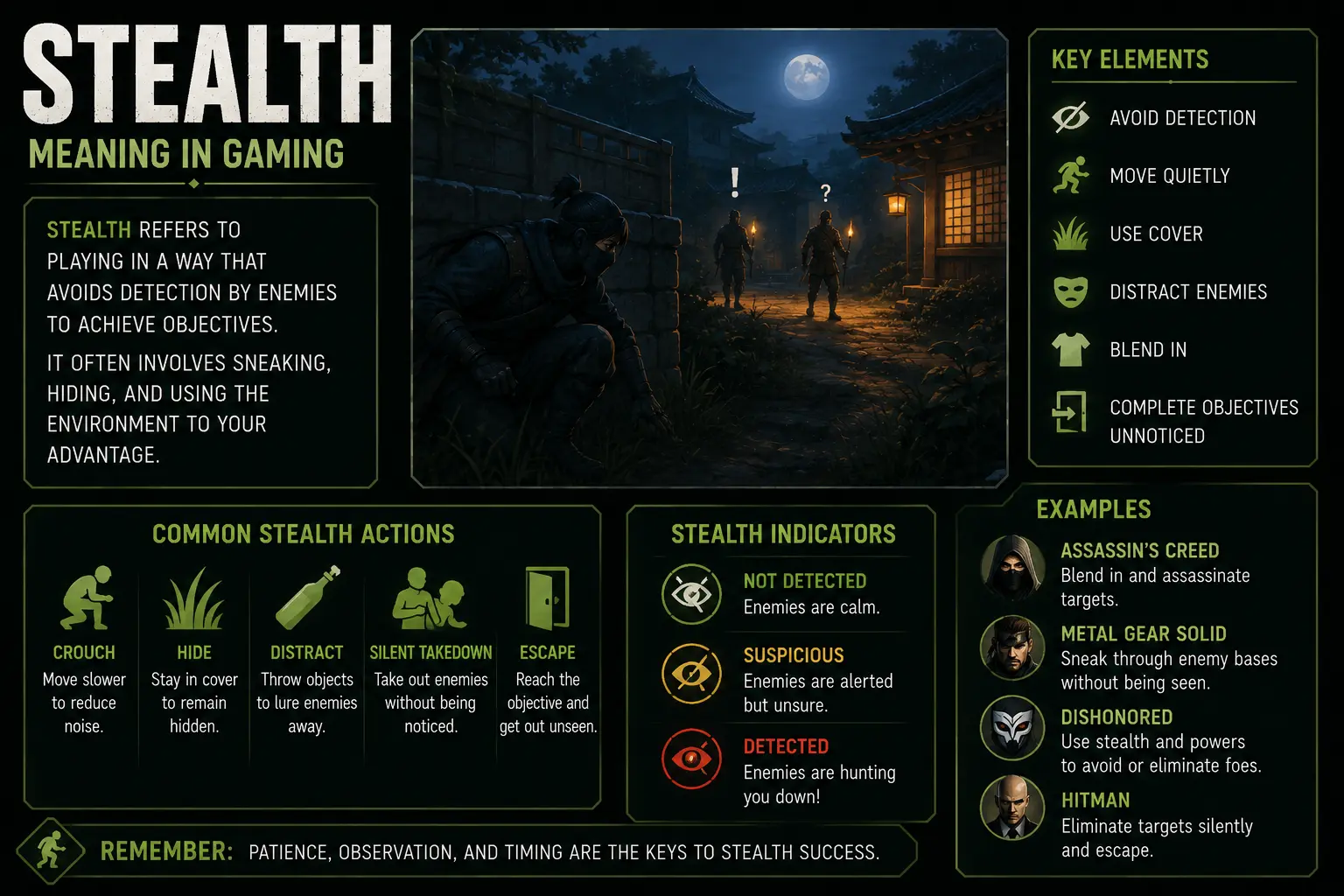
Stealth in games refers to the deliberate avoidance of detection by opponents, often using a combination of movement, concealment, silence, and distraction. It is a design philosophy that treats enemies as sensing systems rather than mere obstacles, rewarding players who study patrol routes, line of sight, and environmental danger. At its core, stealth asks, ‘What happens if I move slowly, hide in shadows, and wait for the moment to act?’ The best stealth experiences blend player agency with a believable world that responds to subtle cues: footsteps, rustling, light level, and sound propagation. Unlike straightforward combat, stealth emphasizes information gathering, resource management, and risk assessment, asking players to think several steps ahead. In many games, stealth is not a single mechanic but a family of tools: concealment, slow movement, noise management, and controlled encounters that minimize risk. Players master each layer to create safe passage through hostile zones, often shaping the story through choice and timing rather than brute force. The vocabulary of stealth includes hiding mechanics, shadow utilization, disguises, and silent takedowns, all of which serve to increase tension and payoff when a run goes clean. Good stealth design balances visibility and opportunity: enemies should feel intelligent, not omniscient, while the player should feel empowered by precision and patience. The result is an experience where speed matters less than timing, and where small missteps can ripple into costly alarms or alarms that force quick, uncertain decisions. Stealth also interacts with progression systems by offering alternative routes, rewards for non-lethal play, and varied endings based on how quietly a player advances. In practice, stealth in games is about control: control over your avatar’s position, your noise footprint, and your detection state, all coordinated to create a satisfying sense of mastery. That sense of mastery is what keeps players returning to stealth games, seeking ever cleaner lines and more efficient routes. The environment itself often acts as a partner, with dynamic lighting, soundscapes, and AI routines that reward patience and careful observation. Players learn to anticipate guard patterns, use distractions, and create openings for safe passage. Stealth can also serve as a narrative lens, letting players influence the pace and tone of a mission through deliberate, quiet decisions. While some journeys climax in sudden confrontations, the majority of stealth sequences reward readers of space and silence as much as players who wield a blade or pistol. In this sense, stealth meaning in gaming is as much about strategy as it is about atmosphere, encouraging players to balance risk, timing, and resource use to move unseen through the world.
Core stealth mechanics
Core stealth mechanics involve several interacting systems that players manipulate to stay hidden and avoid triggering alarms. The most fundamental is concealment, which lets players disappear behind objects or shadows. Movement speed, stance, and stamina influence how easily footsteps or body heat reveal your presence. Disguise options and crowd dynamics can provide alternate routes through hostile areas. Distraction tools, such as noise makers or environmental interactions, create openings or misdirect attention. Patrol logic, line of sight, and hearing ranges are the scaffolding that define how aggressively AI responds to detection and how quickly enemies react to anomalies. Resource management—such as limited gadgets, stamina, or ammunition—forces players to prioritize stealthy routes over brute force and often rewards restraint. Level design often reinforces stealth by weaving choke points, indirect routes, and dynamic lighting into the map. The flexibility of stealth systems means players can approach a problem from multiple angles, choosing between quiet infiltration, controlled takedowns, or calculated backstab opportunities. For designers, a successful stealth system returns the player’s patience and calculation as clearly as a combat win; the challenge is to keep the world feeling responsive without making detection feel arbitrary. Audio cues, visual cues, and AI state machines work in concert to communicate opportunities and risks to the player, turning perception into action. At its best, core stealth mechanics create a satisfying loop: observe, plan, execute, and adapt as the situation changes. The most enduring stealth games coexist with other gameplay loops, allowing players to integrate stealth into broader mission goals rather than treating it as a stand-alone mode. This depth is what keeps stealth a persistent preference among players who crave deliberate pacing and meaningful choice.
Hiding and cover mechanics
Hiding and cover mechanics rely on the player’s ability to merge with environmental features and reduce exposure to enemies. The primary idea is to use shadow, corners, or objects to break line of sight, making it harder for enemies to notice the player. In many games, visual indicators or indicators on the minimap signal when cover is effective or when exposure is rising. Hiding spots are often finite and strategic; players must choose when to retreat, when to wait, and which route minimizes detection risk. Good implementations integrate with AI routines so that guards check shadows, listen for movement, and react to changes in lighting. Timing is crucial: stepping out of cover too soon or staying too long can trigger alarms or combat. Some games layer hiding with disguise mechanics, turning the player into an unnamed unit that blends with crowds or ambient noise. Players may also use environmental clutter—crates, foliage, or furniture—to obscure silhouettes and reduce accuracy for pursuers. The depth comes from subtle variations in cover quality, distance, and angle, which can influence detection thresholds. When designed well, hiding and cover create a back-and-forth rhythm: players vanish for a moment, then reappear in unexpected places, prompting guards to recalibrate their paths. This mechanic often intersects with level design, encouraging routes that reward careful planning and patient observation rather than brute rushing. In stealth action titles, hiding and cover are not mere getaways; they are the core grammar through which players write their approach to every encounter. They empower players to stage quiet infiltrations, extract key items, and slip past threats with precision and calm.
Noise, sound and stealth detection
Sound is a currency in stealth games. Footsteps, breathing, rustling clothing, and even equipment clinks travel through a space and can alert nearby foes. Developers simulate real acoustics by linking noise generation to movement speed, surface type, proximity to enemies, and the use of silenced tools. Players learn to walk slowly on certain surfaces, time bursts of movement, and mute their gear to reduce their footprint. Environmental sounds—water drips, wind, machinery—can mask or reveal presence depending on their intensity and distance. Some games use dynamic noise meters that rise with risky actions and fall when players remain quiet. Effective stealth also counts ambient noise levels, which can be dampened by crouching, moving through soft surfaces, or staying in cover. Distractions, like throwing stones or triggering distant alarms, can lure guards away from critical routes or break line-of-sight. The balance between audible and silent play is a core tension, because too much noise invites attention, while perfect silence can feel inhumanly precise. Designers often tie sound cues to AI states so that enemies shift from idle to alert to search in plausible, believable ways. In well-tuned systems, sound acts as a guide, offering players feedback about how visible they are and where to position themselves next. The best stealth games make sound feel tactile: the player can sense the difference between a soft footstep and a loud crash, and use that knowledge to pace their progress with confidence and poise.
AI perception and line-of-sight
AI perception and line-of-sight play a critical role in shaping stealth outcomes. While each game may implement its own specifics, common threads emerge in how enemies detect, evaluate, and react to the player.
| AI State | Line-of-Sight Model | Detection Range | Notable Behaviors |
|---|---|---|---|
| Idle | Conical FOV | 8–12 m | Looks for movement at range; usually silent |
| Patrol | Raycast plus occlusion checks | 6–10 m | Alerts when player crosses LOS |
| Alert | Expanded FOV with occlusion checks | 12–20 m | Searches area; may call for backup |
| Investigate | Line-of-sight plus noise cue | variable | Moves toward source of sound or shadow |
Understanding these patterns helps players anticipate guards and time their moves for safe passage.
Why players choose stealth
Players gravitate toward stealth for a blend of strategy, atmosphere, and personal challenge. The appeal lies in shaping outcomes through careful observation rather than overpowering opposition. The capacity to slip past threats and complete objectives without a full-scale confrontation resonates with players who enjoy discipline, planning, and controlled risk. Stealth also supports varied playstyles, allowing different routes, pacing choices, and modus operandi on a mission-by-mission basis.
Beyond mechanics, stealth offers a mood that is hard to replicate in brute force sequences: a sense of tension, silence, and accumulation of small advantages that feel earned rather than granted. Some players relish the satisfaction of mastering patrol timing, distraction timing, and precise takedowns that leave no immediate trace. Others enjoy the ethical dimension of non-lethal play and the possibility of outcomes that hinge on stealthy restraint rather than aggression. The promise of cleverness often proves more rewarding than the thrill of a perfect firefight.
For many, stealth is a cerebral workout as much as a test of nerve, rewarding patience, pattern recognition, and the willingness to backtrack or rethink a plan when a route fails. Repetition becomes an opportunity to refine routes, test new gadgets, and uncover hidden pathways that reveal additional lore and world-building. The social and competitive angles—like speedrunning stealth sequences or comparing concealment techniques with friends—add communal value and replayability. Ultimately, stealth appeals to players who want meaningful choice, resilience under pressure, and the quiet confidence that comes from moving unseen through a world that sometimes prefers to overlook you.
Key Features, Benefits, and How Stealth Meaning Enhances Gameplay
Stealth meaning in gaming centers on avoiding detection and manipulating the game’s environment to progress without direct confrontation. It encompasses mechanics like sneaking, cover, silent takedowns, and distractions that let players bypass threats rather than facing them head on. This approach often shifts emphasis from raw power to situational awareness, timing, and resource management. By rewarding careful movement, lighting, and sound control, stealth adds tension and variety to both narrative driven missions and exploration. Understanding stealth meaning helps players choose routes and tactics that fit their play style while allowing designers to tailor challenges around observation, misdirection, and risk.
Common stealth features in games
Stealth features manifest in many design languages, revealing how players interact with enemies and the environment. These features are often layered, combining movement, perception, and tools to create meaningful choices about when to hide, when to engage, and where to go next.
- Compartmentalized detection: enemies respond to silhouettes and shadowed corners, with line-of-sight checks that reward players for moving behind walls or exploiting lighting to stay hidden.
- Hiding mechanics involving crouched movement, sprint suppression, and environmental concealment, such as tall grass or crates, that reduce visibility and slow detection chances.
- Sound management techniques including muffled footfalls, silent takedowns, and gadgets that dampen or redirect noise, enabling routes that avoid noisy confrontations.
- Distraction and misdirection tools such as projectiles, noise emitters, or decoys that lure guards away from critical paths, creating safer windows for movement.
- Camouflage and concealment systems, including clothing dyes or adaptive textures, enabling players to blend with environments and reduce detection by blending into surroundings.
Each item exemplifies a core principle of stealth design, illustrating how players can leverage environment, sound, and timing to navigate complex spaces. Designers balance these tools to maintain tension while preventing repetitive or unfair encounters.
Hiding mechanics and line-of-sight interactions
Hiding mechanics rely on predictable line-of-sight rules that players can learn and exploit. In practice, players observe how guards scan corridors, how shadows deepen around corners, and how environmental elements like doors or crates break visibility. Designers implement cone-based or raycast line-of-sight checks that consider lighting, distance, and obstructions, rewarding players who move from shade to shade and who time transitions between visible and hidden states. These mechanics create a sense of agency as players plan routes, test visibility thresholds, and react to patrol patterns. Subtle feedback, such as audio cues and minimap hints, helps players calibrate stealth risk in real time. When executed well, hiding mechanics become intuitive, inviting experimentation with different routes and tools without penalizing creativity. The result is a tactile, immersive stealth experience that feels earned rather than arbitrary.
Gameplay benefits of stealth systems
Stealth systems reshape how players experience pacing by inserting deliberate delays and careful planning between actions. In stealth sequences, tempo is dictated by detection risk rather than by the pace of a button-mash rebuttal, creating moments of hush before potential confrontation. Players learn to map routes that maximize cover, time movements to coincide with guard patrols, and exploit gaps in visibility to advance unseen. This pacing shift often makes exploration more deliberate, encouraging players to study level layouts, listen for environmental cues, and anticipate how threats will react to their choices. The strategic nature of stealth also elevates risk versus reward decisions, since a wrong step can force a retreat or a costly takedown that consumes resources or alerts additional enemies. Designers can tune these dynamics with enemy AI patterns, lighting design, and audio cues to reinforce the sense that stealth is a meaningful, skill-based option rather than a cosmetic overlay.
Beyond tension, stealth systems reward players for mastery and experimentation. They invite players to think creatively about routes, timing, and tool selection, leading to a more personal playthrough style. With practice, players uncover efficient paths, alternative objectives, and hidden routes that further extend replay value.
They also enable accessibility by offering noncombative progress avenues for players who prefer stealth over direct combat, while preserving challenge through detection thresholds and resource costs. When stealth options are balanced with clear feedback, players feel capable regardless of preferred play style.
When integrated with progression systems, stealth can unlock new mechanics or gear that expand the toolbox and sustain engagement by rewarding experimentation and planning.
Balancing stealth with combat and player choice
Balancing stealth with combat and player choice requires designing for ambiguity, fairness, and variety. The best games let players switch tactics mid mission, choosing stealth or direct engagement depending on context, resources, and risk tolerance. This flexibility preserves agency and prevents one play style from dominating every scenario.
Designers tune AI detection ranges, lighting, sound cues, and level geometry so that stealth feels credible and rewarding rather than arbitrary. When detection is overly punitive, players disengage; when it is too forgiving, stealth loses its bite. The goal is to maintain tension without locking players out of progress or punishing experimentation.
Supporting systems like escape routes, alternative objectives, and gear that enhances stealth capabilities help maintain momentum and variety, ensuring meaningful choices and feedback as players navigate each mission.
Specifications, System Requirements, and Performance Metrics
Stealth-focused games demand a careful balance between concealment mechanics and the technical foundations that render them believable. Designers must consider how rendering, audio occlusion, AI perception, and network synchronization interact across a range of hardware configurations. By exploring the specifications, system requirements, and performance metrics, developers can anticipate bottlenecks before they impact the hush of a covert operation. Grounding stealth gameplay in solid performance metrics helps ensure players experience consistent shadows, believable disguises, and responsive sneaking across PCs and consoles. This section provides a practical overview of what to measure, how to weigh costs, and where to invest optimization effort to preserve the stealth feel while supporting diverse player setups.
Technical considerations for stealth games
Stealth games push engines to simulate plausible concealment, which starts with choosing the right render pipeline and asset budgets. The engine decisions affect how shadows are computed, how light leaks are masked, and how post processing can reveal or hide details that players rely on to stay undetected. For example, a scene using high fidelity shadow casting and ambient occlusion can enhance immersion but at a cost, so developers often implement selective shadow maps, cascaded shadowing, and occlusion culling to keep frame times stable while preserving stealth cues.
Beyond visuals, AI cost dominates CPU budgets in stealth titles. Perception systems must track line of sight, hearing, and suspicious behavior without triggering frequent, expensive ray casts or state checks each frame. Designers frequently decouple sensing from action, enabling tense reactions only when a player crosses a threshold or creates a distinct noise event. This allows guards to switch between patrolling, investigating, and calling for reinforcements without grinding the frame rate to a halt.
Audio plays a critical role in stealth perception, so teams model occlusion, obstruction, and surface materials affecting footstep clarity and weapon sounds. Spatialized audio with intelligent reverb, early reflections, and occlusion tests can convey distance and cover without relying on heavy physics simulations. Streaming audio assets, dynamic music stingers, and procedural noise sources add to immersion while being mindful of memory budgets and CPU load.
Networking for stealth often introduces unique costs in multiplayer modes. State replication for cover usage, silhouettes, or disguises must be efficient enough to prevent desynchronization while keeping bandwidth reasonable. Techniques such as interest-based replication, event-driven updates, and authoritative AI decisions help maintain consistency across clients. Finally, physics interactions with cover objects, raycast-based line-of-sight checks, and navmesh constraints require careful profiling to avoid jitter or overshoot during sneaking segments.
Profiling and instrumentation are essential to steering the balance. Developers rely on traces, frame time histograms, GPU counters, and AI task queues to locate hot spots. The goal is not endless optimization but predictable budgets that preserve stealth cues even as scenes become denser with agents and dynamic lighting. Regular playtests across hardware ranges and stress tests provide early signals when stealth fidelity starts to degrade.
Platform-specific adjustments matter as well. Console targets typically require tighter budgets but benefit from fixed hardware profiles, while PC builds must offer scalable options such as dynamic resolution, shadow quality, and AI tick rate. Integrating scalable settings early in the design helps maintain a believable stealth experience from low-end laptops to high-end desktops, and it makes future hardware generations more adaptable.
Performance metrics: frame rate, AI cost, and responsiveness
Monitoring these metrics during development helps ensure stealth interactions feel smooth and credible across hardware.
| Metric | Baseline (ms) | Target (ms) | Notes |
|---|---|---|---|
| Frame rendering time | 11–16 | 8–12 | Include post-processing; keep headroom for motion blur. |
| AI decision/update cost | 1.5–4 | 0.8–2.5 | Modular perception; asynchronous tasks where possible. |
| Pathfinding computation | 2–6 | 1–3 | Navmesh tiling and caching helps. |
| Input latency | 15–40 | 10–25 | Networked play adds jitter; optimize input buffering. |
Across resolutions and AI densities, teams compare these values to maintain a balance between visual fidelity and the sense of stealthy motion. A higher frame rate is particularly valuable when a guard’s line of sight shifts, or when players must react to subtle cues like footstep timing and body position.
Recommended system requirements for PC stealth games
Minimum system requirements for stealth games should reflect a balance between accessibility and a credible stealth experience. At minimum, a modern 64-bit Windows PC, a quad-core CPU running around 3.0 GHz, 8 GB of RAM, and a midrange GPU such as the GeForce GTX 660 or Radeon HD 7850-equivalent are sensible starting points. Storage should provide at least 25 GB free space for assets, and a solid-state drive is strongly recommended to reduce texture streaming stalls that can betray a hiding spot. DirectX 11 or newer is typically required to support the advanced shadow and post-processing features used in stealth sections.
Recommended specifications build on the minimum by adding headroom for higher resolutions, improved shadow quality, and snappier AI perception updates. A modern multi-core CPU such as an Intel i5-10600K or Ryzen 5 3600, 16 GB of RAM, and a GPU like the GeForce GTX 1660 Super, RTX 2060, or AMD Radeon RX 5600 XT offers a smoother stealth experience at 1080p and beyond. For higher-end PCs or 1440p/4K targets, consider stepping up to a 6-8 core CPU, 32 GB of RAM in some heavy scenes, and GPUs such as RTX 3060/5700XT or better, coupled with an NVMe SSD for asset streaming.
Storage needs depend on content density and whether the game streams assets on the fly; set a target of 40–60 GB for future stealth titles to accommodate large, dynamic levels. Developers should also plan for optional features like high-quality shadows, ambient occlusion, and audio occlusion that push GPU and CPU budgets, but remain togglable to preserve performance on lower-end systems. Finally, while consoles often have fixed hardware, ensuring parity in input latency and frame rate targets across platforms remains crucial for a consistent stealth experience.
Legacy hardware considerations and accessibility options should also influence the baseline requirements. If possible, offer a low-end mode that preserves core stealth cues—clear footsteps, discernible silhouettes, reliable cover detection—without sacrificing the core feel. This helps broaden the audience while maintaining the intended stealth balance for speedrunning and competitive modes.
Pricing, Plans, and Competitive Comparisons
Stealth meaning in gaming centers on moving through environments without drawing attention, using shadows, sound discipline, and misdirection. This section examines how pricing, plans, and competitive considerations shape stealth design across modern titles. Developers increasingly balance revenue goals with the need to preserve fair, engaging stealth experiences, ensuring that purchases enhance rather than overshadow skill. We compare how different packages, editions, and DLCs alter access to tools, missions, and pacing, and we consider how players perceive value without sacrificing depth. Finally, we explore how DLCs and seasonal content can redefine the stealth meta over time, influencing strategies and player expectations.
Monetization models affecting stealth design
Monetization models shape how stealth systems are designed, tested, and balanced across the lifecycle of a game. Revenue goals influence pacing, progression, and the availability of tools that players rely on to stay hidden.
- Cosmetic monetization typically preserves core stealth design while offering skins and cosmetics, allowing monetization without altering player abilities, detection thresholds, or visibility cues which define stealth pacing.
- Paywalls for powerful gear or upgrades can shift balance, prompting designers to tune enemy sightlines or gadget availability to maintain challenge without creating pay-to-win gaps.
- Season passes and timed events often shape stealth tempo, encouraging players to exploit stealth routes during limited windows while standard modes reward steady, long-term progression.
- In-game store tiers might unlock optional gadgets or decoys that alter gameplay feel; designers must keep core stealth mechanics intuitive while offering attractive but non-disruptive options.
- Free-to-play foundations may pressure developers to simplify stealth systems in base content and reserve deeper mechanics for paid expansions, risking frustration if core depth feels gated.
This balance is delicate because players expect depth without paywalls that erode fairness. Studios that align monetization with genuine choice typically retain longer engagement and deeper stealth play.
Comparing stealth-focused games and packages
When evaluating stealth-focused games and their pricing options, players weigh entry price versus the long-term value of ongoing content. Core stealth experiences emerge from level design that rewards observation, timing, and careful movement, while packages and editions add layers of tools, cosmetics, or challenges that may alter pace or risk. In practice, a premium edition might include new missions, unique gadgets, or alternative starting conditions that reshape how a sequence plays out, even if the base mechanics remain familiar. A fair comparison considers both the perceived quality of stealth encounters and the value proposition of add-ons, ensuring that price does not become a barrier to meaningful stealth progression.
Our hypothetical lineup includes a traditional single-purchase game with expansive stealth routes, a deluxe edition that bundles extra missions and gadgets, and a season pass that unlocks recurring challenges. Additionally, bundles and publishers’ bundles often cross-reference stealth-related content with other genres, widening the audience but potentially diluting core focus. When contrasting titles, look for three elements: how AI detects players, how level geometry creates hiding opportunities, and how tools like decoys, sounds, or gadgets affect risk calculations. For instance, some games emphasize shadow mechanics and camouflage, rewarding players who optimize routes through dim areas; others spotlight silent takedowns and gadget-assisted repositioning, which can shift how players plan a mission.
Pricing can also influence perception of difficulty: if advanced stealth tools are locked behind a higher-priced package, players may feel that the challenge is uneven until they upgrade. Yet well-balanced offerings keep the base game robust while presenting optional expansions that feel substantial rather than superficial. Finally, compare community responses to updates and patches; steady communication about changes to stealth balance often signals a healthy ecosystem where competitive play remains fair and evolving.
How DLCs and expansions alter stealth gameplay
DLCs and expansions have a pronounced effect on stealth gameplay by expanding the toolkit, the missions, and the environments where players must stay unseen. In many titles, new campaigns introduce fresh concealment options, such as enhanced cloaking, decoy systems, or more intricate shadow networks, which can alter the risk calculus of each approach. Expansions also extend the pacing of stealth by adding longer missions, tighter time windows, or more complex AI routines that demand adaptive thinking. A robust stealth DLC typically includes both new mechanics and new level design that integrate seamlessly with existing systems rather than invalidating previous strategies. When evaluating these additions, players and editors look for balance: do the new tools reward creativity without trivializing detection, and do the maps provide genuinely new routes rather than recycled layouts? Some expansions focus on reconnaissance and infiltration, offering reconnaissance gadgets and diversion tools that let players plan multi-step heists, while others emphasize traversal and escape, introducing environmental hazards or alternative exit strategies that require different stealth logic. The quality of voice work, scripting, and mission design matters as much as the mechanics; if the narrative stakes do not align with stealth objectives, players lose immersion. Community reception often hinges on whether DLCs deliver meaningful replay value, not just new skins or cosmetic changes, and whether patches adjust core stealth physics so that old strategies remain viable alongside the new options. Additionally, many developers experiment with difficulty toggles and adaptive stealth AI in expansions, ensuring that veterans see fresh challenges while newcomers are not overwhelmed. Finally, price and accessibility matter: compelling DLCs that are reasonably priced and well integrated tend to extend the life of a stealth game, whereas overpriced or superficial packs risk fragmenting the player base and diminishing the perceived value of the core title.