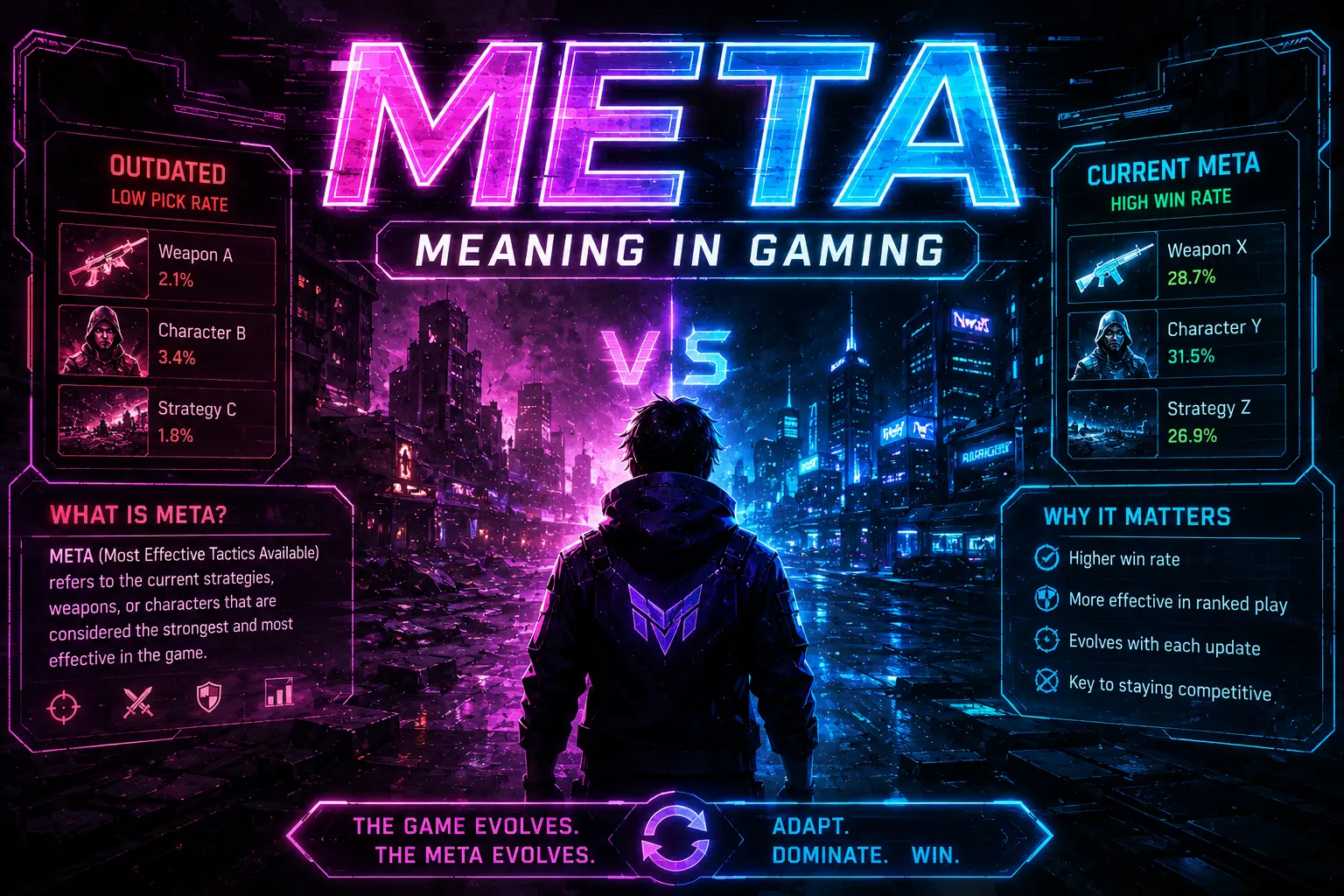
Meta Meaning Overview
Meta meaning in gaming extends beyond a single roster or patch note; it is the collective understanding of what strategies, characters, and builds currently define success across matches and modes. The meta is not a fixed rule but a dynamic map that shifts with balance changes, player ingenuity, and professional play. By studying the meta, players can anticipate shifts, identify viable paths, and refine their approach to different opponents and ladders. This overview explains what the meta is, how it forms, and why it matters for both casual players and top competitors. We also explore how metas evolve across genres and platforms, revealing patterns that transcend individual games.
Definition of ‘Meta’ in Gaming
Meta, short for most effective tactics available, is the collective understanding of which strategies, builds, characters, or loadouts currently deliver the best long‑term results in a game. It emerges from a mix of balance, map design, player skill distribution, and the ongoing experimentation of the community. In team‑based games, metas are often driven by the synergy between roles, how teams coordinate, and how kits complement one another under common maps and objectives. In fighting games and shooters, meta knowledge grows from frame data, timing windows, weapon balance, and map familiarity, while in strategy games it centers on economy, timing, and unit composition. The meta is not a fixed rulebook but a living guide that shifts with patches, tournament results, and shifts in player creativity. Observing professional play, tracking win rates, and reading patch notes all help explain why certain choices rise to prominence and others fade. Regions, ladder tiers, and platform differences can produce distinct metas that reflect local skill pools and available practice time. A strong meta is one that offers both high performance and enough flexibility to adapt to opponents. The meta also encapsulates risk management and resource allocation, such as when to push for map control, how to allocate resources across lanes or lines, and when to pivot to a new strategy to exploit opponent weaknesses. Finally, many players conflate meta with balance; in reality, it represents a spectrum of viable options where context, execution, and timing determine whether a choice becomes dominant. Understanding the meta, therefore, requires not only a snapshot of popular picks but also a lens on how players analyze data, test ideas, and respond to changes across the game’s life cycle.
History and evolution of metas
Metas evolve through three interlocking forces: community experimentation, patch balance, and professional play. The community tests new ideas in unranked and hosted tournaments, revealing which approaches scale across skill levels. Patch notes can elevate or nerf specific picks, creating incentives to explore alternatives and re-evaluate risk/reward calculations. Pro play accelerates change by publicly showcasing successful drafts and timings that fans imitate in streams and personal practice. The result is a rolling timeline where a meta becomes entrenched in a region or ladder, then gradually spreads or contracts as counterplay emerges. The following structured overview highlights how these drivers interact and how major shifts come to be observed by players and analysts.
- Early metas were driven by experimentation among the bravest players, with unconventional picks that surprised opponents and highlighted hidden synergies that later became widely accepted within local communities and matches.
- Patches and balance changes routinely shifted weapon pools and numbers, prompting shifts in lineup priorities and forcing communities to rethink assumptions about the most effective setups across multiple patches.
- Professional play accelerates meta evolution, as top teams publicly showcase new tactics, promote unfamiliar heroes, or demonstrate precise timing, compelling gamers to adopt similar approaches to stay competitive in major events.
- Community discourse, content creators, and streaming feedback further refine the meta, making it more accessible while also inviting radical experimentation on the edges of viable play across communities.
- Historically dominant metas eventually encounter counterplay, which dissolves the old setup and opens space for new ideas, maintaining a dynamic cycle of adaptation and learning globally.
The history of metas is therefore a balance between stability and novelty, a pattern that keeps games engaging and players learning. Understanding this evolution helps players anticipate shifts and adapt more effectively.
Early metas and player adaptation
In the earliest days, players tinker with lineups and skills, often discovering unconventional combinations that reveal underlying synergies before they become widely accepted within local communities and matches.
Patch-driven balance changes
As developers adjust stats, reach, or cooldowns, metas pivot quickly, rewarding teams that can interpret patches and reframe strategy without losing tactical coherence or identity within the shared meta space.
Pro scene influence on meta shifts
When top teams showcase new picks and timing, they set play patterns that fans emulate, compressing long experimentation into rapid, repeatable playbooks across tournaments and streamed content worldwide.
Community-driven meta shifts
Communities discuss, critique, and share data, driving experimentation on a broader scale that sometimes precedes official balancing, ensuring diverse strategies remain viable for years and across regions worldwide.
How the meta forms (community, patches, pro play)
Metas form through the interaction of community experimentation, patch cycles, and professional play, with each factor amplifying the others. The community’s curiosity generates hypotheses and spreadable strategies that test how far a concept can go in practice. Patch cycles introduce calculated changes that can favor certain playstyles, forcing quick reanalysis of options and adaptation of builds or lineups. Pro play serves as a high-stakes showcase, turning successful ideas into widely copied conventions that filter down to amateur players through streams, guides, and practice regimes. Regional differences, platform constraints, and ladder ecosystems contribute to how quickly a meta takes hold in a given space. A robust meta typically offers strong performance with enough flexibility to adapt to counterplay and shifting patches. Successful adaptation relies on data literacy—tracking win rates, understanding matchups, and recognizing when a trend is a temporary blip or a durable shift. Ultimately, the meta is a reflection of what players can execute consistently at scale under real game conditions. Frequent patch cycles, data dashboards, and community analytics create a feedback loop that speeds meta adoption or slows it when changes are more punitive or subtle.
Examples of famous metas
The following table captures high‑profile metas across games to illustrate how the meta shapes play and analysis in different contexts. It provides a compact cross‑section of how dominance, counterplay, and adaptation occur in practice.
| Game | Meta Period | Core Elements | Impact on Playstyle |
|---|---|---|---|
| League of Legends | Season 4–Season 5 (2014–2015) | Strong duelist top, roam emphasis, objective control | Defined early 2010s macro play and siege focus |
| Dota 2 | 6.84 era (2016–2018) | Push-heavy lineups, five‑man teamfights, map control | Encouraged coordinated teamplay and tempo management |
| Overwatch | GOATs era (2018) | Three tanks, three supports; shield dominance; ult economy | Stabilized team layouts and prompted patch diversification |
| Super Smash Bros Melee | Early 2000s–2010s | Fox/Falco/Sheik priority; tech and execution emphasis | Fueled the growth of competition through high skill ceilings |
These cases show how meta awareness influences practice, scouting, and adaptation in real time as patches and competition evolve.
Key Features and Capabilities
A meta strategy typically begins with a core concept or goal, such as controlling tempo, securing map control, maximizing resource efficiency, and shaping early momentum across roles and objectives, while also framing how teams approach risk, execution, and adaptation under pressure, both in practice rooms and during live competition. It serves as a living blueprint that evolves with patches, player talent, and shifting community expectations. The practical value lies in translating abstract strength into reliable in-game results, aligning individual skills with team coordination, and providing a clear path for learning, experimentation, and iterative improvement across multiple patches, meta cycles, regions, and playstyles. Understanding meta shifts requires systematic study: tracking patch notes, analyzing tournament footage, and testing ideas in controlled settings to separate enduring principles from situational trends. This article provides structure for evaluating meta viability, from high-level strategy to practical execution details, ensuring players can translate analysis into repeatable success.
What constitutes a meta strategy
Meta strategy is often composed of a core concept and a clear objective that informs every decision from picks to rotations, while also framing how teams approach risk, execution, and adaptation under pressure, both in practice rooms and during live competition.
The practical value lies in translating abstract strength into repeatable in-game results, aligning individual skills with team coordination, and providing a path for learning, experimentation, and iterative improvement across multiple patches and meta cycles.
- A meta strategy typically begins with a core concept or goal, such as controlling tempo, securing map control, maximizing resource efficiency, and shaping early momentum across roles and objectives.
- It integrates champion or loadout choices, ability rotations, and objective priorities to create a coherent plan that can adapt under pressure and maintain team synchronization throughout a match.
- Roles, spacing, and timing are aligned with expected opponents and common tactics, ensuring your team executes the strategy with synchronized movement, communication, and trade-offs during all phases of play.
- Resource management, economy decisions, and risk assessment determine whether the meta can expand or collapse as the match progresses under fluctuating pressure and evolving opponent choices.
- Counterplay and adaptability are built into the meta, allowing teams to pivot when opponents discover new tactics or patches shift balance, ensuring continued pressure and flexible decision making.
- Positioning depth, spacing efficiency, and threat perception help sustain pressure while minimizing risky jumps or engagements that could swing tempo and turn the advantage against your team.
- Documentation and review ensure lessons are codified, enabling future iterations to refine or replace elements as the meta evolves through practice, patch notes, and competitive play.
By codifying these principles, teams can train toward repeatable patterns while maintaining the flexibility to adapt to opponents and patches that shift the meta.
Role of game mechanics and balance
Game mechanics define what is possible within a title, including damage values, cooldowns, resource generation, scaling, and interaction rules between abilities and environments. The strength of a meta often arises when these mechanical systems align with strategic aims, enabling reliable execution, predictable outcomes, and efficient resource management. When a mechanic cleanly supports a tactic or tempo, teams can practice a narrow set of sequences that consistently yield favorable trades, map control, or objective pressure. In contrast, mechanics that reward inconsistent timing or require complex scripting can introduce variance, making the meta harder to lock in and easier to counter. Designers balance these elements to create opportunities for mastery without creating dead-ends, ensuring that skill expression remains central while the strategic framework stays adaptable.
Balance is not static; it shifts with patches, bug fixes, new characters, item changes, and broader systemic adjustments such as economy or objective values. Meta viability thus evolves as the community learns to exploit strengths, test counters, and move away from overused ideas that become predictable. When balance changes narrow a previously dominant option, players search for alternative archetypes that preserve the intended power curves while offering fresh angles of attack. Conversely, buffs to underused strategies can spark rapid diversification, inviting teams to experiment with synergy, positioning, and risk tolerance that previously seemed inadvisable. Effective meta analysis tracks both immediate outcomes and longer-term settlement patterns, distinguishing between short-lived trends driven by novelty and durable shifts driven by robust advantages. Finally, practitioners should differentiate between personal comfort and team-wide effectiveness, ensuring selections fit the roster, communication style, and strategic tempo that define their competitive identity.
In practice, players should translate mechanical depth into actionable checklists: what timings matter, how to maximize cooldown uptime, which interactions require shared attention, and how to sequence actions to minimize risk while maintaining pressure. Regular drills, review sessions, and scrimmages help ingrain these patterns until they become reflexive, while data-driven reviews validate assumptions and point toward refined goal setting for the next training cycle. The goal is to maintain a healthy balance between theoretical potency and actual performance under pressure.
Tools and analytics for tracking meta
Tracking meta involves collecting data from official patches, match histories, and in-game telemetry, then turning it into accessible insights for players at all levels. Analysts monitor win rates, pick/ban rates, and position-specific performance to identify trends that are not obvious from raw results alone.
Common data sources include patch notes from developers, leaderboard statistics, tournament footage, and third-party analytics platforms. These sources help practitioners understand which strategies are gaining traction, how quickly communities adapt, and which changes persist across patches. Visualization tools such as trend graphs and heatmaps make it easier to spot enduring patterns rather than short-lived spikes.
Practical use involves translating findings into practice plans: testing new builds, benchmarking against established benchmarks, and recording outcomes to refine predictions about the meta’s trajectory. While data can point toward likely shifts, skilled players also weigh qualitative factors like comfort, team chemistry, and strategic fit with their roster.
Community-driven vs developer-driven meta shifts
Community-driven shifts occur when players experiment with unconventional picks, off-meta strategies, and creative synergies during scrims and open ladders. Grassroots momentum can reveal hidden strengths, push patch parity, and accelerate the evolution of the meta beyond what designers anticipated.
Developer-driven shifts come from balance changes, new content, and reworks that systematically adjust the competitive landscape. Patches can nudge the meta toward certain archetypes or broaden the viable options, but they may also cause churn that requires rapid reassessment and adaptation by teams and analysts.
Balancing these forces requires ongoing monitoring, clear communication from developers, and a framework for evaluating patch impact. Players benefit from cultivating meta literacy that respects community experimentation while aligning with official intent, ensuring that strategy remains both robust and responsive to the game’s evolving ruleset.
Benefits and Competitive Advantage
The gaming meta reflects the evolving dominance of strategies, characters, and builds that shape play across titles, platforms, and competitive scenes. Understanding where the meta stands enables players to make informed decisions about picks, roles, and itemization that improve consistency and performance. This knowledge also helps you anticipate balance changes, patch notes, and shifts in opponent behavior, reducing blind experimentation. By aligning with current meta trends or skillfully countering them, individuals and teams can gain a strategic edge, expedite improvement, and communicate clearer game plans. The following sections explore why meta understanding matters for players, how teams and streamers monetize meta insights, and the inherent risks of overreliance.
Why understanding the meta matters for players
Understanding the meta is central to improving outcomes in most games. For a player, meta awareness translates into smarter champion or loadout choices, more precise role decisions, and a steadier path to improvement. When you know which strategies dominate at your rank or region, you can align practice priorities with those patterns rather than chasing every new idea that appears online. This alignment reduces wasted time and increases the likelihood that your hard work translates into tangible results in matches. Meta knowledge also guides how you approach warmups, early game planning, and post-game reviews, making each session more efficient and goal oriented.
Beyond performance, meta understanding builds a resilient mental model. Players learn to distinguish trend-driven experiments from durable strengths, identifying what works reliably under patch conditions and how to adapt when a balance change shifts the landscape. This awareness helps you avoid overreaction to every patch note while still planning for expected pivots and counterplays. It also simplifies decision making under pressure, since you have a framework for evaluating risk, reward, and opponent tendencies in real time.
From a competitive perspective, the meta creates a shared language that accelerates team communication. When teammates reference common trends, drafts feel smoother and shot-calling becomes more coherent. For solo players, meta literacy translates into measurable gains through targeted practice and clearer goal setting. Overall, the right meta understanding acts as a force multiplier, turning many small improvements into consistent performance gains across ladders and tournaments.
In practice, you should blend meta analysis with personal strengths. Track patch notes, watch high-level play, and study replays to identify patterns that fit your comfort zone while remaining flexible enough to counter emerging counters. A disciplined approach to meta study also reduces burnout by giving you a finite set of options to master rather than an overwhelming sea of possibilities. Used wisely, meta knowledge supports a steady, repeatable path to skill development and sustainable competitive advantage through meta understanding.
How teams and streamers leverage meta knowledge
Teams and streamers translate meta knowledge into structured workflows that optimize practice, drafts, and audience engagement. The practical applications below illustrate how meta awareness becomes a competitive and monetizable asset.
- Strategic drafting and counter-picking that align with patch notes, opponent tendencies, and map flow, enabling smoother early games and targeted late-game execution.
- Scrim planning and role specialization driven by meta shifts to maximize synergy and reduce information gaps during high-stakes matches across diverse opponents.
- Analytical reviews of replays and patch implications to refine practice drills and reinforce evidence-based decision making for players at all skill levels to internalize consistent habits.
- Content creation and audience engagement that leverage meta knowledge to educate viewers, drive sponsorships, and attract subscriptions through transparent analysis and entertaining formats.
- Adaptation of training regimens and coaching services to reflect evolving meta dynamics, offering targeted improvement plans for individuals and teams.
By integrating these approaches, teams convert meta reading into measurable performance gains and new revenue streams. Streamers can deepen viewer trust by transparent meta explanations and consistent improvement narratives.
Risks of overreliance on meta
Relying too heavily on the prevailing meta can lead to a false sense of security and a fragile understanding of game dynamics. When players frame every decision around the current top strategy, they begin to overlook core fundamentals such as timing, positioning, and micro-level control that are transferable across patches and titles. This risk is especially acute for newer players who are still building a solid mechanical base and for veterans who chase every patch’s flashy innovations instead of testing them against established principles. Meta-driven thinking should inform, not dictate, choices; otherwise, you may find yourself overspecialized to a snapshot in time rather than building a durable skill set.
Second, meta analysis can be distorted by sampling biases. High-level tournaments yield different dynamics than rank ladders, and hot streaks in data can obscure longer-term outcomes. When teams and players presume that what works in a limited window will persist, they risk wrong calculations about counter-picks, item priorities, or rotation timing. To guard against this, interpret meta signals alongside direct game experiences, opponent history, and your own performance data. The best approach blends understanding with experimentation, keeping you prepared for both trending trends and surprising counters in real matches.
Third, copy-paste meta ideas can erode originality. If everyone adopts the same opener or build, the early phase becomes predictable and invites rapid exploitation by prepared rivals. Individual growth requires exploring options beyond the obvious, testing unconventional approaches, and learning to adapt on the fly. This does not mean ignoring the meta; it means testing its boundaries, validating it in your own practice, and cultivating a flexible repertoire. Coaches and analysts can help by designing experiments that challenge common assumptions and by tracking how small deviations influence win rates across multiple opponents and maps.
Finally, overreliance on meta risks burnout and slows long-term progress for players who want to progress from hobbyist to professional. A healthy meta approach reserves time for exploration, personal refinement, and tactical creativity. By balancing meta-informed strategies with deliberate practice, players maintain motivation, retain curiosity, and stay resilient when patch cycles shift the goalposts. In short, meta literacy should sharpen decision making without suppressing creativity or the willingness to take calculated risks when the circumstances demand it.
Pricing, Plans, and Offers
Pricing, Plans, and Offers for meta tools shape how teams access critical gaming meta data and ongoing optimization capabilities. This section breaks down common pricing structures, compares features across tiers, and highlights the kind of users each plan targets. Understanding these options helps esports teams, content creators, and competitive players balance cost with depth of meta analysis and tactical visibility. You will also see how time-bound promotions, bundles, and loyalty offers can stretch your budget without sacrificing essential capabilities. Read on to identify a plan that matches your current needs and scales with your progress in meta mastery.
Common monetization models for meta tools
Before selecting a monetization model for meta tools, map your usage: how many projects you manage, data retention needs, and how you collaborate with teammates. This quick overview helps you compare price points and features across tiers so you can balance cost with the depth of meta analysis you require. The table below consolidates common monetization models, making it easier to see value at a glance. While price is important, also examine data limits, API access, and support options that align with your workflow. The goal is to choose a plan that scales with your ambition in gaming meta strategies and competitive play.
| Plan | Monthly Price | Included Features | Ideal For |
|---|---|---|---|
| Free | $0 | Basic meta insights, community forums, limited dashboards | Casual learners and individuals exploring meta concepts |
| Starter | $9.99 | Standard meta analysis dashboards, up to 2 projects, 1-year data retention | Individual players and small teams |
| Growth | $29.99 | Unlimited projects, advanced analytics, historical trend comparisons, API access (limited) | Small teams and content creators |
| Pro | $79.99 | Team collaboration, priority support, advanced security, custom dashboards | Esports teams and organizations |
| Enterprise | Custom | SSO, dedicated success manager, SLA, on-prem options | Large studios and enterprise partners |
Beyond price, consider data limits, API access, and support quality when choosing a plan that fits your workflow. Use this table as a practical lens to align your budget with your goals in meta strategies, esports insights, and competitive gaming tactics.
Free alternatives and community resources
Free alternatives and community resources for gaming meta tools provide accessible entry points for players and teams watching trends without committing funds. Open source analytics suites, public dashboards, and script libraries allow you to pull data, replicate popular analyses, and validate strategies on your own schedule. Community-driven projects often share templates for meta reports that highlight top character picks, common item builds, and popular stratagems across different patches or seasons. These resources shine in the early stages of learning, helping you understand the mechanics of the meta and how changes in balance patches ripple through competitive play. When used together with careful note taking, they form a solid foundation for understanding the Meta in video games. Forums, Discord communities, and Reddit threads function as continuing education for gaming meta knowledge. They enable quick feedback on emerging trends, such as shifts in popular configurations or evolving tactical approaches in eSports. Engaging with practitioners—ranked players, coaches, and content creators—can reveal practical insights that formal tools might overlook. Always cross reference community conclusions with data you collect yourself to avoid overfitting to a single ladder or tournament. Free options also encourage experimentation, allowing you to test new meta ideas with lower risk while you develop your own playstyle. To maximize value from free options, set clear limits on what you track, how often you refresh data, and how you measure impact on your results. Document your observations in a simple notebook or spreadsheet, noting which meta strategies seem to outperform under certain conditions. Combine community findings with your own tracking of win rates, matchups, and map picks to build a personal understanding of the meta evolution. This approach aligns with the broader concept of meta awareness for gamers and helps you grow from casual observer to informed competitor without large upfront costs. Over time, you may pair free resources with low-cost add ons or trial periods to progressively extend your analytical capabilities. Many platforms offer generous trial windows or discounted starter plans aimed at hobbyists or student teams, making it feasible to sample advanced features such as API access, deeper historical data, or collaboration tools. If your budget remains tight, focus on the most impactful features first, such as trend dashboards and matchup analysis, before investing in full scale automation. In this way, you can maintain a steady path toward more sophisticated meta analysis while keeping your costs predictable.
Choosing the right plan for your needs
Choosing the right plan for your needs begins with a clear view of how you use meta tools today and how you expect that usage to evolve. Start by mapping your activities: number of projects, number of team members, required data retention, and whether you need API access for automation or integration with other tools. This mapping helps you separate must have features from nice to have extras and prevents paying for capabilities you will not use. If your work revolves around rapid iteration in the meta, you may benefit from higher refresh rates, more dashboards, and stronger collaboration features. If you operate solo or with a small group, a lighter plan can provide essential insights without overextending your budget. Next, test and compare through trial periods whenever possible. Use a simple scoring rubric to rate each plan on key criteria: data depth, ease of use, support quality, and total cost of ownership over six to twelve months. Consider the total cost of ownership rather than the sticker price; for example, API access can unlock automation that saves hours per week, while enterprise grade security and dedicated support may reduce risk for larger teams. Also, assess how easy it is to scale as your needs grow, such as adding more seats, expanding data limits, or integrating with a data warehouse. Remember that the best plan is the one that fits your current needs while keeping room to evolve as the meta continues to shift in eSports and beyond. Take a pragmatic approach: start with a Free or Starter tier to validate your assumptions, then plan a staged upgrade if your workloads increase, your team expands, or you start participating in higher stakes events. Document your usage and track outcomes to justify future investments with objective data. When you are ready to scale, look for plans that offer flexible billing, predictable renewals, or a dedicated success manager if required. The right plan aligns with your broader strategy for Gaming Meta strategies and online communities.