CC Meaning: Crowd Control in Games — Product Overview
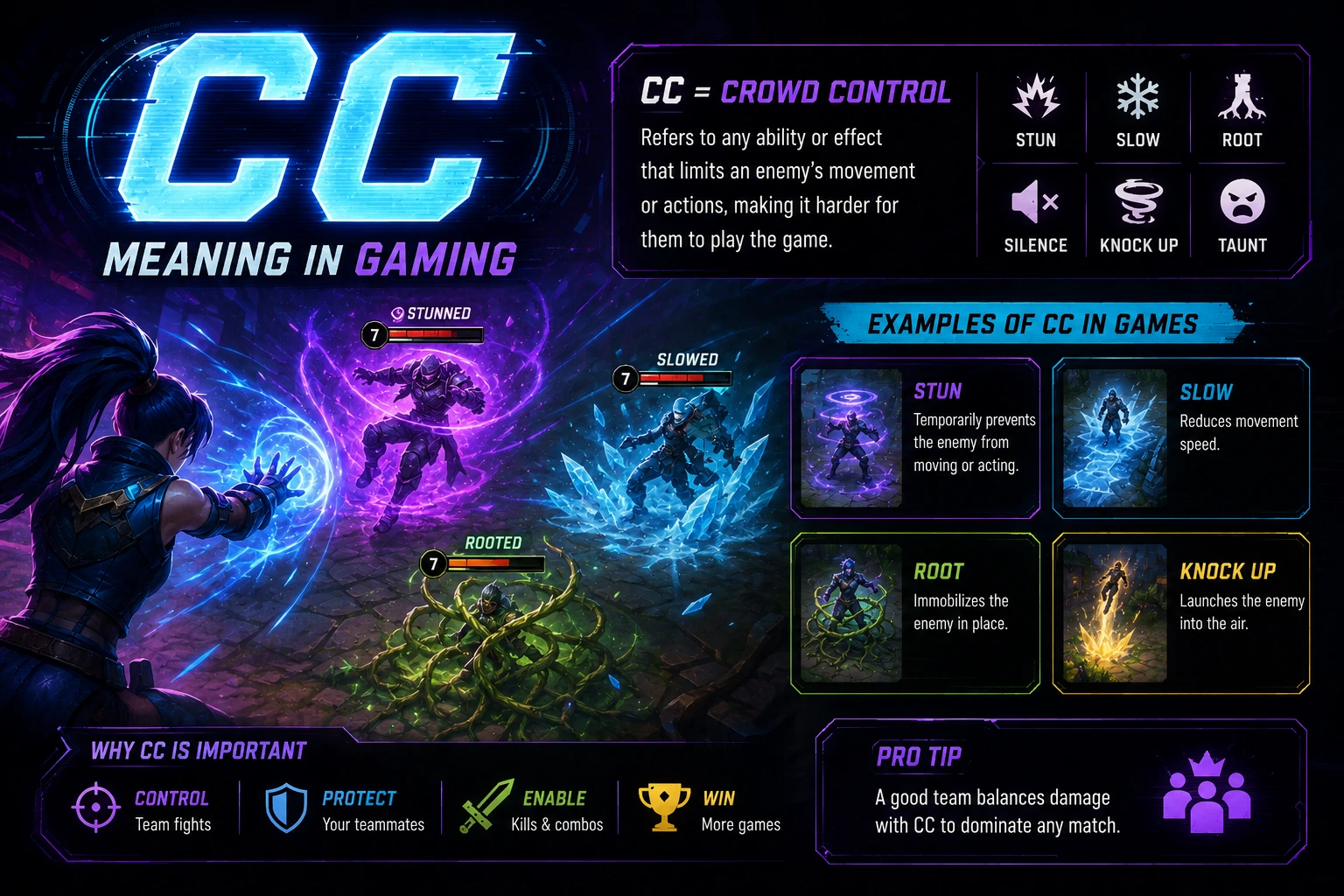
CC, short for crowd control, refers to abilities that restrict an opponent’s actions for a short period. These effects can stun, slow, silence, knock back, or otherwise impede an enemy’s ability to respond. Effective CC is less about raw damage and more about turning the tide of a fight by coordinating with teammates and denying the enemy’s choices. The term is widely used across RPGs, MOBAs, and team-based shooters, and it often has subtle game-wide implications for pacing, positioning, and resource management. Understanding CC is essential for players who want to read fights, time engages, and protect allies while staying safe yourself.
What CC means in gaming
CC means crowd control, a term used across many online titles to describe abilities that temporarily restrict an opponent’s actions. In its simplest form, CC is any effect that stops a target from acting, interrupts an ongoing ability, or changes their movement or positioning. It differs from pure damage in that its value lies in control and information: it gives your team time to execute coordinated plays, creates windows to trade or retreat, and denies opponents their preferred options. CC is not inherently a guarantee of victory; its effectiveness depends on timing, target selection, cooldown management, and how well a team can chain CC with damage and healing. As a rule of thumb, CC should complement offensive pressure, not rely on it; too much CC can stagnate gameplay, while too little CC can make matches chaotic and unrewarding. In practice, players should think about how CC interacts with other mechanics like cleanses or dispels, whether enemies have sources of CC resistance or tenacity, and how line-of-sight, terrain, or crowd geometry affects the reliability of CC. Different genres balance CC in different ways: a MOBA may emphasize precise skill shots and long stuns, while an RPG may use dependable roots that lock a target in place during a multi-turn strategy. In team-based games, supportive roles often rely on CC to protect allies, peel enemies away from carries, or set up engaging combinations where one teammate interrupts an enemy’s escape while others unleash damage. Understanding CC also means recognizing its costs: staggering enemies consumes mana or energy, and many CC effects expose the caster to risk, since casting times and global cooldowns can leave a player vulnerable. Finally, players should be mindful of the pace and tempo of a match, using CC to manage space, control zones, and tilt the momentum in your favor without robbing everyone of agency for too long. Mastery comes from practice: reading enemy cues, anticipating rotations, and coordinating with teammates to maximize the payoff of every CC moment. The best CC timing often turns defensive moments into favorable fights, turning small advantages into larger outcomes.
Types of CC effects
CC effects come in several distinct forms, each changing how a player can respond to threats. Each category creates different strategic options and responses.
- Stun (short incapacitation): Affected unit cannot act for a brief duration, interrupting abilities and basic attacks. Stuns create openings for teammates to follow up or reposition.
- Root (immobilization): Target is fixed in place, unable to move, cast spells, or retreat. Roots enable defensive zoning and prevent escape routes during skirmishes.
- Slow (movement speed reduction): Reduces mobility, enabling pursuers to close gaps or for defenders to hold lines, often stacking with other CC to maximize control.
- Knockback/Knockup (displacement): Physically pushes or lifts enemies, disrupting positioning, interrupting channeled abilities, and creating space or resets for team counters.
Mastering these categories helps teams plan CC chains and protect key targets.
Examples in popular games
Across genres, CC takes different shapes depending on game design and balance. The following table compares CC in a few well-known titles, illustrating how each game implements crowd control to shape fights.
| Game | CC Type | Example Ability | Notes |
|---|---|---|---|
| League of Legends | Stun | Dark Binding (Morgana Q) — a skill-shot that binds a target and briefly stuns on hit | Line-of-sight required; sets up follow-up damage |
| Dota 2 | Hex | Lion’s Hex — transforms the target into a harmless critter for several seconds | Disables actions while remaining visible to team |
| Overwatch 2 | Freeze | Mei’s Freeze — immobilizes enemies with ice, preventing movement and most actions | Counterplay often involves melting or escaping after duration |
| World of Warcraft | Polymorph | Mage Polymorph — transforms the target into a harmless critter, removing them from combat | Do not break CC by damage in early durations; longer durations exist if interrupted |
These examples illustrate how teams leverage CC for aggression, containment, and counterplay in dynamic matches.
Why CC matters in gameplay
- Strategic team synergy: CC sequences create openings for teammates to land big abilities, maximize damage windows, and force opponents into unfavorable positions during moments of high stakes.
- Counterplay and decision making: Anticipating CC and planning escapes or cleanses reduces downtime, while accurate timing punishes errors and keeps fights moving in your favor.
- Objective control: CC helps teams secure zones or capture points by pinning opponents and forcing retreats, creating space for map objectives and favorable trades.
- Balancing CC in game design: Developers tune duration, cooldowns, and resistances to prevent overuse, ensuring CC adds strategic depth without eroding player agency. These adjustments help maintain pace, encourage dynamic counters, and keep matches engaging for players of diverse skill levels in competitive modes.
Key Features, Benefits, and Competitive Advantages
Crowd control (CC) is a foundational mechanic in many competitive and cooperative games. It refers to abilities that limit an opponent’s actions by stunning, slowing, silencing, or otherwise restricting mobility and attack. Understanding CC helps players coordinate engagements, protect allies, and disrupt the enemy team’s plans. In RPGs, MOBAs, and team-based shooters, effective CC requires timing, range awareness, and team synergy. This section examines how CC drives strategy, its measurable attributes, and how players can optimize its use for competitive advantage.
How CC enhances team strategy
CC shapes the tempo of team fights by defining when and where exchanges occur. A well-timed stun or silence can prevent a critical ability from landing, enabling teammates to capitalize on a window of vulnerability. In practice, CC is not just about killing individual targets; it’s about guiding the fight flow to favor your squad’s strengths. Initiators with strong engage force the enemy to react, while peelers protect backline damage dealers from diving threats. Effective CC also involves contingency planning: teams pre-set responses to common threats, like counter-engaging when a high-CC initiation is detected or falling back when a healer is about to reset a fight. The best CC is often not the longest duration but the most reliable at the moment it matters, synchronizing with ults, gaps in the opponent’s stuns, or a retreat that would end otherwise disastrously. Communication is essential: calls such as ‘soft CC on target X’ or ‘save CC for their escape’ help maintain rhythm and ensures that resources are used judiciously. Finally, players must manage cooldowns and resource costs, because wasting a hard CC on a low-value target or missing a chain can leave your team vulnerable during the next sequence. Different game genres reward different CC textures; in MOBAs, immobilizing a frontline tank gives room for your carry to re-position, whereas in shooters slowing a key runner can break a flanking attempt. In RPGs and turn-based battles, CC can lock an enemy long enough to secure a guaranteed kill or to retreat safely. The risk of CC is that it can create predictable arcs that opponents learn to dodge; players should vary durations and combine immediate hard CC with longer soft crowd controls to keep pressure without over-committing. Training teams to read enemy timers and map vision helps CC land more consistently; winning teams habitually track CC respec, cooldown resets, and synergy windows between different CC types. In short, CC is the language through which teams orchestrate aggression, defense, and tempo, turning individual skill into collective advantage.
Common CC ability attributes
The four principal attributes of CC abilities—duration, range, cooldown, and strength—shape how teams draft, land, and respond to engagements. They determine how long a target stays disabled, how far you can reach to apply pressure, how long before you can attempt another contest, and how impactful the effect is in actual fights.
| Ability | Duration (s) | Range (m) | Cooldown (s) | Strength |
|---|---|---|---|---|
| Stun | 1.0–2.5 | 5–15 | 8–25 | High impact; hard CC |
| Slow | 2.0–5.0 | 6–20 | 6–18 | Medium; reduces mobility |
| Silence | 1.5–3.0 | 3–12 | 12–22 | Medium-high; blocks spells |
| Root/Bind | 1.5–3.5 | 6–15 | 15–25 | High; prevents movement |
| Knockback/Knockup | 0.5–1.5 | 4–10 | 12–28 | Medium; position control |
Understanding these attributes helps players plan combos, align with teammates, and exploit enemy cooldowns. When planning lineups, consider how durations and ranges interact with map size, vision, and rotation timing.
Balancing CC: pros and cons
CC has clear advantages: it can secure picks, protect allies, and flip unfavorable skirmishes into favorable trades. It also imposes costs on design teams: long or ubiquitous CC can slow games to a crawl, reduce player agency, and reduce the effectiveness of speed and flanking strategies. On the flip side, CC introduces predictable patterns that opponents can anticipate and counter with cleanses, tenacity, or blink abilities, leading to oppressive cycles if not balanced properly. Designers balance CC by mixing hard and soft CC, spacing out durations, and providing counterplay options that reset engagements without nullifying skill. Additionally, the pacing of CC interacts with the game’s economy and objective timings; too much CC can stall rotations and make fights feel repetitive, while too little CC can leave objectives uncontested and fights chaotic. Effective CC systems encourage team coordination and strategic depth, rewarding players who read queues, track cooldowns, and commit to well-timed sequences. In competitive settings, minor tuning—adjusting durations, ranges, or the availability of cleanses—can substantially shift outcomes, making the line between fair play and frustration. The goal is to preserve agency for both sides while preserving the dramatic impact of crowd disruption, so teams remain engaged and bets remain meaningful across long, stressful matches.
CC synergies and counters
Effective CC synergies require planning beyond individual abilities. Teams that anticipate how opponents will respond to a CC pattern can force misplays and objective fights that swing maps in their favor. The following list presents representative CC synergies and counterplay options that appear across popular game modes, providing a practical reference for training and competitive play.
- Chain a reliable hard CC with a precise damage window: stun the priority target, then coordinate teammates to maximize damage while the target remains disabled and teammates reposition.
- Layer soft CC and area denial to force unfavorable positioning, creating safe lanes for your marksman or mage to land spells and secure high-value objectives before the enemy can respond.
- Set up zone control by combining displacement with vision denial, funneling opponents into choke points where your team can punish with concentrated burst damage and cross-map rotations.
- Prepare for cleanses and tenacity by alternating buffers and multi-target CC, ensuring at least one effect lands despite defensive purges or temporary immunity activations.
- Combine CC with objective timing, such as locking a carrier during dragon or baron fights, to force contested clears and create decisive moment outcomes instead of blank skirmishes.
These patterns are practical tools for training and competition. Regular scrim practice helps players internalize timing, communication, and resource management so CC remains a flexible asset.
Technical Specifications, Performance Metrics, and System Requirements
Technical specifications, performance metrics, and system requirements underpin how crowd control (CC) behaves in modern games. This section outlines the core engine and scripting considerations that enable CC effects like stuns, slows, silences, and other crowd-disruptive actions across genres such as RPGs, MOBAs, and shooters. We address latency, synchronization, and client-server dynamics that influence reliability, as well as the hardware and software environments needed to support accurate CC modeling, logging, and analysis. Understanding these aspects helps developers optimize CC tooling and players appreciate how consistent CC outcomes are achieved in online multiplayer experiences. We also touch on tooling requirements for modding and data gathering to study CC performance without compromising game balance.
How CC is implemented technically
Crowd control systems are typically built as cross-cutting subsystems that attach to characters, abilities, and events in the game world. At the core, CC is implemented as status effects with defined duration, stacking rules, and clearance conditions, all encapsulated in a data-driven layer that can be tuned without touching core gameplay logic. Most modern engines use an ability system that separates the definition of a CC effect from its execution, often through a data asset or scriptable object that lists its type (stun, root, silence), its magnitude, its duration, its target rules, and its cooldown. From there, a centralized Effect System or Gameplay Ability System tracks active CC states on each actor, applying a state machine that transitions a unit from normal to affected states and back when timers expire or immunity frames intervene. This approach supports instant CC like stuns as well as time-based effects such as roots or silences, and it allows combinations such as a stun followed by a slow without hardcoding every permutation. Networking-wise, CC is replicated from server to clients to maintain consistency, with the server acting as the final arbiter of when an effect begins, ends, or is interrupted. To keep latency from erasing fairness, client-side prediction surfaces predicted CC state for the local player while the server reconciles any discrepancies shortly after. Developers also implement rules for stacking, overlap, and CC immunity to prevent abuse and unfun stunlock loops. Implementations often require animation and physics integration so that a stunned unit cannot move or take actions, while a rooted unit may still animate and be pushed by external forces within configured limits. Visual telegraphs, audio cues, and camera effects accompany CC to communicate intent, while server-side checks guard against rapid reapplication or timing exploits. Finally, a data-driven flag system—the status-effect tags—supports extensibility, letting designers add new CC types or tweak existing ones without rewriting core systems. In short, CC in modern engines is a layered construct combining data-driven definitions, state machines, network replication, prediction, and careful balancing to ensure predictable outcomes in diverse matchups.
Latency and client-server considerations
The reliability of CC effects in online games is tightly tied to the quality of the network connection between players, servers, and the game clients. In a typical client-server architecture, the server is authoritative for when a CC starts, ends, or interrupts, while clients render predicted states to keep the experience responsive. The tick rate of the server and the update frequency of the client determine how quickly a CC event is observed and how long a casting animation can precede the effect. Latency, jitter, and packet loss introduce gaps between the moment a CC is initiated and the moment it lands on the target, which can create perceived inconsistencies if not properly managed. To minimize surprises, many systems employ prediction and reconciliation: the client may locally apply the CC state when a cast is confirmed, while the server later validates and corrects any misalignment by snapping to the authoritative state. Delays can also impact duration by causing drift between the server’s timer and the client’s display; designers compensate with safeguards such as fixed durations, clear immunity windows, and robust synchronization of timers. Order of events matters in fast-paced CC chains: an interrupt or staggered application can block subsequent actions or extend remaining CC windows beyond the intended duration. Anti-cheat and fairness considerations require that CC bookkeeping be strict: the server must decide stacking, overlaps, and expiry, preventing client-side toggles or rapid reapplications that would bypass cooldowns. Network optimization techniques, like delta compression and compact CC state representations, help reduce bandwidth while preserving precision. Finally, for players on suboptimal connections, predictive visuals and delayed effects can create misalignment between what the client sees and what the server enforces; balancing these aspects is essential to maintaining competitive parity and an enjoyable experience.
Performance metrics for CC effects
To evaluate CC effectiveness in a game, designers rely on a mix of direct and contextual metrics that capture both the mechanical and the strategic impact of crowd control. The most basic measures are uptime, duration, and hit rate. Uptime tracks the total time an actor spends under any CC effect during a match, while duration records the length of each CC instance from application to clearance. Hit rate measures the success rate of CC attempts relative to attempts, revealing reliability and balance between attacker and defender. Together these metrics reveal how consistently CC lands and how long it constrains a target’s actions, but they do not tell the full story. More strategic indicators include DPS lost, which estimates the decrease in damage output attributable to CC windows, and crowd movement, which analyzes how affected units rearrange themselves in space and time during a skirmish. Objective control metrics capture the impact of CC on game goals, such as point captures, zone occupancy, or objective steal times, highlighting how CC contributes to team success beyond raw damage numbers. Telemetry streams are essential for calculating these metrics: events such as OnApply, OnExpire, OnInterrupt, and position updates must be logged with timestamps to reconstruct sequences and measure correlation with outcomes. In practice, teams compute rolling averages, normalize by match length, and segment data by CC type and stacking rules to identify patterns that indicate balance concerns or strategic opportunities. The interplay between CC duration and cooldowns also matters: short, frequent effects can be more disruptive than long, infrequent ones, so designers often tune a combination that preserves gameplay pace while maintaining fairness. Effective CC design supports both solo play and team coordination, encouraging players to time abilities with allied ultimates and to exploit openings created by opponents’ CC. These metrics, when tracked in a controlled environment and compared against live game data, inform iterative balancing decisions and help maintain enjoyable pacing across modes and player skill levels.
Measuring effectiveness: uptime, duration, and hit rate
Uptime is the fraction of total time a target spends under CC during a defined window, which is computed by aggregating all CC active intervals and dividing by the window length. Duration notes how long each CC instance remains active from application to expiry, providing insight into whether effects feel impactful or excessively brief. Hit rate measures how often a CC attempt successfully applies given the number of attempts and the target’s defenses or immunities. To calculate these, teams collect precise timestamps for application, refreshes, and expiries, along with per-actor status flags. In practice, a 5-minute window might show a target experienced CC for 28 seconds across multiple effects, with varied durations due to stacking rules. Anomalies such as drift between server timers and client visuals should be flagged and corrected through reconciliation logic. These metrics guide balancing: high uptime with short durations tends to pressure players, while long durations with frequent recasts can create frustration. Clear immunity windows help prevent immediate re-cc from opponents, preserving game flow. Visualization dashboards translate raw logs into charts that highlight trends, outliers, and correlation with victories or defeats. When used alongside other KPIs, uptime, duration, and hit rate support data-driven tweaks to CC types, stacking rules, and cooldowns, ensuring CC remains a consistent, predictable part of the game’s competitive feel.
Measuring impact: DPS lost, crowd movement, and objective control
DPS lost quantifies how much damage output is suppressed during CC windows, typically by comparing expected DPS without CC to observed DPS with CC active. Crowd movement analysis tracks changes in unit positions, formation, and spacing when CC is applied, revealing whether enemies are bottlenecked, routed, or seeking safe zones. Objective control measures track time in control points, zone occupancy, or objective timers during and after CC sequences to assess influence on match outcomes. These measures rely on event timestamps and spatial data captured from telemetry, enabling analysts to segment effects by CC type and team. Calculating DPS lost requires careful normalization for abilities that deal damage during channeling or after CC breaks, while crowd movement requires mapping trajectories to detect stutter, retreats, or clustering. Objective control often correlates CC pressure with successful captures or point defense, providing a game-wide signal of effectiveness beyond individual exchanges. As with direct metrics, data cleanliness matters: missing telemetry, desynchronizations, or inconsistent timestamps can distort results. Teams often combine CC-specific impact with broader metrics such as win rate, objective uptime, and time-to-win to determine whether a CC change improves or harms the competitive experience. Presenting these effects in dashboards supports iterative balancing and helps communicate complex tradeoffs to designers, QA, and players who care about fairness and flow, especially in team-based modes that hinge on coordinated CC usage.
Platform and system requirements for CC tools and mods
Tools and mods that analyze or extend CC behavior require a development-friendly runtime environment and careful attention to security and compatibility. Typical platform requirements include a modern 64-bit OS (Windows, macOS, or Linux) with sufficient RAM, a multi-core processor, and a capable GPU for running profiling dashboards and visualizations in real time. Developers should provide access to the game’s data definitions for CC types, durations, and stacking rules via a data-driven pipeline, often backed by configuration files or a Gameplay Ability System. For modding and analysis, interoperability with the game engine (Unity, Unreal, or bespoke) is essential, along with debugging hooks or a dedicated test build that preserves server authority while permitting client-side instrumentation. Instrumentation tools should capture CC events, actor states, timestamps, and position data with minimal overhead, so as not to distort gameplay. Network capture and analysis may be required to study latency effects, using safe, sanctioned tools that respect anti-cheat safeguards. Documentation about CC tagging, replication behavior, and event ordering helps modders implement reliable experiments and reproducibility. Security considerations are paramount: mods must not bypass protections or undermine fairness, and publishers often require signed builds and strict access controls. TV or dashboard interfaces should present CC telemetry clearly to designers, balancing detail with readability. Finally, test rigs should include controlled scenarios with predictable CC outcomes, enabling repeatable experiments to test stacking rules, immunity windows, and timing under varied network conditions.
Pricing, Plans, and Special Offers
Pricing, plans, and special offers shape how players access and experience crowd control features in online games. This section explains how CC related monetization can influence player choices, balance, and perceived value of different plans. We look at cosmetics tied to CC, season passes that unlock CC related content, and paid boosts that affect matchmaking or timing windows. You will learn signs of fair pricing and how to compare offers across titles to avoid overpaying for power. The goal is to help players navigate monetization thoughtfully without compromising gameplay quality or competitive integrity.
Monetization of CC mechanics (cosmetics vs pay-to-win)
Monetization of CC mechanics, namely crowd control abilities, sits at the crossroads of cosmetic design and gameplay power. In many games, CC is a core tool that shapes team fights and skirmishes, so publishers often separate how CC looks from how it works. Cosmetic approaches let developers charge for particles, skins, voice lines, and unique idle animations that accompany CC actions, while keeping the underlying CC rules intact for all players. This separation preserves fairness by ensuring that a stun, a root, or a silence remains available to anyone who earned it through time invested, skill, or luck, rather than being locked behind a purchase. However, some monetization strategies blend cosmetics with power by offering CC boosts, extended durations, reduced cooldowns, or amplified range as part of a paid package. When CC power scales with spending, it threatens balance, because even small advantages can tilt engagements in high skill brackets or in the hands of players who may not have the same practice. The most sustainable approach for live service games is to treat CC as a gameplay resource that is earned or earned via progression, while monetization focuses on skins, animations, announcers, or non functional bonuses that do not modify match outcomes. Community feedback consistently flags pay to win CC as a major turnoff, driving distrust and eroding long term engagement. Transparent patch notes, strict separation between cosmetics and power, and visible commitments to balanced matchmaking are essential to maintaining trust. For players, this means prioritizing titles that clearly label what is cosmetic and what is game affecting, and testing changes in practice modes before judging whether a season pass or microtransaction bundle is worth it. In short, CC monetization works best when purchases influence appearance or convenience but not core mechanics that determine who wins a clash. Developers should also offer earning paths such as seasonal challenges, event quests, or time limited bundles that unlock incremental CC options without creating a pay-to-win ladder. Responsible monetization invites healthy competition and sustains a game’s lifespan for both new and veteran players.
DLCs, season passes, and CC-related items
DLCs and season passes are popular ways to expand a game’s universe, and CC related items are often part of that expansion. A DLC may introduce a new character with a unique CC toolkit, or a new map with environmental CC triggers, both of which broaden strategic choices without removing others’ access to the same core mechanics. Season passes frequently bundle CC related cosmetics, such as alternative particle effects for stuns or distinctive silhouettes for roots, giving players a sense of progression while remaining strictly cosmetic in terms of gameplay power. Some content bundles include CC enhancing items that are decorative or challenge based, while ensuring that standard match experiences remain balanced for all players. Content models that embed CC in paid tiers should be explicit about the difference between aesthetic changes and functional advantages. For fair play, many publishers separate permanent unlocks from season pass cosmetics and require players to complete objectives or earn points to reach premium tiers. Operators and fans benefit from clear schedules of what is new, what is temporary, and what is strictly cosmetic. It also helps when stores show side-by-side comparisons of free and paid routes to unlock CC related items, so players can decide based on value rather than hype. Finally, strong moderation around older DLCs to avoid power creep means older CC kits stay relevant without overshadowing baseline options. In practice, the best DLC and season pass offerings provide aspirational visuals and new narration while shielding core CC power behind skill and teamwork rather than purchases.
Free-to-play vs premium balance
Free-to-play models versus premium options create distinct pressure points for CC fairness. In free-to-play ecosystems, developers typically monetize through cosmetics and time limited boosts rather than direct gameplay advantages, helping preserve parity in public matches. Premium versions may offer immediate access to exclusive CC kits or permanent boosts, raising concerns about fairness if these options visibly influence decisions in the lobby or during combat. The core question is whether players can reach equivalent CC capabilities through practice, earned currencies, or strategic play, rather than through purchases. Free-to-play incentives tend to emphasize equal starting points, while paid paths may accelerate unlocks, but must avoid granting in match power that tilts outcomes. To preserve competitive integrity, many titles decouple monetization from core CC functionality, ensuring CC is earned or otherwise available to all players over time. Clear labeling and consistent rules help players distinguish cosmetic from functional changes, while practice modes and training areas let players explore new CC kits without risking rank. In practice, the best balance rewards skill and teamwork, offers robust free CC options, and positions paid paths as cosmetic or convenience that does not alter critical timing windows or counters. Players benefit when unlocks are predictable, with transparent progression curves and no sudden shifts in who can CC first. By creating space for both F2P and premium players, communities avoid polarization and maintain inclusive competitive environments that encourage growth rather than gatekeeping. Regular player feedback loops and ongoing data analysis help keep this balance dynamic.
How to evaluate offers and avoid pay-to-win traps
Evaluating offers and avoiding pay-to-win traps starts with a simple rule: verify what changes inside the match and what remains cosmetic. Start by reading the product description and checking patch notes to see if the item alters CC duration, cooldowns, range, or resistance to crowd control. If an item claims to make your CC stronger or harder to counter, treat it as a potential pay-to-win and look for independent tests or community consensus. Compare offerings across titles to see whether you receive equal access to CC tools through gameplay or if purchases shorten the time required to reach parity. Check whether the offer is time limited or tied to a seasonal ladder; temporary boosts that disappear at season end may create an uneven playing field for new players. Prefer bundles that are explicit about cosmetics and non functional improvements, and avoid ones that promise guaranteed improvement in match outcomes. For players who want to learn new CC kits, use practice modes or simulated arenas to test items before using them in ranked play. Review refund policies and warranty terms to avoid being locked into an unwanted purchase, and consider using trial currencies or demo access when available. Look for third party analyses or community guides that quantify how much a given CC item actually changes performance, and corroborate with your own experience in casual matches before committing in competitive settings. Finally, remember that the most effective CC investments tend to be cosmetic or convenience oriented; if an offer asks you to surrender critical in game options for a shield of cosmetic upgrades, opt for alternatives that keep core gameplay unaffected. Set a personal budget for microtransactions and track how often you buy CC related items, and use wishlist features to sample new concepts when they appear in a test environment. Consult the game’s community guidelines on monetization to see how developers responded to past feedback, and watch for patterns that suggest risk of imbalance in future patches.