Whiff Meaning Overview for Competitive Attacks
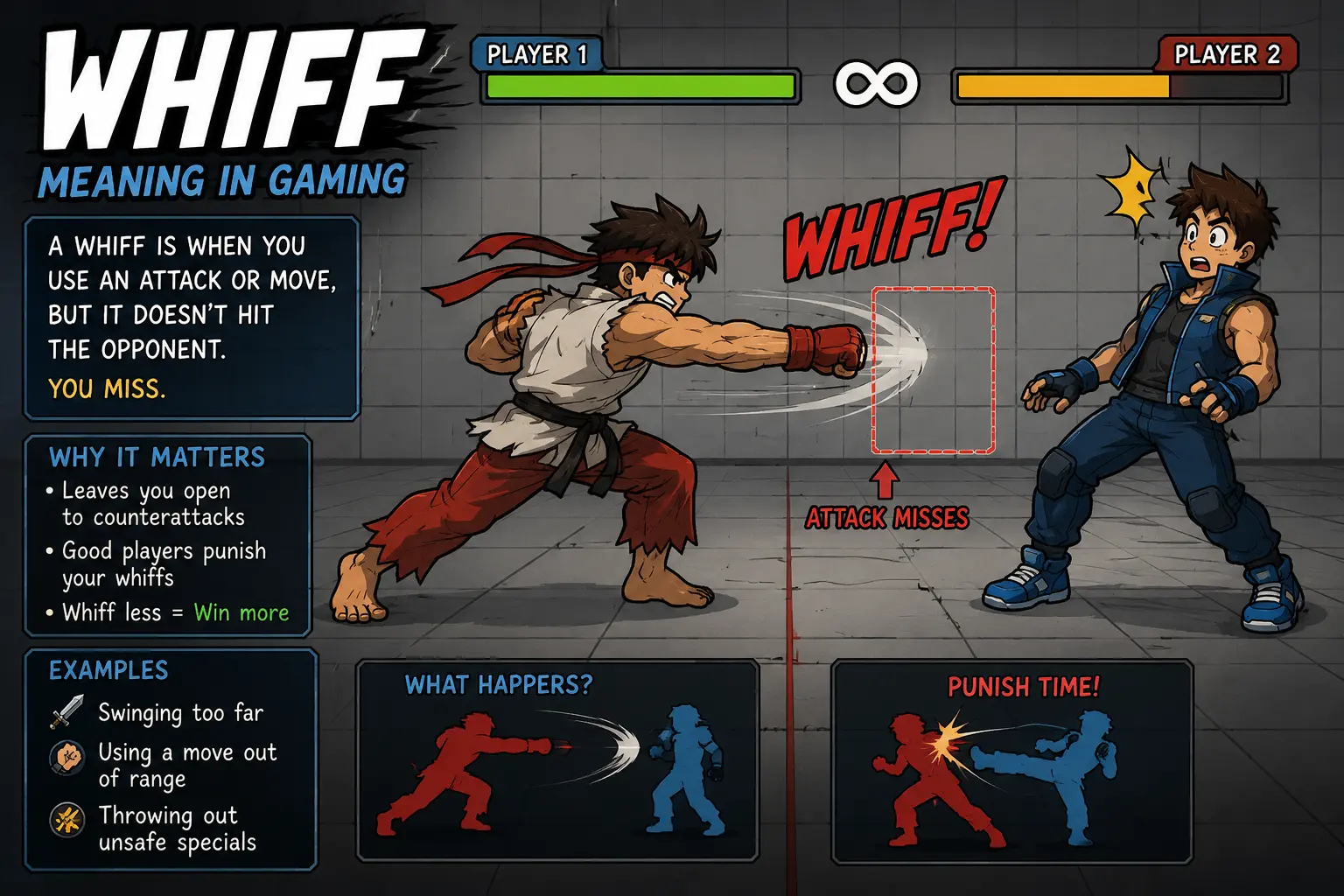
Whiff meaning in gaming refers to any attempted attack or ability that fails to connect with the opponent. In fighting games and arena titles, whiffs create openings for punishments and can swing entire rounds on momentum shifts. Understanding when and why whiffs occur helps players optimize spacing, timing, and decision making under pressure. This overview explains the mechanics, risks, and practical approaches to minimizing whiffs in high stakes play. By studying hitboxes, frame data, and your own muscle memory, you can reduce wasted actions and turn an enemy’s misreads into advantageous punishments.
Definition of a Whiff
A whiff is not simply a miss; it is the result of timing and range misalignment between an attack’s active hitbox and the opponent’s hurtbox. A whiff occurs when an attack resolves without registering a hit, leaving the attacker in recovery as the enemy advances or counters. A practical way to interpret whiffs is to view them as the intersection of your attack’s reach, its active frames, and the adversary’s defensive movements. In neutral clashes and punish opportunities alike, whiffs establish the tempo and risk calculus of the exchange. Below are common whiff scenarios and quick formative examples to reinforce the concept. A whiff is a miss that occurs because the target is outside reach, or because the attack resolves before it can connect. Timing errors, delayed reactions, and misread spacing often produce whiffs, making players vulnerable as their recovery frames begin while the opponent is already counterattacking. Different moves have distinct hitboxes and hurtboxes; misaligning them during trades commonly yields whiffs despite apparent proximity on screen at close range. Some whiffs occur due to unsafe recovery; once an attack misses, the character often trades into lengthy recovery, granting the opponent a free punish. Latency and frame delays can exaggerate a whiff when inputs are registered late, turning a supposed hit into a frustrating slip that costs valuable resources. Practitioners learn to adjust pacing and keep pressure with safer options until a punish window opens. With consistent practice, recognizing whiff patterns becomes a reflex that informs your overall strategy.
Why Whiffs Matter in Competitive Play
Whiffs matter in competitive play because they shape the pace, risk, and control of a match. A whiff denies a direct payoff and simultaneously creates a window for punishment, potentially shifting the momentum in a single exchange. In high level competition, players manage whiff risk by selecting safe moves, mixing aggression with patience, and exploiting opponents’ tendencies to overcommit or mistime their counts. The momentum created by whiffs can alter round dynamics, force on the fly adaptation, and break an opponent’s rhythm. Studying frame data helps you estimate punish windows, so you can convert missed hits into reliable punishes. Reactions, decision speed, and the expected outcomes of each option influence whether chasing a whiff is worth the risk. Training focuses on safe punish options at multiple ranges, turning missed hits into tangible advantage. The psychological aspect matters too; witnessing an opponent whiff can induce hesitation and shift playstyle toward more cautious spacing. In practice, players weave whiff recognition into drills that emphasize safe spacing, correct timing, and efficient punish sequences. The net effect is a better sense of how every action moves the fight toward favorable outcomes, not just toward victory in a single exchange. Regular review of replays helps you identify your own whiff patterns and adjust accordingly, strengthening your overall decision making under pressure.
Common Causes of Whiffs
Understanding the common causes of whiffs helps you diagnose your own play and anticipate opponents traps. Below is a table outlining typical reasons, visible symptoms, and practical fixes. Analyzing these factors across matches teaches you to map your own tendencies and target improvements.
| Cause | Symptoms | Common Fix |
|---|---|---|
| Poor spacing | Attack ends up outside opponent’s reach; hitbox overlaps with air | Work on mid range drills and maintain proper distance before starting a combo |
| Late inputs | Inputs arrive after start up frames; the move whiffs as the opponent reacts | Buffer inputs earlier and practice input timings in training mode |
| Unsafe recovery | Missed attack leaves the character in long recovery; opponent gets free frame advantage | Choose safer options with shorter recovery when near a risk zone |
| Misread hitbox | Hitbox doesn’t connect despite apparent proximity | Study character hitboxes and adjust attack timing for multi range encounters |
Recognizing these causes in practice strengthens your ability to adapt. Analyzing replays and tracking whiff frequency at different ranges helps you map your tendencies and target improvements. Consistent practice builds reliable punishes and reduces unnecessary risk in real matches.
Key Features and Benefits of Whiff Analysis
Whiff analysis unlocks a data-driven view of combat interactions, transforming misses into meaningful opportunities for growth. By quantifying start-up frames, recovery windows, and hitbox overlap, players can predict punish sequences and optimize their spacing. It also helps coaches design precise drills that focus on timing, patience, and pressure management. With reliable whiff data, teams build repeatable decision-making processes, reducing hesitation during high-stress exchanges. Finally, whiff analysis highlights matchup-specific tendencies, informing game plans that adapt across stages and meta shifts.
How Whiff Analysis Improves Player Decision-Making
Whiff analysis translates ambiguous moments into concrete practice goals, helping players read the arena as a sequence of punishable mistakes rather than random misses.
- Identify recovery windows and punish opportunities early by correlating attack speed, startup, and frame data, enabling you to punish safely rather than guessing.
- Adjust decision thresholds based on opponent tendencies, so you trade high-risk options for safer punishments when whiffs signal a pattern of aggression.
- Prioritize spacing and footsies to minimize whiff risk, using timing drills to feel the exact range where your hitbox will connect after their attack misses.
- Incorporate mental models of risk versus reward, recognizing when a whiff punishes scale with character matchup or stage dynamics, shaping your attack choices mid-round.
- Use whiff data to build a practical punish ladder, starting with safe options and escalating to harder punishes as confidence and timing improve.
Whiff analysis helps players translate observed misses into a practical, repeatable framework for practice and competition. It also supports coaching by providing objective benchmarks for progress and a shared language for strategy discussions.
Tools and Techniques for Detecting Whiffs
Detecting whiffs relies on a mix of precise data and careful observation; the right toolkit accelerates learning and reduces guesswork.
| Tool | Type | Accuracy | Ideal Use-Case | Pros | Cons |
|---|---|---|---|---|---|
| Frame Data Analyzer | Software | High (0.01s) | Punish whiffs in neutral and punishables | Granular, Real-time | Steep learning curve |
| Hitbox Visualization | Tool | Medium-High | Compare startup/active frames | Clear mappings | Depends on device calibration |
| Live HUD Feedback | Hardware/Software | Medium | In-game pacing awareness | Immediate feedback | Potential distraction |
| Replay Analytics | Video Analysis | High (post-match) | Identify miss patterns across rounds | Deep insights | Post-game only |
Choose tools that fit your budget, platform, and training goals, then layer insights to build repeatable punishing sequences.
Examples: Turning Whiff Data into Better Strategies
Example 1 demonstrates how a single whiff can seed a reliable punishable sequence. In a neutral exchange, an opponent’s dash punch often contains a short recovery that creates a predictable window. By tracking the exact frame when the whiff begins and when recovery starts, a player can time a light poke to interrupt, then escalate to a heavier punish if the hitbox confirms contact. Over multiple matches, recurring patterns emerge: certain characters favor aggressive dash-ins after retreat, while others rely on mid-range feints that mask a punishable miss. With this data, the defender rehearses a scalable routine that begins with a safe punisher, followed by a stronger option if the whiff is confirmed, all while maintaining spacing to discourage counterattacks.
Example 2 translates data into a training ladder. After several sessions, a coach outlines a step-by-step plan: first, collect whiff data across matches; second, categorize by move type, distance, and timing; third, assign punishments with increasing risk. The trainee then practices the ladder under controlled conditions, starting with safe punishments and gradually incorporating riskier options as timing improves. The emphasis is consistency and adaptability rather than raw damage. During live drills, players test the ladder against different opponent patterns, noting which whiffs create longer windows and adjusting the initial response accordingly.
Example 3 focuses on adapting to matchups. In fights where opponents favor fast, linear pokes, whiffs tend to occur after mis-timed advances or blocked pressure. The strategy shifts to bait-heavy sequences that invite whiffs and then punish with multi-hit combos, while preserving mobility. By comparing across characters and stages, players learn to tweak reach, timing, and punisher choices, building a compact glossary of whiff types and corresponding routes for rapid decision-making in sets. The practical payoff is a more flexible game plan that shifts fluidly with threats rather than sticking to a single read.
Finally, coaching notes emphasize continual transfer of data to live play. Regular review after sessions confirms improvements, and sparring drills stress-test punish sequences under pressure. Pair data-driven routines with intuitive play to sustain fast adaptation, while always tracking recovery frames to avoid getting trapped by the opponent’s escape moves.
Technical Specifications, Performance Metrics, and Security Standards
This section outlines the technical specifications, performance metrics, and security standards used to analyze whiffs in gaming contexts. It covers how to measure whiff frequency, impact, and punishment opportunities, and it explains data collection, privacy considerations, and how teams can use these insights in training and tuning. Readers will learn how hitboxes, timing, and spacing influence whiff dynamics, and how to interpret analytics without compromising player privacy. The goal is to provide a clear framework for consistent measurement across titles and competitive scenarios. By grounding analysis in precise definitions, developers and analysts can improve reporting, coaching, and strategic decision-making.
Performance Metrics for Tracking Whiffs
These metrics provide objective benchmarks for evaluating player performance and tuning training regimens.
- Whiff rate per character and move, measured across sessions to capture timing variability and contextual factors like frame data and spacing.
- Punishability window, the time frame in which a whiffed attack is punishable, calculated from start up frames to recovery metrics.
- Average recovery after whiff, including end lag and vulnerability to counter hits, helping players plan safer spacing during competitive duels and training.
- Whiffing consistency across characters and partners, measuring how reliably players reproduce timing and spacing under pressure in online ranked matches and practice sessions.
- Hitbox alignment accuracy during whiffs, quantifying how hitboxes affect miss timing and the likelihood of opponent whiff reactions across different frame data sets.
These metrics provide objective benchmarks for evaluating player performance and tuning training regimens. Teams and players can monitor trends over time to identify gaps in motion, timing, or spacing. Regular reviews help prioritize deliberate practice focused on whiff punishment.
Whiff Rate Transparency
Whiff Rate Transparency: This section delves into how to measure the frequency of whiffs across characters, moves, and contexts with clarity and reproducibility. It discusses standardizing data collection, normalizing for character complexity, and reporting whiff rates in a way that is useful for coaching and patch analysis. Analysts should document the session types (practice, online ranked, tournaments), the sample size, and the environmental conditions that may influence the rate. By maintaining transparent methods, teams can compare results across patches, player skill levels, and training regimens without ambiguity. The goal is to provide stakeholders with consistent, actionable insights that drive targeted practice and strategic adjustments during competition and development.
Punishability Window Precision
Punishability Window Precision: This topic focuses on the exact time window when a whiffed move remains punishable, incorporating start-up frames, active frames, and recovery. It explains how to align window measurements with frame data sources, frame advantage calculations, and the potential effects of latency and network variance on perceived punish opportunities. The section also covers edge cases, such as multi-hit sequences and move cancellations, and provides guidance on communicating precise windows to players for improved timing and decision-making in real-time play. The objective is to deliver a reliable, frame-accurate basis for punishing whiffs in training and competition.
Recovery Lag and Risk Assessment
Recovery Lag and Risk Assessment: This area analyzes the end of an attack’s recovery phase and the subsequent risk exposure for the attacker. It emphasizes measuring end lag, recovery speed, and vulnerability during recovery frames, along with opponent reaction times. The discussion includes normative benchmarks for safe spacing after a whiff and strategies for maximizing punish windows while minimizing counterplay risk. Practical guidance covers how to use recovery metrics to structure drills, adjust spacing in footsies, and design punish sequences that reliably capitalize on whiff punishment in high-level play.
Hitbox Interaction and Frame Data
Hitbox Interaction and Frame Data: This item investigates how hitbox shape, position, and timing influence whiff outcomes. It covers how inaccurate hitbox data or misinterpretations of frame data can lead to suboptimal punish attempts, and it discusses methods for validating hitbox charts, frame-by-frame analyses, and collision checks. The section also addresses how to correlate hitbox behavior with observed whiff timings across characters, moving from theoretical models to practical, in-game observation and coaching applications. The aim is to strengthen the link between data, visualization, and in-game decision making for more consistent punish play.
Consistency and Confidence under Pressure
Consistency and Confidence under Pressure: This final subsection examines how mental state, nerves, and in-game tempo affect whiff timing and punish reliability. It discusses drills designed to stabilize timing under simulated tournament stress, approaches to track consistency across sessions, and measures to quantify a player’s confidence in their punish options. The content includes practical coaching tips, scenario-based practice, and evaluation metrics that help players translate disciplined timing into reliable punishments when the stakes are high. The section also considers how to integrate these insights into broader training plans and analytics workflows.
Data and Logging Specifications
Data and logging specifications outline the exact fields and formats used to capture whiff-related events across titles and platforms. A well-defined schema ensures that analysts can compare results from different sessions, players, and game builds. At minimum, logs should record identifiers for the player, character, and move involved, along with precise timestamps to enable frame-accurate analysis. The schema should support both real-time streaming and batched processing, so teams can monitor live tournaments while preserving historical data for post-event reviews. Consistency in naming conventions reduces ambiguity when aggregating data from varied sources, and it simplifies integration with training tools and performance dashboards.
Essential data fields include: player_id, session_id, character_id, move_id, move_name, event_type, frame_start, frame_end, recovery_start, recovery_end, hitbox_id, platform, region, game_version, lobby_type, input_method, latency, network_type. The data model should also capture predicted versus actual outcomes, enabling models to measure discrepancies between expected punish opportunities and observed results. This allows analysts to quantify bias introduced by timing windows or hitbox variations and to validate predictive models used in coaching tools. Documentation should specify field types, allowed values, and null handling to ensure clear data contracts across teams and tools.
Sampling rate and timekeeping: Data is captured at frame granularity, typically 60 Hz or higher if the game supports multiple refresh rates. Store timestamps in ISO 8601 UTC with as much precision as the system permits, and align them to the game’s internal clock to avoid drift. Formats and standards: Use JSON Lines for streaming logs or Parquet/ORC for bulk exports, with clear field definitions, allowed values, and null handling documented in a central data catalog. Data governance: Implement integrity checks, versioned schemas, and audit trails to track changes to the data model over time. Ensuring data quality at ingestion reduces downstream errors in analytics and coaching tools.
Data minimization and lifecycle: Apply the principle of least privilege, retain only what is needed for analysis, and apply anonymization where possible when sharing data externally. Regular reviews of logging schemas should accompany game updates to preserve data quality and comparability across patches.
Privacy and Security Considerations
Privacy and Security Considerations address how player data is handled, stored, and shared to comply with applicable laws and industry best practices. The overarching goal is to protect player identities while enabling meaningful analytics for improvement in gameplay, balance, and coaching. Organizations should implement a data governance framework that defines access controls, data ownership, and acceptable use policies for all whiff-related telemetry. Regular privacy impact assessments help identify potential risks and mitigation strategies before deploying analytics features across titles or tournaments.
Data minimization and consent: Collect only data strictly necessary for analytics, and obtain explicit user consent where required by law. Provide clear options for players to opt out of data collection, especially for public-facing dashboards or third-party sharing. Anonymization and pseudonymization techniques should be applied to streams or datasets used for external analysis, with explicit re-identification controls in place for internal audits or debugging.
Security controls and encryption: Encrypt data at rest and in transit using industry-standard protocols. Enforce robust authentication and authorization, role-based access, and regular security training for teams handling sensitive telemetry. Maintain a secure software development lifecycle (SDLC) for analytics pipelines, including code reviews, vulnerability scanning, and incident response planning. Ensure that data stores, processing jobs, and dashboards are protected from unauthorized access and tampering.
Compliance and retention: Align with GDPR, CCPA, and other regional privacy laws as applicable. Establish data retention schedules that balance analytical usefulness with privacy protections, and implement procedures for data deletion on request. When sharing data with partners or researchers, apply data-sharing agreements that specify permitted uses, data destruction timelines, and audit rights. Finally, consider third-party risk management, including vendor assessments and security attestations, to safeguard the analytics ecosystem as a whole.
Transparency and user rights: Provide players with accessible explanations of what data is collected, how it is used, and how it benefits gameplay and balance. Support user rights to access, rectify, or delete data where legally required, and communicate any changes in privacy practices clearly. Ongoing monitoring and independent audits help maintain trust and ensure continuous compliance with evolving privacy standards.
In practice, privacy and security should be integral to every stage of data collection, processing, and sharing, not an afterthought. Regular reviews of policies, technical controls, and organizational practices help ensure that whiff analytics remain both effective for improvement and respectful of player privacy.
Pricing Plans, Availability, and Getting Started
This section explains pricing plans, how available tools fit into your workflow, and how you can get started with whiff analysis today. Whether you are new to whiff meaning in fighting games or looking to sharpen your punishment game, you can explore both free and paid options to access data, tutorials, and community insights. Availability varies by platform, region, and title, so understanding your setup helps you pick the right tools and access channels. The getting started guide below walks you through choosing a plan, setting up tracking, and using the tools to improve your reaction time and punishing whiffs. By combining pricing, availability, and a clear start path, you can quickly begin mastering whiff punishment and incorporating it into your training regimen.
Free vs Paid Tools for Whiff Analysis
Free tools for whiff analysis can be a solid starting point for players who want to understand what a whiff looks like in real matches without committing to a paid plan. They often provide replay capture, basic timing indicators, and simple hitbox overlays that help you visualize why a move misses and how your spacing affects outcomes. While these options are accessible and easy to onboard, they typically come with limits on data depth, sample size, and export capabilities, which means you may be missing the full picture when diagnosing stubborn gaps in your defense. Beginners can use these tools to practice identifying common whiff patterns, track a few representative sequences, and build a mental model of frame-by-frame punishment. As you accumulate experience, you’ll likely outgrow the free tier and look for more rigorous data and automation to stay competitive.
Paid whiff analysis tools usually unlock deeper frame data, more granular hitbox visualization, advanced filtering, and the ability to export datasets for offline review. They often support multiple titles, cross-referencing of attack properties with opponent responses, and integration with training regimens or coaches’ workflows. Depending on the product, you may gain access to cloud libraries of recorded matches, preset dashboards, and automation that flags potential whiff punish opportunities in real time or during post-game analysis. The down side is the cost and the churn of subscriptions; teams and solo players need to justify the investment with consistent usage and measurable improvement. When evaluating a paid option, ask about data retention, privacy, platform compatibility, and how often the product updates its frame data and patch timing to reflect new game versions.
Beyond price, consider how a tool fits your education plan. A free trial or freemium tier can help you test core capabilities before locking in a monthly or annual commitment. If you compete in local tournaments or online ladders, look for features like drill libraries, heatmaps of whiff timing, and configurable feedback that aligns with your training goals. Some tools emphasize integration with popular fighting games by providing prebuilt frames charts and move lists, while others focus on raw data collection you can annotate yourself. The best choice balances depth, accessibility, and a clear path from data to practice, so you can translate insights into tighter spacing, faster reactions, and smarter bait and punish decisions.
ROI for whiff analysis is not only measured in wins but in reduced recovery windows and fewer telegraphed attempts. Free or paid, the right tool should make it easier to pinpoint when you overextend, optimize your spacing, and recognize when opponents are likely to whiff back. A practical approach is to dedicate weekly training blocks to a single concept—like whiff punishing on medium-to-long range—and use the tool to track improvements in reaction time, hitbox timing, and the success rate of punish attempts. Keeping a consistent log of your sessions helps you quantify progress, compare before-and-after games, and build a repeatable workflow you can share with peers or coaches. If you are unsure where to start, choose a plan that offers guided tutorials and a community forum so you can ask questions and learn from experienced players who focus on whiff discipline.
Ultimately, the choice between free and paid tools comes down to your current skill level, training volume, and the degree to which you value structured feedback. Both paths can help you decode whiff mechanics, but paid options are often preferred by players who require deeper analysis, faster iteration, and scalable routines. Regardless of price, look for a clear onboarding path, reliable updates, and responsive support so you can stay focused on improving. Take advantage of the availability window to compare features, test data accuracy against known frame data, and confirm that you can export your findings for review with teammates. With the right toolkit, you can turn every missed attack into a teachable moment and accelerate your progress toward consistent punish opportunities.
How to Set Up Whiff Tracking in Your Game
Step 1 is to define clear goals for what you want to measure in your game. Decide which moves you want to track, what frame data matters for your meta, and how you will judge a successful punish. This clarity guides your choice of tools, data sources, and visualization styles so you can stay focused as you progress. Step 2 is to select a tracking solution that fits your platform and title. Check whether the game offers official replays, whether the editor supports custom hitbox overlays, and whether the tool can ingest your preferred format (replay files, video, or live capture). If you are new to whiff analysis, start with a tool that provides guided tutorials and a gentle learning curve to avoid overwhelm.
Step 3 is to instrument the setup. Install or enable the capture method, align frame timing with game tick rate, and calibrate the system using a few controlled drills where you know exactly when a whiff should occur. This step often requires matching a few sample sequences against known timelines so that the data you collect is trustworthy. Step 4 is to collect data and configure visualizations. Create dashboards that show hitbox alignments, recovery windows, and punishment opportunities on a timeline, and verify that your data aligns with on-screen events in slow motion replays. Step 5 is to validate your results. Run a handful of test scenarios (neutral, whiff punishes, and punish responses) and compare the automated outputs with your own manual observations to confirm accuracy. Step 6 is to begin routine analysis. Use the visuals to spot recurring whiff patterns, track improvements after drills, and refine your training plan based on what the data reveals.
As you grow more comfortable, consider adding a feedback loop that pairs your measurements with live coaching or a training partner. This collaboration helps ensure that your interpretations stay grounded in game feel and real-world timing, not just numbers on a screen. With time, your setup should feel natural, letting you quickly identify an incoming whiff, time your response, and verify that your punish connects consistently.
Best Practices for Ongoing Availability and Support
Maintaining reliable whiff analysis requires a structured approach to availability, updates, and user support. Start with a documented onboarding process that covers installation, data sources, and expected performance so new teammates can join without downtime. Build a small, active support channel—such as a forum or chat group—where players can share issues, ask questions, and swap optimization tips. Regular maintenance windows should be scheduled for software updates, patches, and data model refreshes to keep your analytics in sync with current game versions. Implement monitoring that alerts you to data gaps, latency spikes, or failed captures, and keep a rollback plan in case an update introduces unexpected behavior. Data privacy and security should be part of your baseline, especially if you work with coaching staff or external teammates who access shared databases.
Invest in a clean data lifecycle: version control for scripts, archived replays, and a structured backup strategy. This protects your training history and allows you to compare progress over time. Documentation is essential; maintain a knowledge base with common workflows, troubleshooting steps, and best-practice checklists so that anyone can pick up the tool and start contributing quickly. Encourage community support by nurturing channels where players can exchange dashboards, share heatmaps, and explain how they interpret tricky whiff scenarios. Finally, align your support model with a clear service level expectation—define response times, platform compatibility checks, and escalation paths to ensure timely help when you need it most.