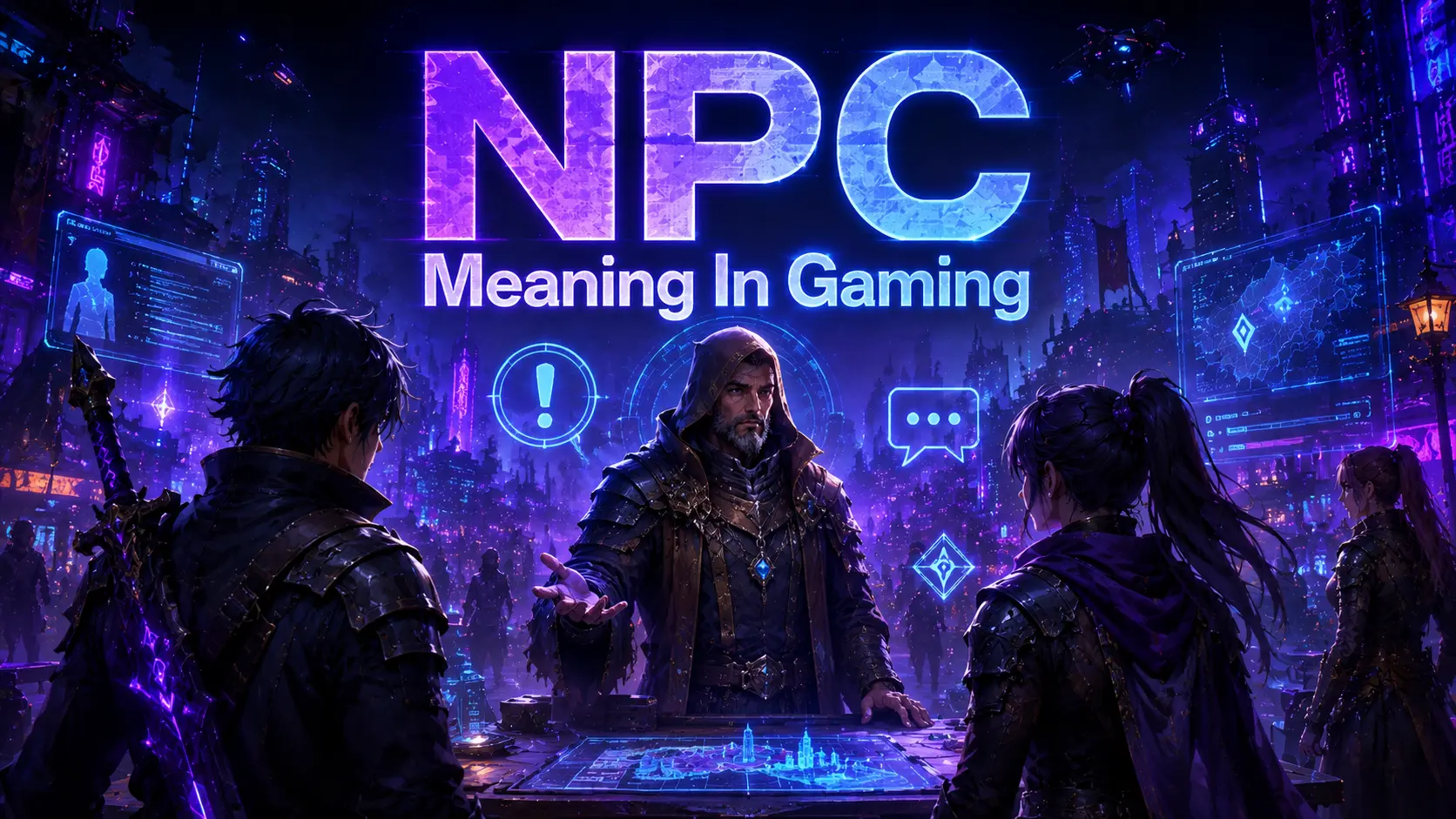
NPC Meaning in Games: Product Overview and Core Benefits
NPCs, or non-player characters, are game-controlled entities that populate virtual worlds and interact with players through dialogue, quests, combat, and storytelling. They form the backbone of many game systems, guiding exploration, shaping decisions, and enabling progress when players engage with them. Understanding their function helps players predict how a game will unfold and how to optimize their strategies for success. For developers, NPCs are a design tool to convey lore, maintain pacing, and create believable ecosystems within diverse genres. This section outlines what NPCs are, why they matter, and how their roles translate into player experience across RPGs, MMOs, shooters, and other formats.
What ‘NPC’ stands for and its origins
NPC stands for non-player character, a term that distinguishes figures controlled by the game’s software from those controlled by the player. In tabletop role-playing games, such characters were part of the narrative world and described by the game master; in video games, NPCs are introduced as pre scripted agents with behaviors and dialogue trees. The origins can be traced to early text adventures and RPGs, where designers needed characters to advance plots, furnish information, or offer items without requiring direct control by the player. In the earliest computer RPGs, simplistic routines handled simple interactions, but even those rudimentary NPCs seeded worlds with personality and purpose. Over time, NPC design evolved from static sprites to dynamic agents capable of nuanced responses, branching quests, and cooperative behavior. The term non-player character appeared in manuals and design documents across the 1980s and 1990s and became a standard part of game development jargon. As games grew more complex, NPCs shifted from mere placeholders to interactive engines that drive storytelling, world building, and player choice. Modern games feature a spectrum of NPCs from ambient background figures to central protagonists who react with meaningful dialogue, affect quests, and influence outcomes. The study of NPC origins also intersects with AI research, as developers seek more natural language, adaptive humor, and plausible behavior. In sum, an NPC is the game’s answer to social presence: it grounds the player in a living world, offers information and options, and pushes the narrative forward without needing the player to script every moment. Recognizing their developmental arc helps players appreciate why some games reward patience while others encourage rapid exploration. Ultimately NPCs mediate access to lore, scarce resources, and critical decisions that shape the path a player travels. Studios often prototype NPCs to test dialogue rhythm, quest pacing, and encounter variety, refining character behavior before final asset production. By examining both technical constraints and narrative goals, we can better predict how future NPCs will blend intelligence, emotion, and utility.
Roles NPCs play in different genres (RPGs, MMOs, shooters)
NPC roles shift with genres, reflecting unique player expectations and design goals. This sample highlights how RPGs, MMOs, and shooters leverage NPCs to support gameplay.
- RPGs: NPCs act as quest givers, lore keepers, and potential party members who develop relationships, reveal lore through branching dialogue, and reward exploration with decisions that shape outcomes.
- MMOs: NPCs populate vast worlds, serve as vendors, mission hubs, and faction anchors, guide new players, organize events, and balance progression through daily quests and rotatable objectives.
- Shooters: NPCs can be allies or enemies, providing cover fire, scripted encounters, and mission critical teammates whose behavior challenges players and adds tactical depth to battles.
- Hybrid and other genres: NPCs adapt to roguelikes, strategy games, and action adventures by offering procedural dialogue, dynamic encounters, and context specific assistance that rewards player style and pacing.
Together these roles show how NPCs support gameplay variety, reward curiosity, and keep players engaged through meaningful social interaction and world building.
How NPCs enhance player experience
NPCs enhance player experience by shaping immersion, enabling meaningful choices, and driving the narrative forward in tangible ways. They provide ambient context that makes worlds feel alive, from bustling markets to quiet halls where rumors travel. When well designed, NPCs react to player actions with believable intent, offering consistent rules and predictable consequences that reinforce the internal logic of the game world. Dialogue systems, quest chains, and faction reputations tie these characters to the player’s path, turning conversations into bridges that connect exploration with reward. They can also serve as mirrors that reflect player decisions, showing how different choices lead to alternate outcomes, alliances, or antagonism. Beyond dialogue, NPCs influence gameplay loops by handing out quests, guiding movement through hubs, or blocking progress until tasks are completed. Their presence also enables dynamic pacing, allowing designers to modulate tension by introducing new NPCs at strategic moments. Some NPCs act as puzzle gatekeepers, requiring players to gather clues, solve riddles, or collect items before advancing, while others provide social reinforcement, offering encouragement, humor, or warning cues that heighten emotional engagement. The most memorable NPCs reveal personality through consistent voice, cadence, and behavior, which helps players form attachments beyond mere mechanics. In multiplayer contexts, NPCs can anchor communities, lead events, and provide shared goals that transcend individual playstyles. They can also carry procedural generation seeds, ensuring that small procedural variations in dialogue or inventory feel natural rather than repetitive. Critics note that NPCs may contribute to world bloat if not aligned with core goals, yet when balanced they dramatically extend replayability and narrative depth. Finally, advancements in AI and animation expand what NPCs can do, enabling more natural dialogue, adaptive combat support, and subtle social cues that respond to learner level, skill, and player history.
Common types of NPCs (vendors, quest givers, companions, enemies)
Table included below illustrates representative NPC categories and how they normally interact with players. The table serves as a quick reference for designers to ensure consistent behaviors while allowing room for genre specific twists. In practice, a game may blend several types or repurpose a single type across different hubs or chapters. By clarifying expectations upfront, teams can balance accessibility with challenge and maintain a coherent world feel. The interaction patterns described here are not rigid; clever writers and artists often push the boundaries to surprise players while preserving trust in the world mechanics. A strong mix of vendors, quest givers, companions, and enemies helps sustain rhythm, reward systems, and narrative momentum across varying playstyles.
Vendors & Quest Givers
Vendors and quest givers form the economy and narrative spine of many games. Vendors provide access to equipment, consumables, and upgrades, with price scales that reflect player progression and reputation. They create pacing by controlling stock, restock timing, and occasional discounts tied to quests or milestones. Quest givers channel motivation by presenting tasks that reveal lore, unlock new areas, or advance major plots. The timing and variety of their assignments matter, balancing challenge with reward to keep exploration engaging rather than tedious. In well designed games, these NPCs remember player choices, reflect faction standings, and respond to prior interactions, which reinforces continuity. The best implementations weave commerce and story into a cohesive loop that rewards curiosity and supports steady progression without feeling exploitative.
Companions & Allies
Companions and allies are more than tactical tools; they enrich player experience through partnership and shared history. They follow the player, provide combat support, and carry items, shaping how teams coordinate during missions. Their AI should be reliable yet flexible, adapting to different tactics and terrain. Companions offer unique dialogue paths and can unlock side quests that reveal lore or shift alliances. They carry backstories that affect responses and loyalties, creating emotional stakes in choices. When trust falters or a companion falls behind, players may lose access to certain benefits or narrative outcomes, increasing tension. Well designed companions also allow customization through gear, skills, and relationship options, boosting player investment and replay value.
Enemies & Neutral NPCs
Enemies and neutral NPCs define the texture of challenge and social interaction in many games. Enemies provide combat encounters, environmental hazards, and progression obstacles that test skill and planning. Their behavior should scale with player ability, presenting predictable patterns that reward mastery while avoiding unfair spikes. Neutral NPCs offer curiosity and information without direct conflict, acting as anchors for rumors, worldbuilding, or trade opportunities. The tension between hostile and neutral actors helps establish a believable moral landscape where players must decide when to fight, bargain, or avoid contact. Both categories benefit from varied dialogue, animation, and context sensitive reactions that reinforce the sense of a living world while maintaining clear gameplay signals for the player.
Key Features and Technical Specifications of Our NPC Meaning Solution
Discover the key features and technical specifications behind our NPC meaning solution for gaming content. This section explains how NPC meaning is defined, modeled, and evaluated across genres, from single-player adventures to large-scale online worlds. You will learn how AI behavior, dialogue design, animation, and server architecture come together to create believable non-player characters. By detailing these elements, we highlight practical considerations for game devs, marketers, and storytelling teams seeking consistent terminology and reliable implementation. This overview ensures you can assess NPC concepts against real-world development needs and audience expectations.
AI behavior systems powering modern NPCs
AI behavior systems power modern NPCs by translating sensing, planning, and acting into believable on screen behavior that players perceive as responsive and intelligent, enabling characters to react to threats, opportunities, and social cues in real time.
These systems shape not only what NPCs do, but when they do it, how quickly they adapt to player strategies, and how persistently they maintain consistent personalities across sessions and shifts in game state.
- Finite State Machines (FSMs) provide predictable transitions between states such as idle, patrol, chase, and interact, offering straightforward debugging, deterministic timing, and easy designer handoffs.
- Behavior trees structure decisions into modular branches, enabling complex routines while remaining readable for designers and testable for QA across iterative development cycles.
- Goal oriented action planning defines high level objectives and computes sequences of actions to achieve them, balancing safety, efficiency, discovery, and player experience in dynamic worlds.
- Utility based systems assign scores to options, enabling NPCs to select contextually relevant actions under uncertainty and changing in-game conditions for believable choices.
- Learning based methods including reinforcement and imitation learning help NPCs adapt over time, improving realism in dynamic multiplayer environments across varied contexts.
Hybrid designs unite the strengths of structured control and flexible planning, delivering reliable behavior while leaving room for emergent moments. Development teams balance performance, authoring workload, and narrative intent by selecting combinations that match project scope and player expectations.
Dialogue systems and branching conversation mechanics
Dialogue systems structure conversations into branching frameworks that govern how players interact with NPCs, how quests unlock, and how information is revealed. They separate content management from execution, allowing writers to craft meaningful encounters without heavy programming work.
As designs move toward richer experiences, two main approaches emerge: dialogue trees and natural language systems. The balance between authoring effort, testing complexity, and player satisfaction guides the choice for a given game.
Dialogue trees and node-based systems
Dialogue trees are a classic approach where conversations flow through nodes, each node representing a line, a response, or a decision. Writers connect nodes with edges to create branching paths that respond to player choices. Node-based authoring tools visualize the graph, support versioning, and let designers tune pacing and tone. Traditional tools integrate with scripting languages to trigger quest updates, reputation changes, or unlocks.
Key advantages include predictability, testability, and reproducibility. Limitations involve authoring overhead, potential for rigid conversations, and difficulty simulating spontaneous language. To mitigate these issues, studios blend trees with modular subtrees, intent routing, and contextual triggers that adjust lines based on player actions, world state, and NPC temperament.
Natural language and procedural dialogue
Natural language dialogue uses NLP components to understand player utterances and generate responses. Techniques range from template based replies to machine learning powered generation, with safeguards to maintain narrative coherence and avoid jank. Procedural dialogue mixes structured cues with generative rules to produce contextually appropriate lines while preserving story beats.
In practice, studios often combine template driven prompts with procedural variation, using intent detection, slot filling, and dynamic inventory values to tailor responses to the current scene. Voice acting constraints, localization, and accessibility considerations shape the design. The result is dialogue that feels responsive without breaking the game’s canon or players’ expectations. Ongoing research and tooling aim to reduce authoring toil while increasing linguistic believability and player agency.
Animation and pathfinding: bringing NPCs to life
Animation and pathfinding connect the decision layer with the on screen presence of NPCs. Animation blending lets multiple motions mix smoothly, whether transitioning from idle to walk or from combat stance to obstacle negotiation. In practice, teams use motion capture data, retargeting, and retiming to maintain character personality while preserving performance.
Pathfinding uses navigation meshes, graphs of traversable space, and obstacle avoidance to plan routes efficiently. Techniques include A* search, hierarchical pathfinding, and crowd simulation to prevent jittery movement in crowded scenes. Real time constraints often drive level of detail decisions about animation detail, blend times, and physics simulation complexity. Tuning is an ongoing collaboration between animation, design, and engineering teams to balance fidelity with frame rates across devices.
Animation events tied to AI decisions allow lip synchronization with dialogue, foot placement matching terrain, and reactive gestures that emphasize intent. When NPCs interact with players or objects, small cues like head turns, eye gaze, and micro-animations contribute to perceived agency and immersion. Reliability in animation systems is critical for maintainability, especially when many characters share rigs or when dynamic level streaming is used.
Scalability and server considerations for NPC populations
Scalability and server considerations determine how many NPCs can exist and behave realistically in a live world. System design must balance simulation quality with network bandwidth and CPU budgets across players and servers. A common strategy is to separate concerns: handle core interactions on authoritative servers while enabling client side prediction and interpolation for smooth visuals.
Load, state synchronization, and data compression matter. Techniques include interest management to stream NPCs into a player’s vicinity, level of detail to reduce AI tick frequency, and domain sharding to distribute load. Authoritative versus simulated NPCs require careful policy: authoritative NPCs enforce critical game rules and determinism, while simulated ones offer richer illusion at the cost of occasional divergence. Tick rate tuning, AI scripting efficiency, and event batching help maintain responsiveness without overwhelming the network. Persistent worlds may use AI refresh cycles, despawning distant NPCs, and caching behavioral plans to minimize recomputation.
Comparative Advantage: NPC Meaning vs. Conventional AI Explanations
NPC meaning in gaming sits at the intersection of lore, gameplay mechanics, and interactive storytelling. This H2 reframes NPC meaning by contrasting it with conventional AI explanations used in software and game engines. We will examine the conceptual scope of NPCs, how their meaning shapes player perception, and how that meaning differs from generic AI behavior descriptions. The distinction matters for design and communication: NPC meaning signals intent, expectation, and immersion, while AI descriptions remain technical and abstract. By separating NPC meaning from broad AI terminology, developers can craft clearer expectations for players and sharper design guidelines for AI designers.
How ‘NPC meaning’ differs from generic AI descriptions
NPC meaning in gaming is not just about scripted lines; it encompasses how players read a character’s role, agency, and contribution to the game’s world.
Generic AI descriptions tend to focus on algorithms, state machines, and decision trees that operate behind the scenes rather than how a character feels and acts within a story.
NPC meaning foregrounds narrative purpose and social dynamics: a quest giver who can alter the world through choices, a companion whose loyalties shift, or an informant whose reliability affects outcomes.
The distinction matters for design and communication: NPC meaning signals intent, expectation, and immersion, while a purely technical AI description remains abstract and functional.
When players ask what NPC meaning really means in a game, they probe embedded values, consequence chains, and emotional resonance rather than computational efficiency.
Understanding this difference helps writers, designers, and players align goals with mechanisms, and it informs how we discuss NPCs in marketing and documentation.
NPC meaning is multidimensional, including backstory, voice, appearance, and the ways players can interact with a character.
Conventional AI explanations usually isolate behavior to deterministic rules, but NPC meaning requires variability or dynamic relationships that surprise players at times.
In RPGs and multiplayer worlds, the same concept shifts with genre: in open world games, NPCs host towns, quests, or events; in story-heavy titles, they pursue long-range arcs.
By focusing on meaning rather than raw code, developers can craft experiences where players feel connected to a world rather than simply aware of a system.
This approach also affects player trust and agency, because meaningful NPCs reward curiosity, memory, and consistent behavior across sessions.
Understanding NPC meaning in gaming thus becomes a design lens for narrative pacing, branching dialogue, and social mechanics.
For writers and AI engineers, aligning the expressive goals of characters with the underlying mechanics creates a coherent experience that players describe as alive.
Case studies: NPC-driven narratives vs scripted content
The following table contrasts NPC-driven, reactive narratives with fully scripted encounters to illustrate practical outcomes.
| Case Study | Platform | Type | Player Impact | Key Takeaway |
|---|---|---|---|---|
| Dynamic quest-giving NPCs in open-world RPGs | PC/Console | NPC-driven, reactive narratives | Players experience larger sense of agency and world responsiveness | Increases replayability and depth of worldbuilding |
| Fully scripted encounters in linear RPGs | Console/PC | Scripted encounters | Predictable pacing; strong narrative cadence | Easier quality control; tighter storytelling but limited variance |
| Procedurally generated interactions in social sims | PC/Console | Procedural NPCs with adaptive dialogue | Fresh dialogue on each playthrough; potential repetition risk | High replayability; design challenges to maintain quality |
| Dynamic companion AI in action-adventure | PC/Console | Adaptive companions | Enhanced cooperation and emotional engagement | Greater narrative cohesion with higher development cost |
Across these cases, the tradeoffs become evident: dynamic NPCs boost immersion and agency but require more design discipline and robust QA, while scripted content offers reliability and precise pacing at the cost of replayability.
Pros and cons: dynamic NPCs compared to traditional ones
Dynamic NPCs offer adaptivity and emergent storytelling, while traditional NPCs provide reliability and tightly controlled narratives. The primary advantage of dynamic NPCs is increased player agency; players can influence dialogue, quests, and even relationships, which deepens immersion and personal investment in the game world.
On the other hand, dynamic systems can create inconsistency if the NPCs behave in unexpected ways or if story cues are not clear. This raises development costs, longer QA cycles, and the risk that players experience imbalance or confusion when outcomes diverge too far from intended arcs.
Traditional, scripted NPCs excel at pacing, narrative clarity, and performance predictability. They can ensure that critical plot beats occur at precise moments, provide targeted hints, and deliver a curated emotional journey that aligns with the designer’s vision.
Balancing these approaches often requires hybrid strategies: core story nodes remain scripted, while peripheral characters or optional content use dynamic dialogue and state-based outcomes. Designers can also standardize underlying rules to reduce inconsistency, while still preserving a sense of liveliness and surprise for players.
From the perspective of players, dynamic NPCs can feel more like real participants in a living world, which boosts the perceived NPC meaning and non-player character significance in games. Yet the added complexity can raise expectations and require more careful onboarding and tutorials to avoid frustration.
In practice, the best choice depends on genre, platform, and narrative aims. A narrative-heavy RPG might benefit from robust dynamic systems, while a tight action game may prioritize precision and exploit scripting for reliability. Understanding the role of NPCs in gaming helps teams align production schedules with storytelling goals and marketing messaging.
For game designers, the decision also hinges on how players connect with the world, with many players valuing characters that feel credible, reactive, and consequential. The NPC in gaming meaning expands beyond dialogue to encompass trust, loyalty, and memory across sessions.
That emphasis on meaning also influences how players perceive the NPCs in terms of trust, memory, and relational consistency across sessions.
Understanding NPC in gaming as a concept means recognizing how function, behavior, and meaning interact to shape the player’s relationship with the game world.
Pricing, Offers, and How to Get Started with NPC Meaning in Games
NPC meaning in games goes beyond a simple placeholder. Understanding what an NPC stands for helps teams design better interactions, quests, and story beats while evaluating how licensing, integration, and support affect project timelines. In this section, we explore pricing models, available offers, and practical steps to get started with deploying meaningful NPCs in RPGs and multiplayer worlds. You will find clear guidance on licensing, implementation, training, and demo access to help teams plan a successful integration. Whether you are prototyping a single character or scaling an entire cast, these considerations support a sustainable NPC strategy.
Licensing models and pricing tiers
Licensing models for NPC meaning in games vary by vendor and by how teams plan to use the technology. Common approaches include per-seat licenses for developer access, per-project licenses that grant mileage for a specific game delivery, and usage-based pricing tied to the number of NPCs, dialogues, or interactions simulated in a given period. Some providers offer tiered plans that scale with active concurrent NPCs or monthly active players, while others keep a flat rate for indie projects with clear upgrade paths as the game expands. When evaluating pricing tiers, teams should map expected load: the number of characters actively interacting, the length and frequency of dialogues, and whether AI-driven features like dynamic dialogue or sentiment analysis are included. Additional costs may cover content moderation, data storage, asset streaming, localization, and ongoing update cycles. Long-term contracts can unlock discounts, but they may reduce flexibility for experimentation or changing creative direction. It’s important to distinguish between upfront licensing fees and recurring maintenance, support, or hosting charges, as these recur over development and live operations. In practice, a blended model—combining a base license with usage-based add-ons—often provides the best balance of cost control and predictability. When budgeting, also consider how licensing terms apply across platforms (PC, console, mobile) and across regions with differing data transfer or localization needs. Finally, build a cost model that includes potential scale for player growth, seasonal events, and the possibility of NPCs that cross-game borders in live-service worlds.
Integration steps: from prototype to production
To move NPC meaning from prototype to production requires a structured integration plan that addresses technology, content, and operations. The steps below present a practical checklist that teams can adapt to their game engines and art pipelines.
- Define success metrics for NPC interactions, such as response latency, dialogue depth, player engagement, and error rates, and align them with your game engine capabilities and content pipelines.
- Choose an integration architecture (cloud, on-premise, or hybrid) and document data flows, latency budgets, model update processes, and fault-tolerance requirements to guide engineering decisions.
- Set up a modular dialogue system with reusable templates, branching logic, localization hooks, and clear API boundaries to simplify updates and prevent core gameplay code changes.
- Establish content pipelines for writers, QA, and localization teams to ensure narrative consistency, timely reviews, and automated validation of dialogue structure and tone.
- Implement robust logging, telemetry, and privacy safeguards to monitor NPC behavior, detect anomalies, and support rapid diagnostics during live service.
- Plan incremental testing across platforms, hardware, and network conditions, including offline modes, simulated latency, and robust fallback behavior for unresponsive or degraded NPCs.
Ensure review gates with design, audio, and technical leads, and prepare a gradual rollout plan with feature flags.
Prototype evaluation and success criteria
Prototype evaluation focuses on validating core NPC capabilities in a controlled environment. Define concrete success criteria such as dialogue depth, latency, memory usage, and the ability to gracefully degrade when AI services are unavailable. Create a short, contained scenario with a handful of characters and quests to measure end-to-end flow from player initiation to reward. Collect feedback from designers, writers, and QA to refine narrative continuity and ensure the system respects established lore and tone. Establish a baseline dataset for dialogue generation, runtime performance targets, and localization readiness, then compare results against these benchmarks across platforms and network conditions.
Security, privacy, and compliance checks
Security and privacy considerations should be addressed early. Review data handling for player inputs, ensure encryption in transit and at rest, and confirm consent flows for data collection where applicable. Verify compliance with regional regulations and audit logs for access to NPC content generation services. Implement access controls for authoring tools and restrict deployment to approved environments. Include a plan for incident response, versioning of dialogue content, and rollback procedures in case of problematic behavior.
Data preparation and content governance
Data preparation and content governance cover how dialogue data, lore, and assets are stored, versioned, and localized. Establish naming conventions, reusable dialogue blocks, and quality standards to maintain consistency. Define review workflows for new quests, translations, and cultural considerations, and set up moderation processes for automated content generation. Ensure provenance tracking so writers can attribute changes, and implement data retention policies aligned with privacy requirements. Provide guidelines for deprecation and migration when NPC policies or storylines evolve across seasons.
Performance and integration testing
Performance testing evaluates how the NPC system behaves under peak load, across devices and network conditions. Simulate concurrent NPC interactions, test fallback modes when AI services experience latency, and measure frame time impact on gameplay. Validate integration with core subsystems such as animation, audio, and quest logic, and check for memory leaks or resource contention. Use automated tests to verify stability over long play sessions and across updates, with clear stop criteria if thresholds are exceeded. Document results and create remediation plans for any bottlenecks discovered.
Training and support: onboarding, documentation, and community resources
To enable effective onboarding, organizations should offer structured training paths that cover theory and hands-on practice. Official documentation provides step-by-step guides, API references, and integration best practices, while curated tutorials and sample projects accelerate learning. Live workshops, webinars, and office hours help teams clarify concepts, troubleshoot issues, and share tips for aligning NPC behavior with narrative goals. Community resources like forums, chat channels, and user groups supplement internal training by surfacing real-world use cases, edge cases, and creative approaches. A clear onboarding plan reduces ramp time for engineers, designers, and writers and supports consistent NPC quality across releases.
Special offers, trials, and demo access
Special offers, trials, and demo access provide hands-on evaluation opportunities before committing to a licensing plan. Many vendors offer time-bound trials with sandbox environments, limited NPC counts, and data import/export capabilities to test integration. Demos often cover core features such as dialogue management, quest assignment, and AI-assisted storytelling, allowing teams to assess user experience, latency, and reliability. Be sure to check renewal terms, data retention policies, and whether trial data can be migrated into a paid plan if you decide to continue.