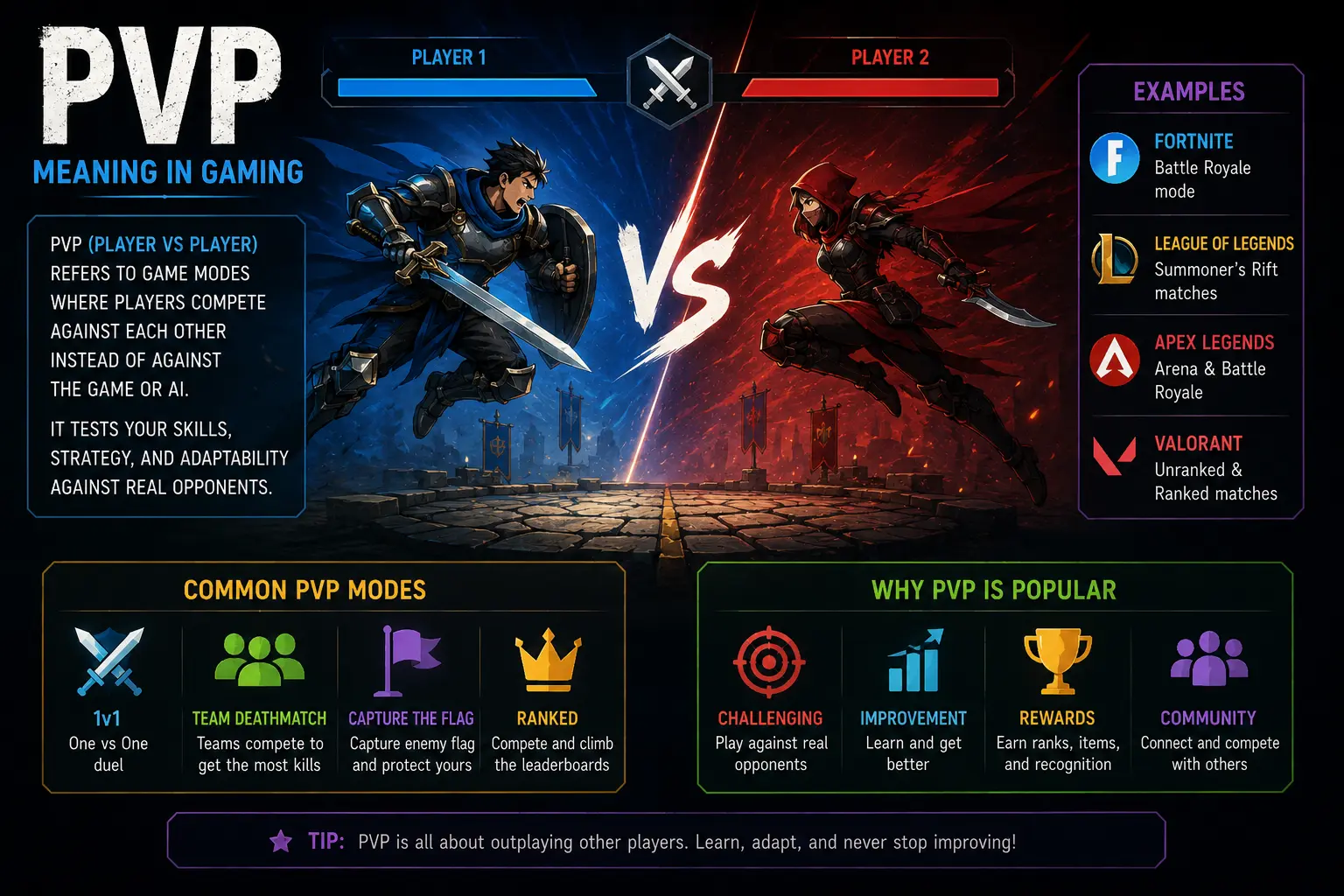
PvP Meaning Overview for Players
PvP, or Player versus Player, is a core pillar of many online games. It pits real players against each other in direct competition, testing skill, strategy, and adaptability. Whether in quick duels or large-scale battles, PvP emphasizes player interaction and fast decision-making under pressure. Understanding PvP means recognizing both the thrill of real-time rivalry and the discipline required to improve through practice, tuning, and feedback from the community. This overview covers common PvP formats, how they fit into competitive gaming, and the language gamers use to describe these encounters.
What PvP Means
PvP means Player versus Player and refers to game modes where human participants are the primary adversaries rather than computer controlled NPCs. In PvP, every encounter tests more than raw numbers; it measures reaction time, decision making, resource management, map awareness, and psychological resilience. PvP can appear in many forms including one on one duels, team battles, or large scale sieges that rely on coordination and quick adaptation. The appeal of PvP often lies in its immediacy and fairness: victories and defeats are determined by skill and split second choices rather than purely by level or gear alone. For new players, PvP can seem intimidating because opponents are unpredictable and capable of exploiting any misstep. However, the core appeal is in direct feedback: you immediately see the impact of your choices, learn from mistakes, and adjust your approach. PvP communities thrive on sharing tactics counter strategies and balance updates which keep the meta evolving. In many games PvP rewards range from cosmetics to currency or tokens that unlock higher gear or abilities providing ongoing motivation to participate. Real time PvP battles demand multitasking: you manage cooldowns, position yourself effectively, and anticipate your opponents intentions under pressure. This constant tension makes PvP a skill based experience that rewards practice patience and persistence. Successful players cultivate a broad toolkit of strategies analyze patterns exploit openings and communicate with teammates to synchronize efforts. Important distinctions exist between matchmade PvP where systems pair players of similar skill and open world PvP where rival encounters can happen anywhere at any time. Across genres PvP thrives on player interaction and a shared vocabulary of terms signals and etiquette. In short PvP is not only about victory it is about learning faster than rivals climbing ranks and enjoying the dynamic energy of online competitive communities.
Types of PvP: Duel, Arena, and Open-World
PvP formats vary in pacing and complexity, and understanding these formats helps you tailor practice and goals. Knowing what to expect from each format makes it easier to plan your training and gear progression:
- Duel: A focused one-on-one contest designed to isolate fundamental skill. In a duel, both players typically agree on weapon sets, no external interference, and a fixed arena or space. The emphasis is on timing, spacing, and resource management, with each decision creating a visible consequence. Players study opening patterns, learn to read their opponent’s tells, and practice quick counterattacks. Mind games play a big role as players fake movements to bait an overextension. Short, controlled exchanges often reward precision and discipline more than raw durability. While duels can escalate into long battles, most successful attempts rely on consistent execution, adapting after every round, and maintaining composure under pressure.
- Arena: Team-based battles on a dedicated map with respawns, objectives, and strong emphasis on coordination, role specialization, and rapid adaptation to shifting numbers.
- Open-World PvP: Large, unstructured skirmishes that occur across the game world, blending exploration with risk and spontaneous tactics when rivals appear outside a controlled arena.
- Dueling Etiquette and Standards: The informal rules that keep PvP fair and fun, such as sportsmanship, respecting honest play, and accepting rematches when appropriate.
Choosing a format often aligns with your preferred playstyle and the rewards you chase.
How PvP Differs from PvE
PvE, or Player versus Environment, contrasts with PvP by pitting players against computer controlled enemies rather than real people. In PvE, the challenge often centers on story progression, exploration rewards, raid or dungeon mechanics, and predictable AI that teaches encounter patterns. PvE experiences tend to reward careful planning, teamwork, and gear progression, with clear indicators of success such as loot drops or percent completion. PvP, on the other hand, places players directly against human opponents who adapt, improvise, and attempt to outthink you in real time. The unpredictability of other players makes PvP inherently less deterministic and more volatile, with momentum shifting as characters exploit openings and counters evolve during a match. Balancing and tuning are also more complex in PvP because player skill varies widely, while PvE balance can be anchored to AI behavior and scripted encounters. From a design perspective, PvP emphasizes speed, reflexes, positioning, and mind games, whereas PvE emphasizes coordination, resource management, and strategy against known patterns. For players, this means different practice paths: PvE may reward learning boss mechanics and optimizing rotation, while PvP rewards mastering counters, team communication, and adapting to evolving metas. Many games include hybrid modes that blend PvP and PvE elements, such as arena missions against AI squads or duels with bot-assisted practice partners. Understanding these differences helps you choose where to invest time, gear, and skill development based on your goals and the social dynamics of your gaming community.
Common PvP Terms and Acronyms
These terms are widely used across competitive PvP and online gaming communities.
| Term | Definition |
|---|---|
| MMR | Matchmaking Rating; a numeric score representing your relative skill in the current player pool. |
| K/D | Kill-to-Death ratio; a measure of how often you defeat opponents compared with how often you are defeated. |
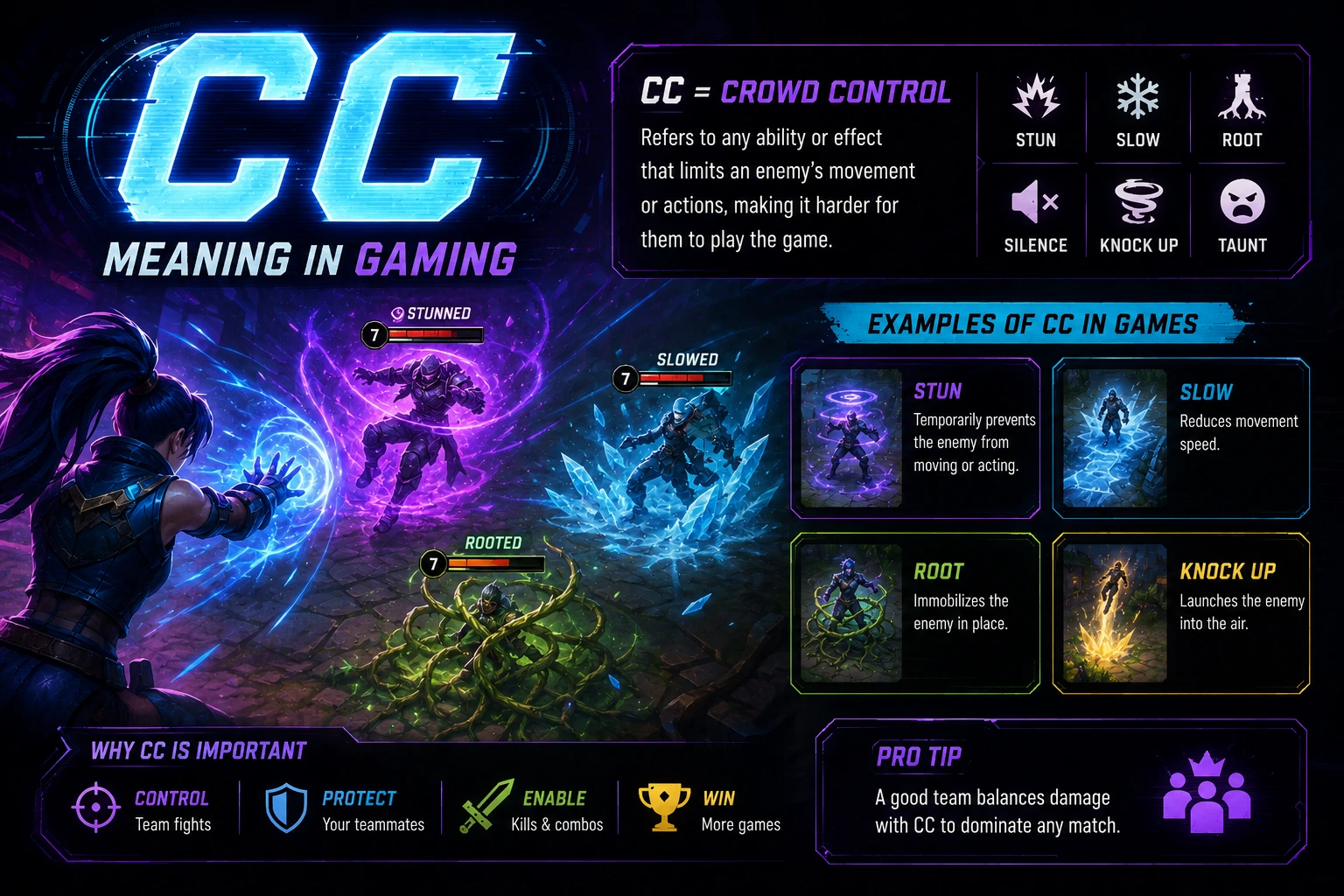
| CC | Crowd control; abilities that disable, detain, or hinder enemy actions for a window of time. |
| AoE | Area-of-Effect; attacks or abilities that affect multiple targets within a radius. |
Familiarity with these terms helps you interpret matchups, read opponents, and communicate more effectively with teammates.
Core Features Driving PvP Performance
PvP performance hinges on more than raw reflexes. In player versus player modes, fairness and speed of response shape every encounter from casual skirmishes to high-stakes esports. This section examines the core features that influence how responsive, balanced, and engaging PvP remains across competitive environments. From network timing to matchmaking logic, these factors determine how players interact, strategize, and rise through competitive rankings. Understanding these elements helps players optimize setup, developers tune for balance, and communities craft tougher, more rewarding multiplayer battles.
Latency, Tick Rate, and Netcode
Latency, tick rate, and netcode shape how fair matches feel and how quickly players can express skill in real-time combat. A range of technical factors determines the reliability of hit registration, input responsiveness, and the perceived smoothness of action in PvP gameplay. The following items highlight the major influences on timing and fairness in online PvP experiences:
- Latency and input delay directly affect action timing, making responses snappier or laggier depending on how quickly your input reaches the server and is reflected on-screen.
- Tick rate governs how often the server updates the game state, influencing hit registration, movement precision, and the opponent’s visible actions during high-speed exchanges.
- Netcode models blend client prediction with server authority, trading occasional mispredictions for smoother play and relying on reconciliation to keep outcomes fair over time.
- Packet loss and jitter introduce latency variance, which can cause occasional stuttered inputs or delayed hits; robust mitigation prioritizes consistent timing and resilient hit detection.
- Packet retransmissions and congestion control mechanisms also influence how quickly state updates propagate, potentially widening gaps in timing and forcing players to adapt strategies.
- Server region proximity and routing paths affect round-trip time, making regional matches feel more immediate for nearby players and slower for distant opponents.
- Security and anti-cheat measures can impact fairness by introducing extra checks or delays; transparent implementations minimize friction while preserving integrity.
Together, these technical factors determine whether skill, strategy, and quick adaptation translate into reliable victory or whether timing variance erodes confidence. Understanding them helps players diagnose connection issues, choose favorable servers, and practice around predictable latency patterns to improve consistency.
Input, Aim, and Control Responsiveness
In PvP gameplay, how you translate your intentions into action is as important as your decision-making. The moment-to-moment rhythm of a match depends on input latency, device type, and control configuration. On PC, a high refresh rate monitor and a responsive mouse or keyboard can reduce perceived lag, while on console, built-in latency compensation and aim assist may alter the precision landscape.
Players often customize sensitivity curves, acceleration, and dead zones to match their muscle memory, and even small changes can change how easily you track fast targets or pull off precise combos in a prolonged exchange.
Beyond raw hardware, software-level refinements matter too. Input buffering, which queues inputs to avoid missed actions during frame drops, can smooth out jitter but sometimes introduces a slight delay. Aim assist or velocity-based recoil controllers can help beginners land shots, yet they may undermine a veteran’s precision in certain PvP modes. The balance is delicate: too much assistance reduces skill expression, while too little increases frustration for newcomers. Developers must choose default settings that feel fair while allowing players to tailor experiences across PvP arenas and modes.
Control design also shapes player expression. Movement mechanics like strafing, sprint cancels, or slide transitions interact with hit registration in complex ways, so designers often tune hit windows, crosshair behavior, and recoil patterns to create intuitive yet challenging experiences. Training modes and practice ranges give players the chance to dial in their reactions, test new gear or weapons, and build consistent muscle memory before entering ranked or ladder-based play.
Finally, player interaction thrives on clarity and feedback. Visual indicators, audio cues, and haptic feedback help players understand when a hit registers or a dodge lands, reinforcing responsive decisions. The result is a feedback loop where skill development, control fidelity, and system latency all contribute to your effectiveness in PvP gameplay and the satisfaction of competitive matches.
Matchmaking and Skill Balancing
Matchmaking and skill balancing are the practical engines that keep competitive play fair and enjoyable. Well-tuned systems help players progress at a pace that matches their improvement and reduce the frustration of counterintuitive matchups.
- Queue design and regional routing aim to minimize wait times while maintaining fair skill separation, preventing matches that punish or reward luck more than demonstrated ability.
- Matching thresholds such as MMR, hidden ratings, or dispersion controls help pair players of similar skill, reducing stomps and keeping comebacks possible.
- Dynamic matchmaking can adjust to queue composition, time of day, and regional populations, balancing latency fairness with competitive variance to keep sessions engaging.
- Role balancing and metas shift expectations, so systems must adapt to patches and evolving strategies without penalizing players who adjust quickly.
- Anti-cheat enforcement and trust-building measures influence the health of ranked play, and transparent policies paired with robust detection sustain a fair competitive ecosystem.
In practice, matchmaking quality affects both perceived fairness and willingness to invest time in sharpening PvP skills. If players frequently encounter mismatches or long waits, engagement drops, and the excitement of competitive play can wane.
Competitive Ranking Systems and Stats
Competitive ranking systems anchor how players measure progress and compare themselves against a broader player base in PvP modes. Ladders, tiers, divisions, and rewards structures give players clear milestones to chase, while also providing developers with a framework to balance matchmaking and incentives across seasons. A common approach uses Elo or MMX-like rating systems, where each win or loss updates the player’s score according to the opponent’s expected strength. More modern implementations may adopt probabilistic or Bayesian estimations that adjust faster for newcomers while gradually stabilizing for veterans, helping to reflect true skill over time rather than short-term streaks.
In practice, ranking systems influence both behavior and strategy. Players often tailor their play around expected opponents; they study maps, genres, and character picks that historically perform well within their current ladder tier. Statistical dashboards—showing wins, losses, streaks, and accuracy—offer feedback that can encourage risk-taking or careful patience, depending on how volatile the rating is. Some games also feature hidden MMR, designed to prevent match exploitation by rewarding genuine performance rather than raw score inflation. Season resets and decay mechanics create fresh starting points, providing renewed motivation and opportunities for rank progression, even after a pause or break.
Stats tracking extends beyond the visible leaderboard. Detailed metrics such as objective contributions in multiplayer battles, time-to-kill, headshot accuracy, and healing or shielding efficiency inform balance decisions and community discussions about PvP rewards. Persistent records let players analyze trends across patch cycles, metas, and major tournaments, which helps them calibrate strategies and identify personal weaknesses. Developers frequently use this data to tune PvP modes, arenas, and reward systems, ensuring that the progression curve remains rewarding without becoming punitive or predictable. Transparent reporting and privacy-respecting telemetry are essential to maintain trust among participants in competitive gaming communities.
PvP Solutions Comparison: Benefits and Specifications
PvP, or Player versus Player, remains a driving force in gaming’s competitive landscape, delivering adrenaline, skill checks, and constant interaction among players. This section explores the practical benefits of different PvP approaches and outlines the specifications that affect performance, fairness, and accessibility. By examining modes, platforms, and tools, gamers can select environments that amplify engagement while remaining mindful of balance and player interaction. Understanding these PvP solutions helps developers optimize matchmaking, rewards, and progression systems, while players can align their practice and hardware setups with the demands of real-time competition. Ultimately, the right combination of modes, mechanics, and anti-cheat measures creates thriving multiplayer ecosystems.
Popular PvP Game Modes and Which Players They Suit
Popular PvP game modes are designed to satisfy different motivations, from speed and reflex tests to long-term strategic planning. The best modes balance risk and reward, provide meaningful decisions, and keep players engaged across sessions. By understanding these formats, players can tailor their practice and expectations to maximize improvement.
Comparing PvP Platforms: Consoles, PC, Mobile
Platform choice deeply influences how you experience PvP, affecting responsiveness, accessibility, and the social dynamics that drive competition. By comparing consoles, PC, and mobile across performance, input, latency, ecosystem features, cross-play potential, monetization, and power considerations, players can select the environment that aligns with their skill level and lifestyle.
- Performance and frame rates: Consoles typically offer stable, optimized performance with consistent frame pacing, PC enables higher frame rates and resolutions, while mobile prioritizes battery life and efficiency.
- Control schemes and precision: Controllers on consoles feel accessible for casual players, keyboards and mice on PC deliver precise aiming, while mobile relies on touch gestures and gyro-based inputs.
- Latency and matchmaking realities: PC ecosystems often provide broad regional options, consoles benefit from tight, vendor-optimized servers, while mobile games optimize for on-the-go connections and quick pairing.
- Ecosystem and social features: PC platforms emphasize large communities, mod support, and competitive leagues; consoles cultivate robust friend lists and party systems; mobile emphasizes social invites and quick matches.
- Cross-play and account infrastructure: Cross-platform play expands player pools but requires unified progression, anti-cheat alignment, and consistent account linking across devices to maintain fairness.
- Monetization and content cadence: Console and PC titles benefit from seasonal passes and cosmetic shop rotations, while mobile leans toward microtransactions, time-limited offers, and accessible free-to-play progression.
- Power efficiency and portability: Mobile devices excel for on-the-go PvP, consoles deliver stable couch co-op with peripherals, and PC enables modular upgrades and unusual control setups.
Ultimately, the platform you choose should fit your playstyle and life constraints, balancing speed with control and access to the communities you want to join. In practice, a well-selected platform supports fair matchmaking, reliable updates, and a healthy competitive environment that remains accessible to new players while rewarding improvement.
Third-Party Tools and Anti-Cheat Solutions
Third-party tools and anti-cheat solutions play a central role in maintaining fair play in PvP, especially in skill-based multiplayer where tiny advantages compound over time. Anti-cheat systems are designed to detect unauthorized software, memory manipulation, and botting, while monitoring unusual patterns in inputs and game state changes. Most modern titles rely on a multi-layered approach that combines behavior analytics, signature checks, and kernel-level monitoring to deter sophisticated cheats without harming legitimate players. Developers must balance effectiveness with privacy and performance, since heavy scanning can impact frame rates, input latency, and user trust. Community and player feedback are crucial in refining these systems, as transparent reporting and timely updates help sustain a healthy competitive environment.
Popular, widely deployed solutions include BattleEye, Easy Anti-Cheat, and Valve Anti-Cheat for PC titles, each with different deployment models and vendor ecosystems. BattleEye focuses on proactive scanning and real-time kernel-level checks, while EAC emphasizes cross-game integration with cloud-based challenge responses and trusted runtime environments. VAC, running natively across Steam games, uses heuristics, code signatures, and server-side validation to catch known cheats without frequent user prompts. Console ecosystems often rely on platform-level protections integrated into the system software, reducing user friction but limiting direct inspection by game developers. These tools are complemented by server-side validation, movement prediction, and anti-aimbot algorithms that detect unnatural target acquisition and aim patterns.
To minimize abuse while protecting legitimate software, many studios release robust documentation, transparent changelogs, and user-friendly reporting channels that encourage players to flag suspicious behavior. In addition, independent researchers and community moderators help test edge cases, verify false positives, and contribute to balance improvements that keep competitive environments inclusive. Third-party utilities that interface with games—for example overlay tools and performance profilers—are commonly allowed when they operate in a read-only or sanctioned mode but are scrutinized for code injection or memory hooks. The best practices emphasize minimizing intrusive scanning, providing clear opt-out options for non-cheating players, and avoiding unintended consequences that could block legitimate play.
Anti-cheat adoption also benefits from integration with the broader security ecosystem, including secure boot, encrypted kernel drivers, and regular security audits, which collectively raise the barrier to entry for would-be cheaters without compromising common user workflows.
Finally, ongoing education for players about recognizing spoofed software, phishing attempts, and responsible reporting helps sustain trust and reduces the risk of mistaken bans, ensuring competitive environments remain welcoming to both new and veteran players.
Independent testing, transparent metrics, and public roadmaps are increasingly expected so players can gauge the reliability of protections and hold developers accountable for maintaining fair play across patches and seasons. As the PvP landscape evolves, the balance between robust security, performance overhead, and user privacy will continue to shape anti-cheat strategies and third-party tooling choices for both developers and communities.
Promotions, Pricing, and Service Details for PvP
PvP sense means players competing directly against each other, which drives much of the energy and strategy in online games. This section explains how Promotions, Pricing, and Service Details support or shape PvP experiences on Guilty Gear Game. You will learn how in-game purchases, subscriptions, and event rewards interact with PvP modes, arenas, and matchmaking. We also discuss fairness, accessibility, and how community events tie into ongoing PvP engagement. By understanding these elements, players can plan their investments and strategies for sustained competitive play.
In-Game Purchases, Battle Passes, and Cosmetics
Players can access a range of in-game purchases that directly support PvP ecosystems while offering cosmetic customization and convenience. Most titles use a virtual currency system that players earn through gameplay or purchase with real money, allowing them to acquire skins, animated emotes, banners, and rare visual effects for characters and weapons. Battle Passes are a popular form of structured progression, offering a season-long track of challenges that unlock cosmetics, portraits, and occasional XP boosts for those who complete objectives. Cosmetics are designed to be visually appealing without altering core PvP balance, preserving fair competition in ranked and casual modes. Some items are time-limited or tied to special events, encouraging regular engagement but not required to participate in a season. For players concerned about fairness, it is important that performance-tuning, matchmaking, and progression remain separate from cosmetic purchases. Developers often link cosmetic rewards to participation in PvP modes, so free-to-play players can still earn meaningful items through consistent play. The pricing strategy typically includes base bundles, subscription perks, and rotation offers that refresh monthly, creating predictable value without pressuring players to overspend. Transparent refunds and clear disclosures about what purchases unlock help build trust with the community. Players should be aware of caps on currency so that ambitious collectors do not feel compelled to overspend to complete a collection. In well-balanced PvP ecosystems, monetization supports ongoing server costs, anti-cheat updates, and content expansion that keeps arenas balanced and fresh. Community feedback on pricing is regularly reviewed to adjust bundles and drop rates, aiming to minimize paywalls while sustaining high-quality PvP content. Ultimately, purchases should feel optional yet accessible, giving players meaningful reasons to invest time and money when the value aligns with their competitive goals. Seasonal collaborations with partners sometimes appear in bundles, expanding value without creating entry barriers. In some games, players can trade cosmetics across accounts or display rare items during tournaments, reinforcing the social dimension of cosmetic purchases. The best practice is to keep gameplay progression separate from cosmetic access and to provide a clear, consistent path for free players to earn desirable items through participation, achievements, and events. This approach reduces friction for new players while sustaining a robust revenue model that funds servers, security, and content updates. By maintaining transparency about sale periods, item availability, and regional price differences, developers foster trust across diverse player bases.
Esports, Tournaments, and Prize Pools
Competitive PvP thrives when there is a structured path from casual play to high level rivalry. This section covers how official esports programs, online ladders, and local or online tournaments are organized, from registration to finals. Tournaments typically feature multiple brackets, regional qualifiers, and live broadcasts that showcase top players and educate audiences about tactics and decision making. Prize pools are funded through a mix of publisher support, sponsor partnerships, and community-driven fundraising, creating incentives for players to invest time in mastering PvP mechanics. Event formats emphasize skill-based multiplayer matches, strict anti-cheat measures, and clear rulesets to ensure fair play across platforms and regions. Teams, coaches, and analysts often work with players to optimize strategies, practice regimens, and matchup-specific tactics that translate into competitive performance. Season-long leagues may reward overall consistency, while finals or invitational events offer prestige and higher stakes for the very best performers. Viewers gain exposure to strategies and meta shifts, while organizers work to balance broadcast timing with regional audiences and streaming slots. Participation costs, travel requirements, and acceptance of digital submissions are weighed to keep entry accessible without diluting competition. In addition to cash prizes, many programs offer equipment, scholarships, or in-game rewards that carry real and perceived value within the community. Anti-cheat and fair play enforcement remain central to competition, with clear appeals processes for disputes and disqualifications. Community forums and developer-sanctioned feedback channels help organizers adjust rules, schedules, and reward structures in response to player input. For players, success in PvP tournaments often translates into sponsorships, team signings, or invitations to higher levels of play, creating a healthy progression ladder that motivates ongoing practice. As the esports ecosystem grows, new formats such as mixed-team events, regional qualifiers, and cross-region showdowns broaden opportunities for players to compete and earn meaningful rewards. Streaming, mentoring programs, and academy-style boot camps are increasingly common, helping newcomers learn fundamentals while seasoned players refine advanced tactics. Transparent qualification criteria, clear prize distributions, and accessible formats help demystify competitive PvP and encourage broader participation across skill levels.
Server Costs, Subscriptions, and Microtransaction Models
Maintaining reliable PvP services relies on robust server infrastructure, continuous security, and responsive matchmaking systems. Operators allocate budget to data centers, network optimization, DDoS protection, and anti-cheat technology to ensure fast, fair, and secure matches across regions. Ongoing costs are balanced with revenue streams that include optional subscriptions, one-time purchases, and regular cosmetic drops, allowing players to choose how they support the game. Subscriptions often offer benefits such as faster queue times, early access to new PvP modes, higher daily currency caps, and exclusive cosmetics, while avoiding any advantage that would obscure or distort skill in gameplay. Microtransactions typically cover cosmetic items, seasonal battle passes, and small convenience bonuses that do not alter core mechanics, keeping PvP competitive by design. Some games include limited-time bundles or rotating offers to encourage return visits, while maintaining price points that are accessible to new players and long-time fans alike. Revenue models are designed to fund servers, content updates, localization, and ongoing balance tuning so that PvP remains responsive to player feedback. Free-to-play players can participate fully in PvP modes, with optional monetization providing enhanced customization or faster progression for those who opt in. Regional pricing, currency exchange considerations, and seasonal promotions help teams reach diverse communities around the world. Clear disclosures about what is included in each purchase and how currencies convert into in-game value are essential for trust. Cross-platform support and data migration costs are also part of the ongoing investment in PvP ecosystems, ensuring players can compete across devices. As monetization evolves, publishers track engagement metrics, conversion rates, and player satisfaction to refine offers without compromising competitive balance.
Community, Moderation, and Reporting Systems
Safe and welcoming communities are fundamental to long-term PvP health, so this section outlines the tools used to manage behavior and maintain fair play. Most games include an in-game reporting feature, a structured moderation workflow, and clear escalation paths for incidents ranging from harassment to cheating. Players can flag behaviors, messages, or accounts, triggering review by human moderators and automated systems designed to detect toxicity or suspicious activity. Moderation teams operate with guidelines that emphasize due process, evidence preservation, and timely responses, with options to appeal decisions if needed. Reporting data informs ongoing balance work, such as refining chat filters, adjusting punishment scales, or tweaking matchmaking to reduce griefing. Chat systems often incorporate filters, mute options, and conversation etiquette prompts to curb abuse while preserving genuine competition and strategy sharing. Communities benefit from proactive safety features, including burnout prevention, anti-scam measures, and secure account management to protect players in and out of PvP sessions. Anti-cheat programs rely on continuous updates, telemetry analysis, and user reports to identify new exploits without compromising privacy or performance. Transparent policies about sanctions, temporary suspensions, and permanent bans help deter wrongdoing while offering avenues for review and learning. Regularly scheduled updates to rulesets, community guidelines, and safety resources ensure that players understand what behavior is expected and what consequences may follow violations. Moderation is complemented by community moderation efforts, including volunteer mentors, trusted veterans, and in-game helpers who model positive conduct and help new players learn the ropes of PvP. Formulaic incentives, such as honor systems or reputation tiers, can encourage constructive play and discourage disruptive behavior. Finally, robust reporting and moderation contribute to a sense of trust and safety that enables players to focus on strategy, skill development, and the thrill of real-time PvP battles rather than fearing toxicity or harassment. Ongoing dialogue with the community, regular transparency reports, and accessible grievance channels help sustain healthy, competitive environments across all PvP modes.